The idea: differentiate the equation, not a formula for y
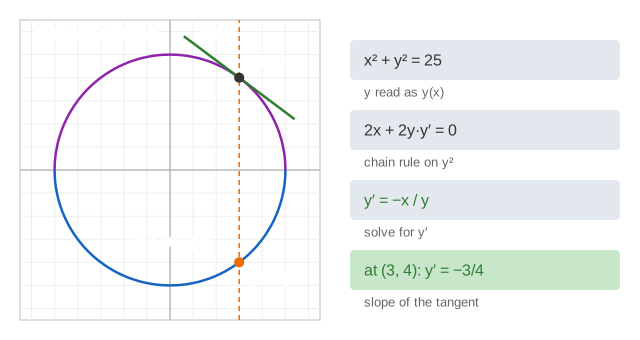
The circle x² + y² = 25 has a tangent at (3, 4), but it is not the graph of a function: the vertical line x = 3 meets it at y = 4 and y = −4. You could split it into two halves, y = √(25 − x²) and y = −√(25 − x²), and differentiate one of them. Implicit differentiation skips that: treat y as some unknown function y(x), differentiate both sides of the equation with respect to x, and solve for y′ = dy/dx. For the circle the answer is y′ = −x / y, so the slope at (3, 4) is −3/4. (Demo: circle at (3, 4))
Differentiate both sides
If x² + y(x)² = 25 holds for every x on the curve, the two sides are equal as functions of x, so their derivatives are equal too. Each term is differentiated with the usual rules. A term with only x is differentiated as usual. A term with y needs the chain rule, because y depends on x: the outside is differentiated and multiplied by the inside's derivative y′. A product of x and y needs the product rule.
| term | d/dx | rule |
|---|---|---|
| x² | 2x | power rule |
| y² | 2y · y′ | chain rule |
| y³ | 3y² · y′ | chain rule |
| xy | 1 · y + x · y′ | product rule |
| sin y | cos y · y′ | chain rule |
| 25 | 0 | constant |
On the canvas each term is a box; orange boxes contain y. Differentiate drops each term's derivative into the row below, with the rule it used.
Collect, factor, solve
After differentiating, y′ appears only to the first power, so the equation is linear in y′ and can always be solved: move every term with y′ to the left, factor y′ out, divide.
- Circle: 2x + 2y·y′ = 0, so 2y·y′ = −2x and y′ = −x / y.
- Tilted ellipse x² + xy + y² = 7: 2x + (y + x·y′) + 2y·y′ = 0, so y′(x + 2y) = −(2x + y) and y′ = −(2x + y) / (x + 2y); at (1, 2) that is −4/5. (Demo: x² + xy + y² = 7)
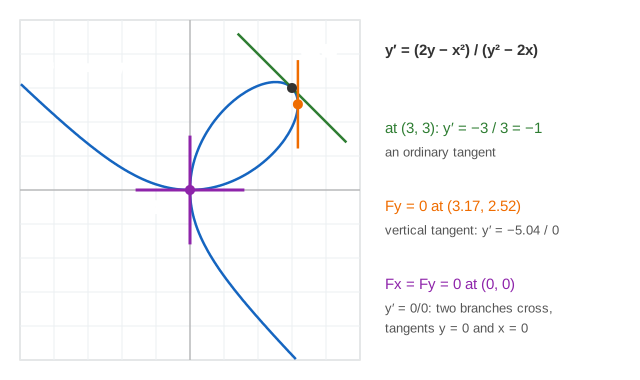
- Folium of Descartes x³ + y³ = 6xy: 3x² + 3y²·y′ = 6y + 6x·y′, so y′ = (2y − x²) / (y² − 2x); at (3, 3) that is −1. (Demo: folium at (3, 3))
The answer is a formula in x and y. That is not a defect: one x can have several points, with different slopes, so the slope must depend on which point you mean. Walk the Curve moves P round the circle and the tangent follows −x / y. (Demo: walk the circle)
The shortcut y′ = −Fx / Fy
Write the curve as F(x, y) = c. Differentiating gives Fx + Fy · y′ = 0, where Fx and Fy are the partial derivatives (differentiate in x with y held fixed, and the other way round). So y′ = −Fx / Fy. For the circle Fx = 2x and Fy = 2y, the same −x / y. The tangent is perpendicular to the gradient (Fx, Fy), which is why level curves cross the gradient at right angles.
The formula breaks where Fy = 0:
- Fy = 0 and Fx ≠ 0: a vertical tangent. The circle at (5, 0) gives y′ = −5 / 0. (Demo: vertical tangent at (5, 0))
- Fx = Fy = 0: y′ = 0/0 says nothing. The folium crosses itself at the origin, and its two branches have different tangents, y = 0 and x = 0. (Demo: folium crossing at (0, 0))
Why it works: locally a function
The implicit function theorem says: if Fy ≠ 0 at a point of F(x, y) = c, then near that point the curve is the graph of one differentiable function y(x). The vertical line test colours that piece purple: the arc through P on which x keeps moving one way, from one vertical tangent to the next. Implicit differentiation computes the slope of that function without ever writing it down, which matters because often you can't: the tilted ellipse needs the quadratic formula, the folium a cubic, and an equation like y⁵ + y = x has no formula for y at all.
Where it is used
- Related rates: differentiate an equation like x² + y² = L² with respect to time t, and dx/dt and dy/dt appear the same way y′ does here.
- Derivatives of inverse functions: from y = ln x write eʸ = x, then eʸ·y′ = 1, so y′ = 1/x. The same trick gives arcsin′ x = 1/√(1 − x²).
- Tangent lines to conics and to level curves of a function of two variables, and the Lagrange multiplier condition, which compares gradients.
The chain rule behind every y′ factor is animated on The Chain Rule, and the power and product rules on Derivative Rules as Pictures.
What the page leaves out
Only three curves, each with three fixed points. The second derivative y″ (differentiate y′ = −x / y again), implicit equations with three variables (surfaces and partial derivatives ∂z/∂x), and the proof of the implicit function theorem are not shown. The slopes come from the derived formulas, not from symbolic algebra.