The idea: 0/0 means two curves through one point
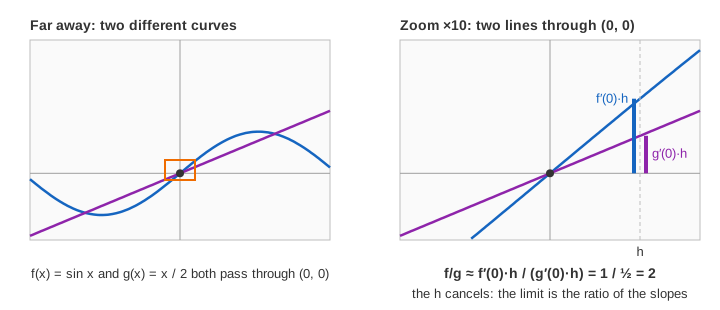
Try to compute lim sin x / x as x → 0 by plugging in: you get 0/0, which says nothing. But 0/0 has a picture. The top curve f(x) = sin x and the bottom curve g(x) = x both pass through the point (0, 0). Near that point f(x)/g(x) is the height of one curve divided by the height of the other at the same x. On the canvas the grey line marks x = a + h, and the blue and purple bars are the two heights.
Why the ratio of slopes is the limit
Zoom in on (a, 0), both axes by the same factor. A smooth curve turns into its tangent line (see local linearity), so near a the two curves are lines through (a, 0) with slopes f′(a) and g′(a). Their heights at a + h are
f(a + h) ≈ f′(a)·h and g(a + h) ≈ g′(a)·h.
Divide and the h cancels. That is L'Hôpital's rule: if f(a) = g(a) = 0 and g′(a) ≠ 0, then lim f(x)/g(x) = f′(a)/g′(a). The table on the canvas shows it for sin x / x: zoom ×2 at a time, both heights halve, their ratio settles at cos 0 / 1 = 1. (Demo: sin x / x at 0)
| zoom | h | f = sin h | g = h | f / g |
|---|---|---|---|---|
| ×1 | 2.4 | 0.675463 | 2.4 | 0.281443 |
| ×2 | 1.2 | 0.932039 | 1.2 | 0.776699 |
| ×4 | 0.6 | 0.564642 | 0.6 | 0.941071 |
| ×8 | 0.3 | 0.295520 | 0.3 | 0.985067 |
| ×16 | 0.15 | 0.149438 | 0.15 | 0.996254 |
| ×32 | 0.075 | 0.074930 | 0.075 | 0.999063 |
The same works for (x² − 1)/(x − 1) at 1, with slopes 2·1 = 2 and 1, so the limit is 2 (Demo: (x² − 1)/(x − 1)), and for ln x / (x − 1) at 1, with slopes 1/1 and 1, limit 1 (Demo: ln x / (x − 1)). The real theorem is a bit stronger: lim f/g = lim f′/g′ whenever the second limit exists, which follows from the Cauchy mean value theorem.
When the slopes are 0 too: apply it again
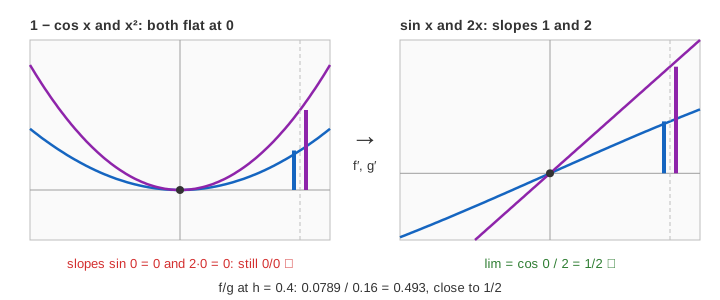
For (1 − cos x)/x² at 0 both curves touch the x-axis flat. Zoomed in, both lie on the axis: slopes sin 0 = 0 and 2·0 = 0, so f′(0)/g′(0) is 0/0 again. But the rule says lim f/g = lim f′/g′, so look at the new pair f′ = sin x and g′ = 2x. These cross the axis with slopes 1 and 2, so the limit is 1/2. The table on the canvas already showed f/g heading to 0.5 before the slopes were known. (Demo: (1 − cos x)/x²)
When the rule does not apply
The rule needs 0/0 (or ∞/∞). (x + 1)/(x + 2) at 0 is 1/2 by plugging in. Both slopes are 1, so "comparing slopes" gives 1, which is wrong. In the picture the curves do not pass through (0, 0): the heights start at 1 and 2, not at 0, so the slopes only add a little to them. Zooming about (0, 0) pushes both curves out of the window. (Demo: (x + 1)/(x + 2) is not 0/0)
| case | check | what to do |
|---|---|---|
| f(a) = g(a) = 0, g′(a) ≠ 0 | 0/0 | limit = f′(a)/g′(a) |
| f′(a) = g′(a) = 0 | 0/0 again | apply the rule to f′/g′ |
| f(a), g(a) not both 0 | not 0/0 | no rule: limit = f(a)/g(a) if g(a) ≠ 0 |
| f, g → ∞ | ∞/∞ | the rule also holds |
| 0·∞, ∞ − ∞, 1^∞ | other forms | rewrite as 0/0 or ∞/∞ first |
See also limits and continuity, the derivative as a limit and Taylor series, which give the same limits by expanding sin x = x − x³/6 + … and 1 − cos x = x²/2 − ….
What the page leaves out
The page only shows 0/0 at a finite point a. The ∞/∞ form, limits as x → ∞, and the other indeterminate forms (0·∞, ∞ − ∞, 0⁰, 1^∞, ∞⁰) are only listed. The proof by the Cauchy mean value theorem is mentioned, not drawn. The derivatives come from the known formulas, and 1 − cos x is computed as 2 sin²(x/2) so that tiny h stays exact.