The idea: dollars are made in the US and used everywhere
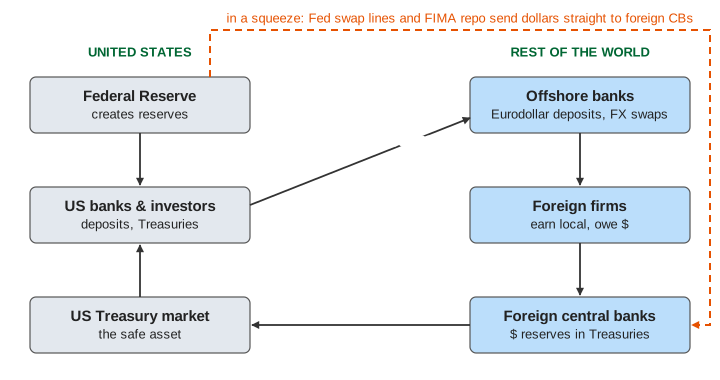
Only the Federal Reserve creates the final form of dollars: bank reserves and currency. But most dollar borrowing and lending happens outside the US. Banks in London, Tokyo and Hong Kong take Eurodollar deposits and make dollar loans; firms and governments around the world owe dollar debt; and a huge FX swap market turns euros and yen into dollars for a few months at a time. Global dollar liquidity is how easily all of them can get dollars when they need them.
The page draws six simplified balance sheets in $ billions. Every action moves dollars or securities between them, and every balance sheet changes on both sides, so they always balance. The numbers are round and stylized, close to their 2024 sizes.
Net liquidity: Fed assets minus TGA minus ON RRP
When the Fed buys a Treasury it pays with reserves, so the Fed's assets set how many dollars exist at the core. Two accounts on the Fed's liability side hold dollars that banks can't use:
- the Treasury General Account (TGA), the government's checking account at the Fed;
- the overnight reverse repo facility (ON RRP), where money market funds park cash at the Fed.
Market analysts therefore watch net liquidity = Fed assets − TGA − ON RRP, all read from the Fed's weekly H.4.1 release. On the page it starts at 7,000 − 800 − 400 = $5,800bn. Because the Fed's balance sheet balances, the same number equals currency + bank reserves + foreign official deposits.
| Action | Fed assets | TGA / ON RRP | Net liquidity |
|---|---|---|---|
| QE: the Fed buys $500bn of Treasuries | +500 | no change | +500 (5,800 → 6,300) |
| QT: $300bn mature, ON RRP still full | −300 | ON RRP −300 | no change |
| TGA rebuild of $400bn (ON RRP $100bn left) | no change | TGA +400, ON RRP −100 | −300 |
| TGA spend-down | no change | TGA − | + |
| Fed swap line or FIMA repo | + | no change | + |
The order matters. New Treasury bills are bought first by money funds, who move cash out of ON RRP because bills pay a little more. Only when ON RRP is empty do the purchases come out of bank deposits, and then reserves fall. That is why QT in 2023 hardly touched reserves while ON RRP shrank from over $2 trillion. (Demo: QE expands reserves; Demo: QT and a TGA rebuild drain liquidity ends at Fed assets $6,400bn, reserves $2,600bn, net liquidity $5,200bn.)
Offshore dollars and the FX swap market
Dollars leave the US in three main ways:
- The current-account deficit: US importers pay foreign exporters. The deposit stays inside a US bank but is now owed to an offshore bank, which credits the exporter with a Eurodollar deposit.
- US investment abroad: US investors buy foreign bonds, shares and firms, paying in dollars.
- Eurodollar lending: offshore banks lend dollars by crediting deposits, as any bank does. But they can't create reserves and, outside the US, have no direct access to the Fed: when the borrower spends the dollars, the bank must find real dollars.
Offshore banks fund their dollar books with Eurodollar deposits, with commercial paper and CDs sold to US money funds, and with FX swaps: they hand over euros or yen today, get dollars, and swap back later at a rate fixed now. The BIS estimates that tens of trillions of dollars are owed this way, mostly off balance sheet.
If borrowing dollars through a swap costs more than borrowing them directly, the cross-currency basis is negative. It is a price of dollar scarcity: in calm times a few basis points to −20 bp, in 2008 and March 2020 well below −100 bp for some currencies. On the page, basis = −15 − 2 × (DXY − 100) − 0.1 × (FX swap funding − 800) bp, labelled calm, strained or severe.
Dollars also come back. Exporters sell dollars to their central bank for local money, and the central bank invests them in Treasuries: Demo: dollars flow out and come back sends $300bn out through imports, recycles $200bn into foreign-CB Treasuries (3,000 → 3,200) and lends $200bn offshore; net liquidity stays $5,800bn.
The squeeze: a stronger dollar tightens everything
Firms outside the US owe dollars but earn in local currency. When the dollar rises, their debt stays the same in dollars but their assets and income are worth fewer dollars. Lenders pull back, hedgers need more dollars, and the basis widens. The doom loop:
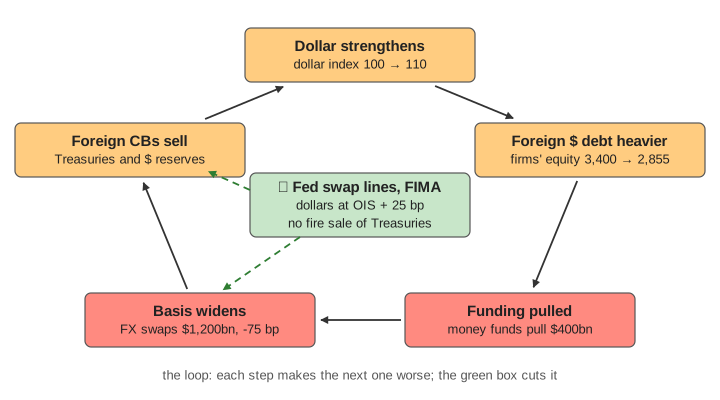
Demo: dollar shortage shock: the dollar index rises 10 points (firms' equity 3,400 → 2,855); money funds pull $400bn of CP/CDs, so offshore banks borrow $400bn more in FX swaps and the basis falls to −75 bp (severe). Foreign central banks then sell $200bn of Treasuries and lend the dollars to their banks: the basis recovers to −55 bp, but the Treasuries had to be sold into a stressed market.
The relief valves: swap lines and FIMA repo
| Way to get dollars | What the foreign central bank does | Effect |
|---|---|---|
| Sell Treasuries | Sells from its reserves | Dollars raised, but Treasury yields jump; reserves shrink |
| FIMA repo (since 2020) | Pledges Treasuries to the Fed overnight | Dollars raised, Treasuries kept; Fed assets + |
| Central bank liquidity swap line | Swaps local currency for dollars with the Fed | Dollars at OIS + 25 bp; Fed assets +; no collateral sold |
In a swap line the Fed buys, say, euros from the ECB for dollars and agrees to sell them back at the same rate later. The ECB lends the dollars to euro-area banks, who no longer need expensive FX swaps. Swap lines peaked near $600bn in December 2008 and near $450bn in May 2020; the standing lines with the ECB, BoJ, BoE, SNB and Bank of Canada make them always available. Because any bank with access can borrow at OIS + 25 bp, the swap line puts a ceiling on the dollar premium. Demo: swap line rescue (March 2020) ends with swap lines $400bn, FX swap funding back to $800bn and the basis back to −35 bp; net liquidity is $5,800bn again. Demo: FIMA repo instead of selling Treasuries gets the same relief while foreign-CB Treasuries stay at $3,000bn.
Carry trades and their unwind
When dollar rates are low and the dollar is stable, borrowing dollars to buy higher-yielding local assets pays: a carry trade. It leaves the borrower with a currency mismatch. If the dollar rises, losses force borrowers to sell local assets and buy dollars to repay, which pushes the dollar up further. Demo: carry trade unwind: firms borrow $300bn, the dollar rises 5 points, and a $500bn unwind lifts it 10 more (105 → 115). The central bank spends all its dollar cash and sells $200bn of Treasuries to meet the demand; the basis ends at −75 bp.
See also Flight to Quality, Monetary Transmission, Credit Cycle and Flow of Funds.
What the page leaves out
Interest rates and prices, except the basis and the dollar index (Treasury yields move only in words). Real balance sheets are far bigger and messier: the Fed's other liabilities and capital, foreign banks' US branches holding reserves, dealers, the repo market, the Standing Repo Facility, and the many currencies with their own basis. Swap-line and FIMA operations are repaid after days or weeks; the page leaves them outstanding. The rules for the basis and the dollar index are simple formulas chosen to make the direction and size of each effect visible, not estimates.