The idea: hydrogen glows in a few sharp colours
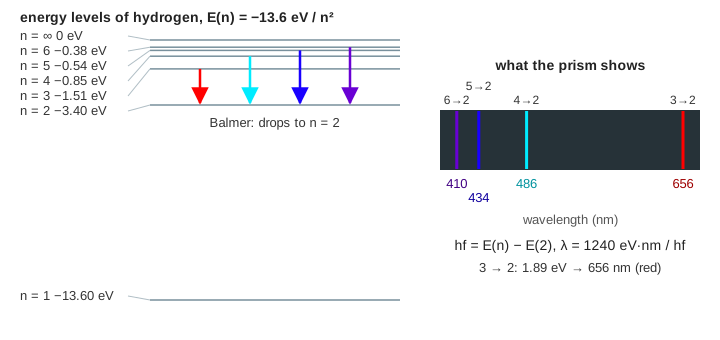
Pass a spark through a tube of hydrogen gas and look at the glow through a prism. Instead of a rainbow you see four thin lines: red, cyan, blue and violet. Every hydrogen tube in the world shows the same four lines at the same places. In 1913 Niels Bohr explained why: the electron in a hydrogen atom can only have certain energies, its energy levels, and it gives out light only when it jumps from one level down to another.
Bohr's rules
Bohr kept the picture of an electron circling the proton, and added two rules that classical physics did not have:
- Only some orbits are allowed: those where the electron's angular momentum is a whole number of ħ, L = nħ, with n = 1, 2, 3, … (the quantum number). On an allowed orbit the electron does not radiate, so the atom is stable.
- The electron can jump between allowed orbits. A jump down sends out one photon that carries away exactly the energy lost; a jump up needs exactly that energy put in.
Working the first rule through with Coulomb's force gives the size and the energy of each orbit:
rₙ = n² · a₀,          a₀ = 0.0529 nm (the Bohr radius)
Eₙ = −13.6 eV / n²     (n = 1: −13.60, 2: −3.40, 3: −1.51, 4: −0.85, 5: −0.54, 6: −0.38 eV)
The energy is negative because the electron is bound: 0 eV means free and at rest (n = ∞). The levels crowd together near 0. n = 1 is the ground state; the others are excited states. The page draws the orbits evenly spaced, because at the real size n = 6 would be 36 times wider than n = 1.
One jump, one photon: hf = Eₙ − Eₘ
When the electron drops from level n to a lower level m, energy is conserved, so the photon gets
hf = Eₙ − Eₘ = 13.6 eV · (1/m² − 1/n²) λ = hc / (Eₙ − Eₘ), hc = 1240 eV·nmFrom 3 to 2: hf = −1.51 − (−3.40) = 1.89 eV, so λ = 1240 / 1.89 = 656 nm, the red line called Hα (Demo: jump 3 → 2 → 1). The second drop of that demo, 2 → 1, is 10.2 eV, a 122 nm photon far in the ultraviolet. Written with wavelengths this is the Rydberg formula 1/λ = R (1/m² − 1/n²), which Balmer and Rydberg had found from the measured lines before anyone knew why it worked. The page uses 13.598 eV, the value for hydrogen's real nucleus, so its wavelengths match measured ones to 0.1 nm.
The series
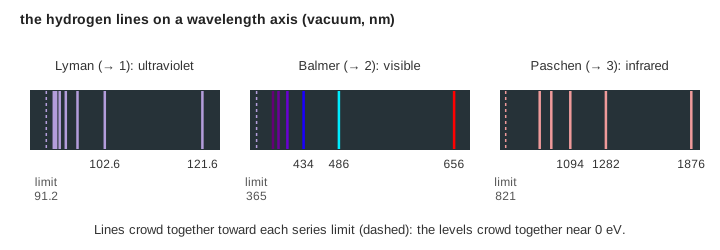
All the drops that end on the same level form a series. Bigger drops make bluer light, and every drop to n = 1 is bigger than any drop to n = 2, so the series sit in separate parts of the spectrum (Demos: the Balmer series; Lyman, Balmer, Paschen):
| series | ends on | lines (nm) | limit (from ∞) | region |
|---|---|---|---|---|
| Lyman | n = 1 | 121.6, 102.6, 97.3, 95.0, … | 91.2 nm | ultraviolet |
| Balmer | n = 2 | 656.5, 486.3, 434.2, 410.3, … | 364.7 nm | visible |
| Paschen | n = 3 | 1876, 1282, 1094, … | 821 nm | infrared |
| Brackett | n = 4 | 4052, 2626, … | 1459 nm | infrared |
| Pfund | n = 5 | 7460, … | 2280 nm | infrared |
Inside a series the lines get closer and closer as they near the limit, because the levels near 0 eV crowd together. One excited atom can also fall in several steps, sending out one photon per step (Demo: cascade 5 → 4 → 3 → 2 → 1): the four photons together carry the same energy as the single 5 → 1 photon would.
Emission and absorption lines
The rule works both ways. White light shone through cool hydrogen loses exactly the wavelengths that hot hydrogen gives out, because only a photon with exactly the energy of a jump up can be absorbed. A photon that fits no gap is not partly used; it passes straight through (Demo: absorption: at n = 2 a 500 nm photon passes, a 486 nm photon lifts the electron to n = 4). The spectrum of the Sun has dark lines at 656 and 486 nm for this reason: hydrogen in its outer layers absorbs them. Each element has its own levels and so its own set of lines, like a fingerprint: neon signs are red-orange, sodium street lamps yellow (589 nm), and astronomers read off which elements a star contains and, from how far the lines are shifted, how fast it moves.
Ionization
Give the electron 13.6 eV or more from n = 1 and it is no longer bound: the atom is ionized and only a bare proton is left. 13.6 eV is a photon of 91.2 nm. More than that is fine too: the rest becomes the free electron's kinetic energy, just as in the photoelectric effect. When a free proton catches an electron again (recombination) the photon goes the other way (Demo: ionization).
Where Bohr's model breaks
The model gets hydrogen's levels exactly right, which is why it is still taught, but the orbits are not real. It cannot explain atoms with two or more electrons, why some lines are brighter than others, or why each line is really several lines close together. Quantum mechanics replaced orbits with wave patterns (orbitals): the electron is a wave that fits around the proton only with whole numbers of wavelengths, which is where the allowed levels come from (see Quantum Tunneling for electrons as waves). The energies Eₙ = −13.6 eV / n² come out the same. Light as a wave and its colours are on Electromagnetic Waves, and how a grating spreads light into a spectrum is on Diffraction.
What the page leaves out
Levels above n = 6, the fine structure and the Lamb shift (each line split into close lines), the width and brightness of the lines, how long an excited atom waits before it falls (about 10 ns for 2 → 1), selection rules from the electron's angular momentum, the recoil of the atom, the difference between wavelengths in air and in vacuum (the page uses vacuum values: Hα is 656.3 nm in air), the Zeeman effect in a magnetic field, and atoms with more than one electron.