The idea: light spreads out behind a narrow slit
Send light through a slit a few wavelengths wide and it does not make a sharp line on a far screen. It spreads out into a bright middle with fainter fringes on each side, separated by dark gaps. This is diffraction: every point of the opening sends out its own wavelet (Huygens' idea), and on the screen those wavelets add up, in step or out of step depending on the direction θ.
The dark gaps of a single slit of width a are at
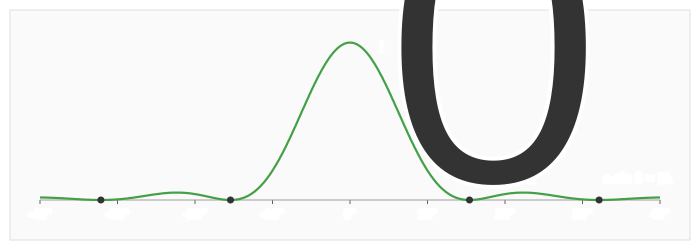
a · sin θ = m λ m = ±1, ±2, …With a = 2 µm and green light (λ = 532 nm) the first dark gap is at sin θ = 0.266, θ = 15.4° (Demo 1 sweeps the probe P across the screen). The narrower the slit, or the longer the wavelength, the wider the light spreads: a = 1 µm puts it at 32.1° (Demo 2), and red light spreads more than violet (Demo 3).
Why the dark fringes: wavelets that cancel in pairs
At the first dark angle the far edge of the slit is exactly one wavelength farther from P than the near edge. Split the slit into an upper and a lower half: each strip in the upper half has a partner in the lower half that is half a wavelength farther, and the two cancel. All of them cancel in pairs, so no light arrives.
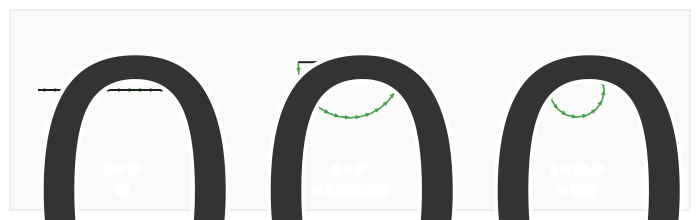
The phasor chain on the right of the canvas shows the same sum as a drawing. Each of the 16 strips of the slit is an arrow; its direction is its phase, which grows with the path difference. Straight ahead all arrows point the same way and the chain is a straight line: the sum is as long as it can be, I = I₀. As θ grows the arrows turn a little more each, the chain curls up, and when the edge-to-edge path difference is exactly λ the chain closes into a circle: the sum is zero (Demo 7). Its length squared is I/I₀.
Two slits and the envelope
Two slits a distance d apart act like the two sources of Wave Interference: bright fringes where the path difference between them is a whole number of wavelengths, d·sin θ = mλ. But each slit still spreads its light with the one-slit pattern, so the fringes are only as bright as that pattern allows. It becomes the envelope (dashed on the canvas):
I = I₀ · cos²(π d sin θ / λ) · [sin β / β]² β = π a sin θ / λWhen a bright fringe falls exactly on a zero of the envelope it disappears: a missing order. With d = 3a the 3rd, 6th, … fringes are missing (Demo 5).
Gratings: more slits, sharper lines
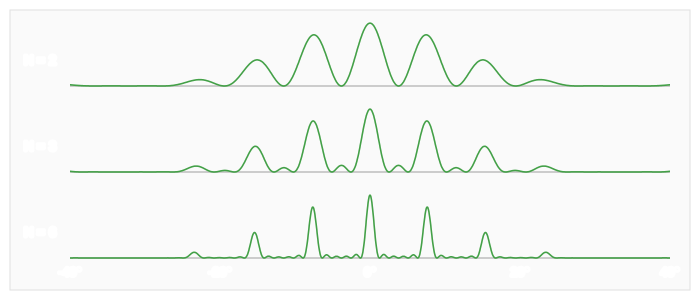
With N slits the bright fringes stay at d·sin θ = mλ, but they get N² times as bright as one slit and about N times narrower, with N − 2 faint bumps between neighbours (Demo 6). A diffraction grating has thousands of slits, so each colour lands on its own thin line: green and red first orders are at 7.6° and 9.4° for d = 4 µm (Demo 8). That is how a spectrometer measures wavelengths.
Where you meet it
| Where | What diffraction does |
|---|---|
| Rainbow colours on a CD or DVD | The tracks are a reflection grating (1.6 µm and 0.74 µm apart) |
| Spectrometers | A grating sends each wavelength to its own angle |
| Microscopes and telescopes | Diffraction at the lens opening blurs every point; details smaller than about λ cannot be resolved |
| X-ray crystallography | The atoms of a crystal act as a 3D grating for X-rays (λ about 0.1 nm) |
| Hearing round corners | Sound waves are metres long, so doorways diffract them strongly |
What the page leaves out
Near-field (Fresnel) diffraction close to the slit, circular holes (the Airy disc that sets a telescope's resolution), real slit edges and the vector nature of light, and the finite size of the source. The view is not to scale: the screen is drawn close and the slits large. The phasor chain uses 16 strips per slit, so its length² is a close approximation of the exact intensity, with the zeros in exactly the same places.