The idea: light has the same speed for everyone
Einstein's second postulate says that light in empty space moves at c = 299 792 458 m/s for every observer moving at a steady speed, whatever the speed of the lamp. The first postulate says the laws of physics are the same in all such frames: Bob on a smooth train cannot tell he is moving without looking out. Taken together, these two rules force time and length to depend on the frame.
The page uses c = 0.3 m per nanosecond (light goes 30 cm in 1 ns). Bob's train car is 6 m long and holds a light clock: a photon bouncing between two mirrors 3 m apart. Up and back is 6 m, so one tick is 20 ns. Alice stands on the platform, and Bob passes her at t = t' = 0.
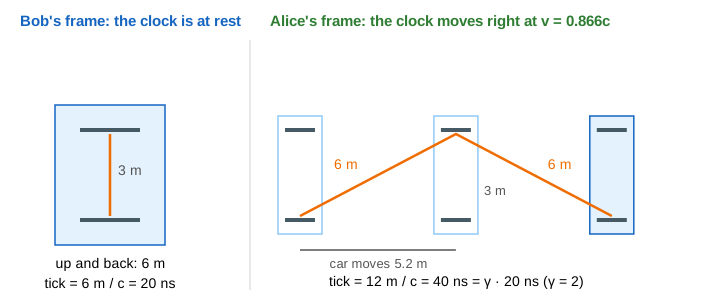
Time dilation from the light clock
In Alice's frame the car moves at v while the photon goes up. Let one tick last t. In half a tick the car moves v·t/2 and the photon goes c·t/2 along a diagonal whose height is still 3 m. Pythagoras:
(c·t/2)² = (3 m)² + (v·t/2)²   →   t = (2 · 3 m / c) / √(1 − v²/c²) = γ · 20 ns
γ = 1 / √(1 − v²/c²)
A moving clock ticks slower by the Lorentz factor γ. This is time dilation. At 0.866c, γ = 2: Alice times one tick of Bob's clock at 40 ns, while Bob, in his own 40 ns, sees his clock tick twice (Demo 2: light clock at 0.866c). At rest both see 20 ns (Demo 1). The rule works for every clock, not only light clocks: if a wristwatch on the train disagreed with the light clock, Bob could tell he was moving.
| v | γ | Bob's tick seen by Alice | 6 m car seen by Alice |
|---|---|---|---|
| 0 | 1 | 20 ns | 6 m |
| 0.6c | 1.25 | 25 ns | 4.8 m |
| 0.8c | 1.67 | 33.3 ns | 3.6 m |
| 0.866c | 2 | 40 ns | 3 m |
| 0.998c (muon) | 15.8 | 316 ns | 0.38 m |
Each side sees the other's clock run slow. That is not a contradiction, because they can only compare clocks that are far apart by agreeing on what "at the same time" means, and they do not agree (below).
Length contraction
To measure a moving car, Alice marks where its two ends are at the same moment of her time and measures the marks. She gets L = L₀/γ, where L₀ = 6 m is the rest length Bob measures with a ruler lying in the car. At 0.8c that is 3.6 m (Demo 3: length contraction at 0.8c). Only the length along the motion shrinks: the mirrors stay 3 m apart, otherwise Bob and Alice could tell who is moving by holding two rulers side by side.
Relativity of simultaneity
Lightning strikes the front F and rear R of the car just as Bob passes Alice. For Alice the strikes are at the same time: their light reaches her, in the middle of the scorch marks, together at t = 8 ns (at 0.6c). Bob rides toward F's light and away from R's, so he sees F at 5 ns and R at 20 ns.
Bob is in the middle of his car, and for him both flashes also move at c. He saw F first, so in his frame F really happened first: at t' = −6 ns, and R at t' = +6 ns. The gap is β·L₀/c = 0.6 × 20 ns = 12 ns (Demo 4: two lightning strikes). The Lorentz transformation says the same:
t' = γ (t − v·x/c²)        x' = γ (x − v·t)
F: t = 0, x = +2.4 m  →  t' = 1.25 × (0 − 0.6 × 2.4 m / (0.3 m/ns)) = 1.25 × (−4.8 ns) = −6 ns
R: t = 0, x = −2.4 m  →  t' = +6 ns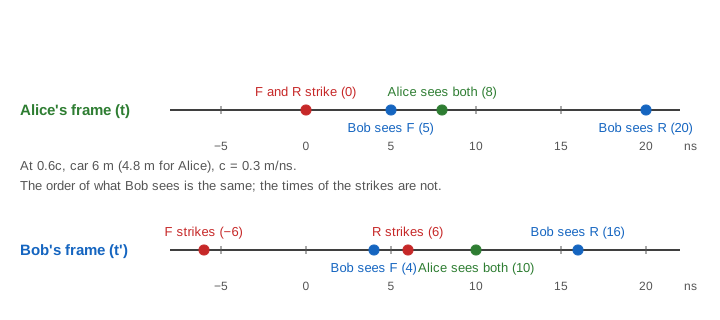
The spacetime (Minkowski) diagram
A spacetime diagram draws place x across and time up, as ct so that both are in metres. Light then moves at 45°. Each point is an event: a place and a moment. Alice's axes are the usual square ones. Bob's time axis ct' is his own worldline, x = v·t, tilted right by slope β = v/c. His x' axis, the events that happen at t' = 0, is tilted up by the same slope. The two blue axes close in on the light line like scissors; at v = c they would meet it.
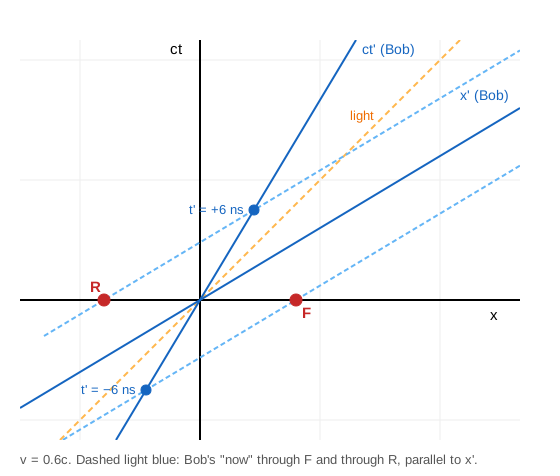
Lines of "same time" for a frame are parallel to its x axis. Alice's are horizontal; Bob's tilt. That one picture holds all three effects: an event on Bob's ct' axis at ct' = 6 m sits at ct = 6γ m on Alice's axis (time dilation); the two ends of the car cut Alice's horizontal "now" closer together than Bob's tilted one (length contraction); and two events on one horizontal line lie on different tilted lines (simultaneity). The blue dots on Bob's axes mark every 10 ns and every 3 m of his: they are spread out on the paper, because the diagram's geometry is not ordinary geometry (the interval (ct)² − x² is what stays the same).
Real numbers: muons and GPS
Cosmic rays make muons about 15 km up. A muon at rest lives τ = 2.197 µs on average. At 0.998c it would cover only 0.66 km in that time, and 15 km would take 22.8 lifetimes: almost none would arrive. But γ = 15.8, so for Earth the muon lives 34.8 µs and goes 10.4 km; on the muon's clock the trip takes 3.17 µs = 1.44 τ, and about 24 % reach the ground. The muon sees the same thing differently: for it the air is only 15 km / γ = 0.95 km thick (Demo 5: cosmic-ray muons).
GPS satellites move at 3.874 km/s, β = 1.29 × 10⁻⁵. Tiny, but their clocks must agree to about 20 ns. Speed makes them lose 7.2 µs per day; the weaker gravity 20 200 km up (general relativity) makes them gain 45.7 µs. Net +38.5 µs per day, which at 300 m per µs is 11.5 km of position error each day. The satellite clocks are tuned slow before launch to cancel it (Demo 6: GPS satellite clocks).
The same constant c that this page holds fixed is the speed of the waves in Electromagnetic Waves: Maxwell's equations give c = 1/√(μ₀ε₀) with no word about who measures it, which is what led Einstein here. For light, the Doppler effect also needs γ: f' = f·√((1 + β)/(1 − β)).
What the page leaves out
Acceleration (the twin paradox needs a turn-around), the full Lorentz transformation of velocities (u ⊕ v = (u + v)/(1 + uv/c²)), mass, energy and momentum (E = γmc²), the invariant interval as a drawn hyperbola, general relativity (only its GPS number is quoted), and how light actually looks to a fast observer (aberration, the Terrell rotation). Speeds are limited to four values, c is rounded to 0.3 m/ns for the train, and the train is a thought experiment: no real train goes near 0.6c.