The idea: two fields that keep each other going
A magnetic field that changes makes an electric field: that is Faraday's law, the coil and magnet of Faraday's Law. Maxwell added the reverse: an electric field that changes makes a magnetic field. Far from any charge the two can keep each other going and travel through empty space as a wave. In 1864 Maxwell worked out its speed from two constants measured with batteries and coils, found the speed of light, and concluded that light is such a wave.
For a wave travelling along x, the simplest one is
E = E₀ sin(kx − ωt) ŷ        B = B₀ sin(kx − ωt) ẑ

k = 2π/λ      ω = 2πf
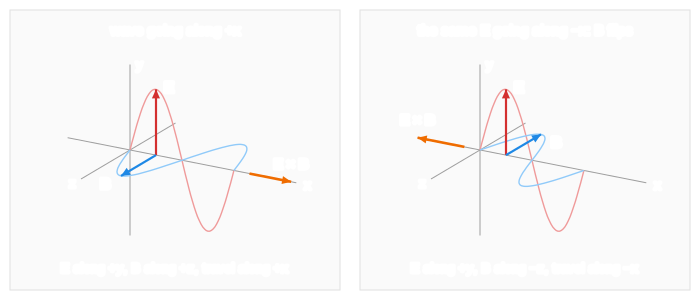
E points along y and B along z. Both are at right angles to the direction of travel, so the wave is transverse. They are also in step: both peak at the same place at the same moment. On the canvas E is red, B is blue, and the spokes join each curve to the x axis.
E₀ = c·B₀ and c = 1/√(μ₀ε₀)
Put the wave into Maxwell's equations and two conditions come out. Faraday's law gives E₀ = c·B₀, and the two together give the speed:
c = 1/√(μ₀ε₀)

μ₀ = 1.25664 × 10⁻⁶ N/A²     (magnetic constant)
ε₀ = 8.85419 × 10⁻¹² F/m     (electric constant)
c  = 299 792 458 m/s ≈ 3.00 × 10⁸ m/s
In SI units B is tiny next to E. A strong field of E₀ = 1000 V/m comes with B₀ = E₀/c = 3.34 µT, less than a tenth of the Earth's magnetic field. That is why the canvas draws c·B: at that scale the blue curve is as tall as the red one. Demo 2: radio or light, 1 or 1000 V/m changes E₀ and shows B₀ follow.
A snapshot in space, a sine in time
Freeze the time and the field along x is a sine with period λ, the wavelength. Stand at one place and the field there is a sine in time with period T = 1/f. In one period every crest moves forward exactly one wavelength, so the speed is
c = λ/T = λ·fDemo 1: the wave moves one λ per period T plays one period: every crest moves one λ to the right, the picture ends where it started, and the probe records one full cycle.
A probe a quarter wavelength further on sees the same signal a quarter period later: E(x + λ/4, t) = E(x, t − T/4). Demo 3: λ/4 further on moves the probe from 2λ to 2.25λ, and the curve in the time plot shifts right by T/4.
Which way it goes: E × B
The wave carries energy along S = E × B / μ₀, the Poynting vector, in watts per square metre. For the wave above, ŷ × ẑ = x̂: S points the way the wave travels. A wave going the other way is
E = E₀ sin(kx + ωt) ŷ B = −B₀ sin(kx + ωt) ẑE is the same, B has flipped, and E × B now points along −x. Demo 4: E × B points the way it goes reverses the wave: the orange arrow moves to the other end, and in the time plot c·Bz becomes the mirror image of Ey.
Averaged over a period, the intensity is
I = E₀² / (2μ₀c) = ½ c ε₀ E₀²For E₀ = 1000 V/m that is 1327 W/m², close to sunlight above the atmosphere (about 1361 W/m²).
One wave, many names: the spectrum
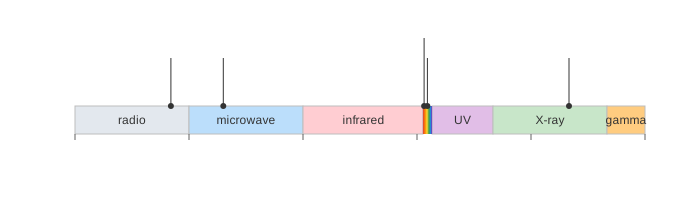
Radio, microwaves, light and X-rays are the same wave with different wavelengths. The canvas draws everything in units of λ, so the picture is the same for every source; only the numbers change.
| Source | λ | f | T |
|---|---|---|---|
| FM radio | 3.00 m | 100 MHz | 10.0 ns |
| Wi-Fi | 12.5 cm | 2.40 GHz | 417 ps |
| red laser | 650 nm | 461 THz | 2.17 fs |
| green laser | 532 nm | 564 THz | 1.77 fs |
| X-ray | 0.100 nm | 3.00 × 10¹⁸ Hz | 0.334 as |
Polarization: linear, circular, elliptical
The wave so far is linearly polarized along y: E only swings up and down. Add a second wave along the same x, with E along z and shifted by a phase φ:
E = E₀ sin ψ ŷ + a·E₀ sin(ψ + φ) ẑ ψ = kx − ωtIts B is along −y, so B still turns with E and stays at right angles to it. What E does depends on a and φ. The end-on panel shows it, looking back along −x at the probe: y up, z to the left.
| a | φ | Tip of E (end-on) | Demo |
|---|---|---|---|
| 0 | any | a vertical line: linear along y | 1 |
| 1 | 0° | a line at 45°: linear | 6 |
| 1 | 90° | a circle, counter-clockwise: circular, |E| = E₀ always | 5 |
| 0.5 | 90° | an ellipse twice as tall as wide | 7 |
| 1 | 270° | a circle, clockwise | 8 |
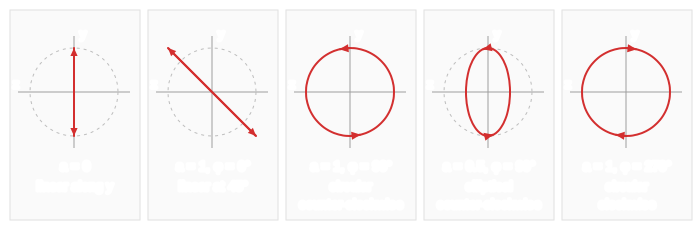
In circular polarization |E| never changes; only its direction turns, once per period, so in 3D the tip of E draws a helix. With φ = 90° E turns from y toward z. In the radio (IEEE) convention that is right-handed: point the right thumb along the travel and the fingers curl the way E turns. Optics books often use the opposite name, so check which convention a source uses. The end-on paths are the 1 : 1 Lissajous figures: line, ellipse and circle as the phase goes from 0° to 90°. To make, filter and convert polarized light with polarizers and quarter-wave plates, see Polarizers and Malus's Law.
Where such a wave comes from, charges sloshing up and down an antenna, and why it is strongest broadside: see A Dipole Antenna.
What the page leaves out
Where waves come from (accelerating charges, an antenna's current) and the near field close to them; waves that spread out from a source and get weaker with distance (the page has one plane wave); matter, where the speed is c/n, E₀ = (c/n)·B₀ and the wave can be absorbed; real light, which is many short waves with random phases (unpolarized until a filter picks one direction); and photons, the quantum picture in which the energy comes in lumps of E = h·f. The picture is not to scale: real fields are drawn in units of E₀ and λ.