The idea: a particle is a wave
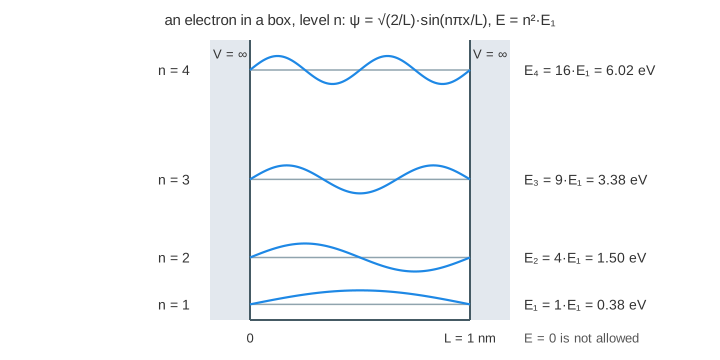
In quantum mechanics an electron is described by a wave function ψ(x, t), a complex number at every point. It is not a wave of anything you can touch: its size tells you where the electron is likely to be found. Shut the electron in a box with walls it cannot pass, and ψ must be zero at both walls, just like a guitar string held at both ends. Only standing waves fit, so only certain energies are allowed.
Why the energy is quantized
A box of width L holds a whole number n of half-wavelengths, as on a string: λₙ = 2L/n. The wave is
ψₙ(x) = √(2/L)·sin(nπx/L), n = 1, 2, 3, …De Broglie's rule gives the momentum p = h/λ = nh/(2L), and the energy of a free particle is p²/2m, so
Eₙ = n²·h²/(8mL²) = n²·E₁For an electron in a 1 nm box E₁ = 0.376 eV, and the next levels are 1.50, 3.38 and 6.02 eV. Nothing in between is allowed. There is also no level with E = 0: confining a particle always costs energy (the zero-point energy). A box half as wide has levels four times higher, because E ∝ 1/L². (Demos 1 and 2; the energy-level panel draws the ladder.)
Probability density |ψ|²
The chance of finding the electron near x is |ψ(x)|², the probability density; over the whole box it adds up to 1. ψₙ has n − 1 nodes inside the box, places where |ψ|² = 0 and the electron is never found. In level n = 1 it is most likely in the middle; in n = 2 it is never in the middle.
In one level, ψ(x, t) = ψₙ(x)·e^(−iEₙt/ħ): the whole wave turns in the complex plane at the rate Eₙ/ħ. The real part, drawn in blue, swings up and down like a string. But |e^(−iEₙt/ħ)|² = 1, so |ψ|² never changes. That is why a level is called a stationary state (Demo 1).
Superpositions move
An electron can be in two levels at once: ψ = (ψ₁e^(−iE₁t/ħ) + ψ₂e^(−iE₂t/ħ))/√2. The two parts turn at different rates, so where they add up and where they cancel changes in time. |ψ|² sloshes from wall to wall with the period h/(E₂ − E₁) = 3.67 fs, and the average position ⟨x⟩ goes from 0.32 nm to 0.68 nm and back (Demo 3). This is the quantum picture of an atom giving off light: the charge sloshes at the frequency (E₂ − E₁)/h and the photon carries the energy E₂ − E₁ (here 1.13 eV, near-infrared).
Tunneling through a barrier
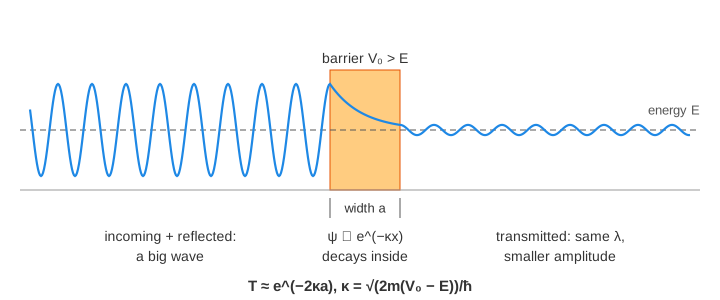
Now take a free wave packet (a lump of wave, see Group Velocity) with energy E and send it at a barrier of height V₀ > E. A classical ball would bounce back every time. The wave does not stop at the edge: inside the barrier the Schrödinger equation gives a decaying wave instead of an oscillating one,
ψ ∝ e^(−κx), κ = √(2m(V₀ − E))/ħIf the barrier is thin, some of the wave is still left at the far side and goes on as a smaller packet. The packet splits: a part R is reflected and a part T is transmitted, R + T = 1. That is tunneling. The particle is not split; T is the chance that it is found on the far side (Demos 4 to 6). While the packet hits the barrier, the incoming and reflected waves interfere and |ψ|² gets ripples half a wavelength apart, as in Standing Waves.
Exponential fall-off with width
The amplitude drops by e^(−κa) across a barrier of width a, so the probability drops by about e^(−2κa). For a plane wave the exact answer is
T = 1 / (1 + V₀²·sinh²(κa) / (4E(V₀ − E)))and with E = V₀/2, as on the page, this is T = 1/cosh²(κa). In the page's units (ħ = m = 1, E = 0.5, V₀ = 1) κ = 1. The packet is solved numerically (Crank–Nicolson) and agrees with the plane-wave formula:
| width a | plane wave 1/cosh²(a) | packet T (page) | ratio to the row above |
|---|---|---|---|
| 0.5 | 0.786 | 0.785 | |
| 1 | 0.420 | 0.420 | 0.53 |
| 2 | 0.0707 | 0.0727 | 0.17 |
| 3 | 0.0099 | 0.0107 | 0.15 |
| 4 | 0.0013 | 0.0016 | 0.15 |
Each extra unit of width multiplies T by roughly e^(−2) ≈ 0.14: on a log scale the points lie on a straight line (Demo 7). The packet holds a small spread of energies, and its faster parts tunnel more, so for wide barriers it gets through a little more than the plane wave.
This steepness is used everywhere. In a scanning tunneling microscope an electron tunnels across the vacuum gap from a sharp tip to a surface; with a work function of about 4 eV, κ ≈ 10 nm⁻¹, so moving the tip 0.1 nm changes the current about 8 times, enough to see single atoms. Alpha decay is an alpha particle tunneling out of the nucleus, and flash memory stores bits by tunneling electrons through a thin oxide.
See also
The box levels are the same counting as the harmonics of a guitar string in Standing Waves. That electrons are waves at all was shown by electron diffraction, the same fringes as light in Diffraction.
What the page leaves out
The page stays in one dimension with ideal shapes: infinitely high walls, a rectangular barrier and no spin. A real well has finite walls, so ψ leaks a little into them and there are only a few levels. Energies above the barrier (where a packet can still partly reflect), smooth barriers (the WKB formula T ≈ e^(−2∫κ dx)), measurement and what "collapse" means, and how fast a particle tunnels are left out. The barrier scene uses units with ħ = m = 1 rather than electron-volts and nanometres.