The idea: a healthy bank can fail if everyone believes it will
A bank takes deposits that can be withdrawn any day and lends most of them out for years. That is maturity transformation, and it is useful: savers get money on demand, and borrowers get long loans. It also leaves the bank unable to pay everyone at once. If enough depositors ask for their money on the same day, the bank has to sell loans in a hurry at a loss. That loss is what makes everyone else want to get their money out first. Douglas Diamond and Philip Dybvig turned this into a simple model in 1983, and the page follows it.
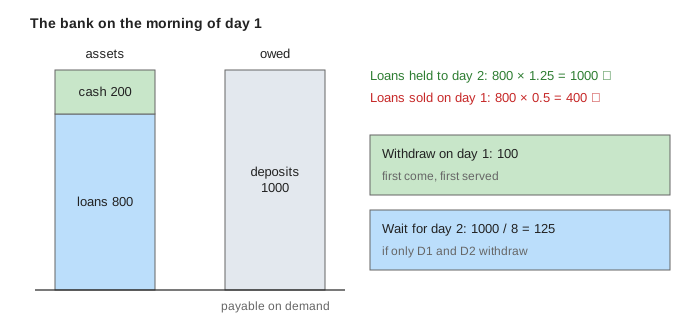
Ten depositors have 100 each. D1 and D2 need their money on day 1. The other eight can wait until day 2, when the loans pay 1.25 times their face value. If only D1 and D2 withdraw, the cash covers them and the eight who waited share 1000: 125 each, better than 100 (Demo: a normal day).
First come, first served, and fire sales
The bank pays withdrawals in the order people arrive, 100 each, while it can. This is sequential service. After the 200 of cash, every extra 100 paid out means selling 200 of loans to fire-sale buyers, who pay only half price in a hurry. Those loans would have paid 250 on day 2, so each early withdrawal beyond the cash costs the people who wait 150. With one extra withdrawal (Demo: small rumor), the seven who wait still get 1.25 × 600 / 7 = 107.14 each. That is less than 125 but still more than 100, so nobody else runs.
Two equilibria: the value of waiting
What waiting is worth depends on how many withdraw on day 1. Call that number k. Then W(k) = 1.25 × (800 − 2 × (100k − 200)) / (10 − k). The chart on the right of the canvas draws these bars.
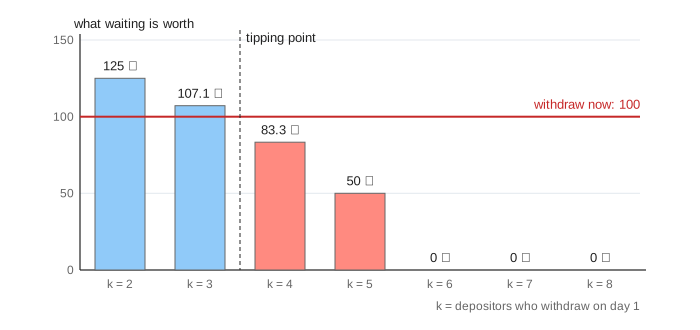
While k is 2 or 3, waiting beats withdrawing, and the good outcome holds. From k = 4 on, waiting pays 83.33 or less, so each depositor's best move is to run, and running makes k bigger still. Both outcomes are equilibria: each is the best response to what the others do. A rumor that sends just two patient depositors to the bank is enough to tip it (Demo: big rumor). Six depositors get 100, four get 0, and a bank whose loans were worth 1000 is gone. Nothing was wrong with the loans; only the beliefs changed.
Deposit insurance
With a government guarantee of 100 per deposit, waiting is worth at least 100 whatever the others do (the green top-ups on the bars). Nobody gains by running, so the panic stops after the two rumor-struck depositors (Demo: big rumor, deposit insurance). Their withdrawals still force fire sales, so the six who wait get 83.33 from the bank. The insurer adds 16.67 each, 100 in all. In the model, if everyone believes the guarantee even the first two have no reason to run, and the insurer pays nothing. The US created the FDIC in 1933 after thousands of bank failures; runs on insured deposits have been rare since.
The lender of last resort and Bagehot's rule
A central bank can lend the bank cash against its good loans, so it never has to fire-sell. Walter Bagehot's 1873 rule is to lend freely, against good collateral, at a penalty rate. On the page the bank pledges 125 of loans for each 100 it borrows and repays 110 on day 2 (Demo: big rumor, lender of last resort). The loans keep their full value, so the six who wait get (1000 − 220) / 6 = 130, and running makes no sense. The rule has a condition: lend only to a solvent bank. A central bank that props up a bank that is truly broke is spending public money, not stopping a panic.
Suspension of convertibility
Before deposit insurance, banks sometimes simply stopped paying when their cash ran out. They "suspended convertibility" until the panic passed, as US banks did in 1893 and 1907. In the model this works perfectly: the bank pays 200, shuts the window, sells no loans, and all eight who wait get 125 (Demo: withdrawals suspended). The catch is that in reality the bank cannot tell a scared depositor from one who really needs cash that day.
Panic vs insolvency
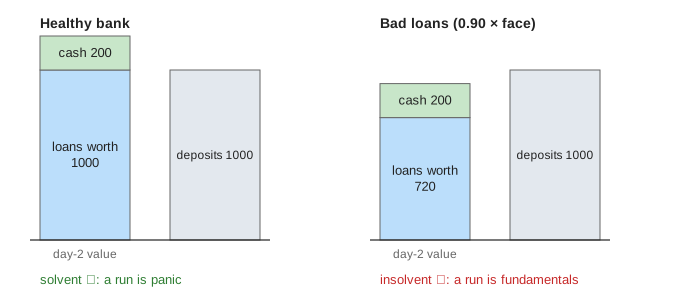
If the loans go bad and will pay only 0.90 × face, the bank owns 200 + 720 = 920 but owes 1000: it is insolvent. Even with no run, waiting pays only 90, so every patient depositor runs at once (Demo: bad loan news). This run is about fundamentals, not panic. A lender of last resort must refuse, and only insurance (or a bail-in or a takeover) decides who bears the loss.
Real runs
In September 2007 depositors queued outside Northern Rock branches in Britain. It was the first run on a British bank in over a century, and the bank had relied on short-term market funding that dried up. In March 2023 Silicon Valley Bank lost $42 billion of deposits in one day, mostly by phone and app. Most of its deposits were above the $250,000 insurance limit, and its long-dated bonds had lost value as rates rose. Runs are faster now, but the logic is the one in the model. Today's runs also hit money-market funds and repo lenders, not only banks (see Flight to Quality and Credit Cycle).
What the page leaves out
The model has one bank, one day of withdrawals and depositors who know exactly what everyone else is doing. Real depositors guess from rumors, prices and the news, and global-games models show how that uncertainty decides which equilibrium happens. Fire-sale prices here are fixed. In reality they fall further when many banks sell the same assets, which is how one run spreads to other banks. The page also leaves out bank capital, central bank reserves and the moral hazard that guarantees create: insured banks may take more risk.