The idea: money later is worth less than money now
If you can earn 5% a year, then 1000 today grows to 1050 in a year. Turned around, 1050 paid a year from now is worth only 1000 today. Finding what a future payment is worth today is called discounting, and the answer is its present value (PV).
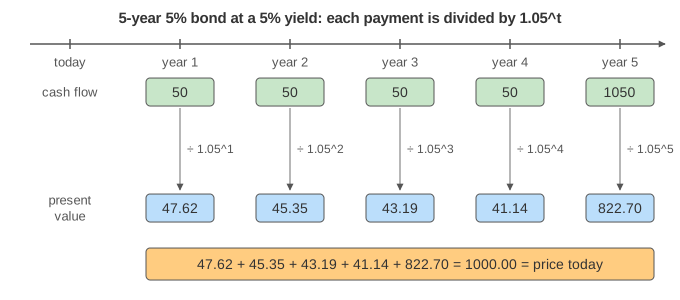
A bond is a promise of future payments. The page uses a bond with face value F = 1000, an annual coupon C (the coupon rate times 1000) at the end of each year, and the face value paid back with the last coupon at maturity N. The bond's price is simply the sum of the present values of all those payments.
Discount factors and present value
With a yield (interest rate) y per year, a payment in year t is multiplied by the discount factor:
DF(t) = 1 / (1 + y)^t PV = cash × DF(t)At y = 5%, DF(1) = 0.9524, DF(5) = 0.7835 and DF(20) = 0.3769. The blue bars on the canvas are these factors: they shrink with every year, and they shrink faster when y is higher. Adding all present values gives the bond pricing formula:
P = C/(1+y) + C/(1+y)^2 + … + (C + F)/(1+y)^NThe coupons form a geometric series with ratio 1/(1 + y), which is why the sum has a closed form (an annuity). Demo 1 discounts the five payments of the 5-year 5% bond one by one: 47.62 + 45.35 + 43.19 + 41.14 + 822.70 = 1000.00.
Par, discount and premium
When the coupon rate equals the yield, the bond pays exactly the market rate, so its price is its face value: it trades at par. If market yields rise above the coupon, the fixed coupons look poor and the price must fall until the buyer's return matches the market: a discount bond. If yields fall below the coupon, the price rises: a premium bond.
| 5-year 5% bond | yield | price | trades |
|---|---|---|---|
| Demo 3 | 3% | 1091.59 | at a premium (+9.2%) |
| Demo 1 | 5% | 1000.00 | at par |
| Demo 2 | 7% | 918.00 | at a discount (−8.2%) |
A zero-coupon bond pays nothing until maturity, so it always sells below face value when y > 0: the 5-year zero at 5% costs 1000 / 1.05^5 = 783.53 (Demo 4). The price you pay now and the face value you get later fix your return, and that return is the yield. This is why "yield" and "price" are two ways to quote the same bond.
Yield up, price down
The payments of a bond are fixed when it is issued. Only the discount factors change when market rates change, and every one of them moves the same way. So a higher yield means a lower price, always. The chart on the canvas draws the price for every yield from 0.5% to 12%: the price–yield curve.
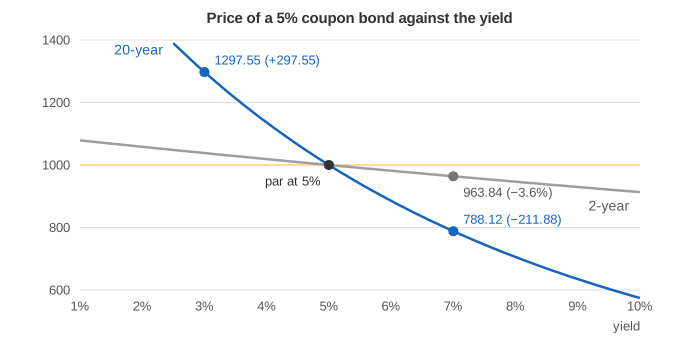
The curve is not a straight line; it bends upward (it is convex). For the 20-year 5% bond, a fall from 5% to 3% raises the price by 297.55, but a rise from 5% to 7% lowers it by only 211.88 (Demo 6). Each step up in yield takes away less than the step before, because the discount factors are already small.
Duration: why long bonds move more
A payment far in the future is discounted many times, so it reacts most to a change in y. A long bond has most of its value far away, so its price moves more. The Macaulay duration measures this: the average time of the payments, weighted by their present values.
D = Σ t · PV(t) / P modified duration = D / (1 + y)The modified duration is roughly the percentage price change for a 1% change in yield. The 2-year 5% bond has D = 1.95 years and falls 3.6% when the yield goes from 5% to 7%; the 20-year bond has D = 13.09 years and falls 21.2% (Demo 5, the 2-year curve stays grey for comparison). A zero-coupon bond has only one payment, so its duration equals its maturity.
Where discounting is used
- Interest rates and bond markets: when a central bank raises rates, existing bonds lose value, and long bonds lose the most.
- The yield curve: in real markets each maturity has its own rate; pricing then uses one discount factor per year from that curve.
- Valuing companies and projects: discounted cash flow (DCF) and net present value (NPV) discount expected future profits the same way; a project is worth doing when its NPV is positive.
- Loans and mortgages: the loan amount is the present value of the monthly payments at the loan's rate.
See also Supply and Demand for how a market price is found, and Exponential Graphs for the shape of (1 + y)^t.
What the page leaves out
Semi-annual coupons and accrued interest (clean vs dirty price); a different rate for each maturity (spot rates and the term structure); default risk and credit spreads; inflation-linked bonds; callable bonds; continuous compounding; taxes; and convexity as a formula.