The idea: an orbit is falling around the planet
Throw a stone sideways and it curves down to the ground. Throw it faster and it lands farther away. Throw it fast enough and the ground curves away under it as fast as it falls: it never lands. That is an orbit. On the page a satellite starts at distance r from the Earth's centre, moving straight sideways at speed v, and only gravity acts on it. How fast it goes decides everything: a circle, an ellipse, a crash, or an escape on a parabola or hyperbola.
Gravity is the centripetal force
Anything moving on a circle of radius r at speed v needs a pull toward the centre of v²/r per kilogram (the centripetal acceleration). For a satellite that pull is gravity, GM/r². Set them equal and you get the circular speed v_c = √(GM/r). Gravity then never changes the speed, it only turns the velocity: the red arrow is always at right angles to the green one (Demo: circle).
| r | gravity GM/r² | v_c | escape √2·v_c | period of the circle |
|---|---|---|---|---|
| 2 R (12 742 km) | 2.46 m/s² | 5.59 km/s | 7.91 km/s | 3.98 h |
| 3 R (19 113 km) | 1.09 m/s² | 4.57 km/s | 6.46 km/s | 7.31 h |
| 4 R (25 484 km) | 0.61 m/s² | 3.95 km/s | 5.59 km/s | 11.25 h |
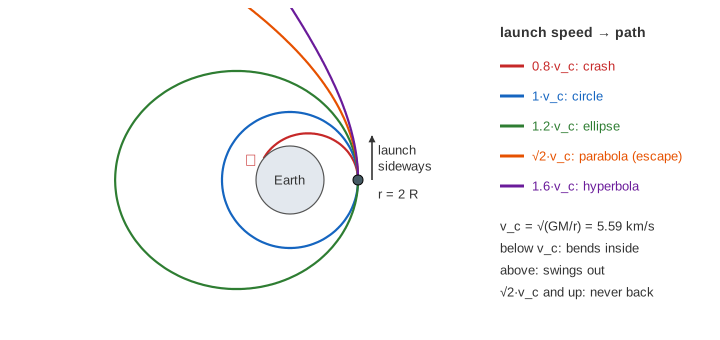
Farther out gravity is weaker, so the circle is slower and much longer. Slower than v_c, gravity is more than a circle needs and the path bends inside: an ellipse whose far end (apoapsis) is the launch point (Demo: slower, an ellipse). Too slow and that ellipse dips below the surface (Demo: too slow, it crashes: at 2 R and 0.8·v_c its near end would be 0.94 R). Faster than v_c the launch point becomes the near end (periapsis) and the path swings out.
Energy decides the shape
Per kilogram the satellite has kinetic energy v²/2 and potential energy −GM/r. Their sum, the orbital energy ε = v²/2 − GM/r, stays the same the whole way. So does the angular momentum h = r·v_sideways, because gravity pulls straight at the centre and cannot twist the motion. Those two numbers fix the whole path, a conic section with the planet's centre at a focus. For a sideways launch at v = k·v_c the eccentricity is simply e = |k² − 1|.
| speed | energy ε | e | path |
|---|---|---|---|
| k < 1 | < 0 | 1 − k² | ellipse, launch point = far end |
| k = 1 | −GM/(2r) | 0 | circle |
| 1 < k < √2 | < 0 | k² − 1 | ellipse, launch point = near end |
| k = √2 | 0 | 1 | parabola: the escape speed |
| k > √2 | > 0 | k² − 1 > 1 | hyperbola |
With ε < 0 the satellite cannot climb out of the planet's pull; the size of the ellipse is a = −GM/(2ε), half the longest diameter. At ε = 0 it has exactly enough energy to reach infinity, arriving there with speed 0: v = √(2GM/r) = √2·v_c (Demo: escape speed). Above that it keeps a speed √(2ε) even far away (Demo: a hyperbola).
Kepler's 2nd law: equal areas in equal times
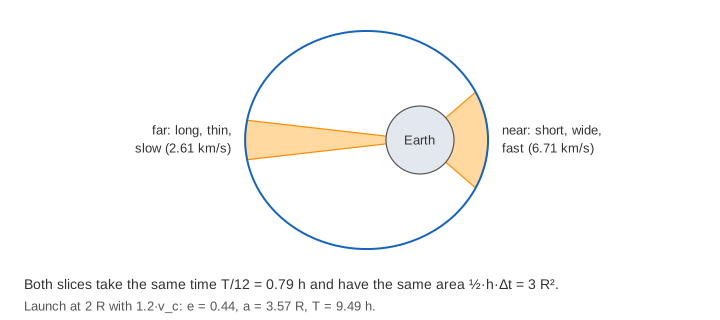
The line from the planet to the satellite sweeps out area at the rate ½·h. Since h is kept, the slices the page shades, each lasting the same time, all have the same area. Near the planet a slice is short and wide, far away it is long and thin. So the satellite moves fast when it is close and slow when it is far; in the movie each Step is the same time, and you can see the steps stretch near the planet (Demo: Kepler's 2nd law: at 2 R and 1.2·v_c it moves 2.57× faster at 2 R than at 5.14 R).
Kepler's 3rd law: T² ∝ a³
The time for one orbit is T = 2π·√(a³/GM). It depends only on the size a, not on the shape: every ellipse with the same a takes as long as the circle of radius a. A 2× bigger orbit takes 2^1.5 ≈ 2.83× longer (Demo: bigger orbit: 3.98 h at 2 R, 11.25 h at 4 R). The plot on the page puts every finished orbit on the curve T = 2π·√(a³/GM), where T²/a³ = 4π²/GM ≈ 1.98 h²/R³ for the Earth.
Where the positions come from
The page does not step the motion forward in small time steps (that would slowly drift). Each position is computed exactly. Time is turned into an angle with Kepler's equation M = E − e·sin E, where M = 2π·t/T grows evenly with time and E (the eccentric anomaly) gives the position: ρ = a·(1 − e·cos E). The equation has no closed solution, so it is solved by Newton's method to full precision. A hyperbola uses M = e·sinh H − H, a parabola Barker's equation D + D³/3 = t·√(GM/(2q³)), which is a cubic.
ellipse:    M = n·t,   M = E − e·sin E,      ρ = a(1 − e·cos E),   n = √(GM/a³)
hyperbola:  M = n·t,   M = e·sinh H − H,     ρ = a(e·cosh H − 1)
parabola:   D + D³/3 = t·√(GM/(2q³)),        ρ = q(1 + D²)
See also
Seen from the side, a circular orbit is a back-and-forth motion x = r·cos(ωt), the same as the Spring Oscillator. Gravity and a swing that turns kinetic into potential energy and back also drive the Simple Pendulum.
Why a careless simulation makes orbits drift outward (Euler's method gains energy every step) and how RK4 fixes it: Runge–Kutta vs Euler.
What the page leaves out
Air drag (which makes low satellites spiral down), the Earth's spin and its flattened shape (which make real orbits turn slowly), launches that are not straight sideways, the satellite's own pull on the planet (both really circle their common centre of mass), the Moon, the Sun and other planets, and relativity (which turns Mercury's ellipse a little each orbit). The page keeps r at 2, 3 or 4 Earth radii and stops an escaping satellite when it leaves the view.