The idea: does Σ settle?
A series Σan = a1 + a2 + a3 + … is an endless sum. Its partial sums Sn = a1 + … + an are ordinary numbers. If they settle at a number S, the series converges and S is its sum; otherwise it diverges. On the canvas the top chart shows the terms an as bars and the bottom chart the partial sums as dots.
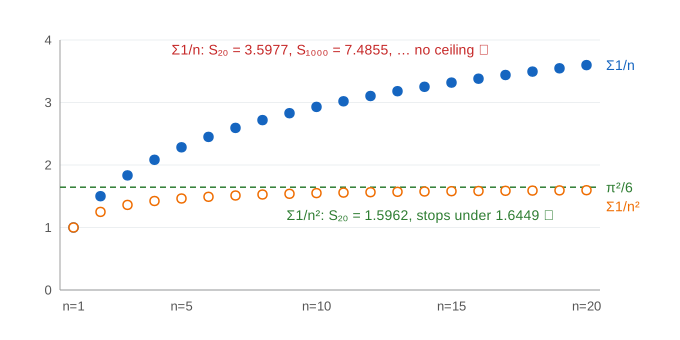
Looking at 20 terms is only a hint. Σ1/n looks calm (S20 = 3.5977) and still passes every number, while Σ1/n² stops below π²/6 ≈ 1.6449. A convergence test decides it without adding forever. Each test answers converges, diverges or says nothing; when one says nothing, try another.
The term test
If the terms an do not go to 0, the series diverges: each step keeps adding a sizeable amount. So 1.2n/n diverges: its terms shrink at first (1.2, 0.72, 0.576, …) but then grow, to 1.9169 at n = 20 (Demo: 1.2ⁿ/n shrinks, then grows).
The other way round fails. 1/n → 0, yet Σ1/n diverges (Demo: harmonic Σ 1/n, terms → 0 but no sum). Terms going to 0 is needed for convergence, never enough.
The comparison test
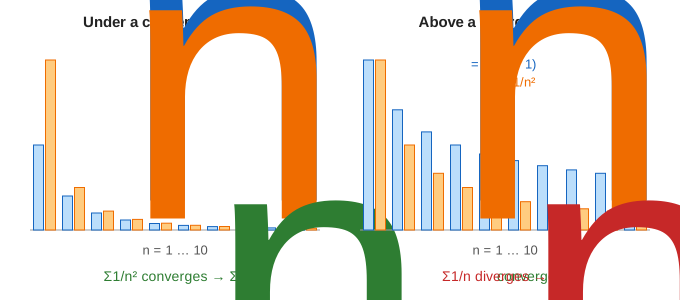
For series with positive terms the partial sums only go up, so they settle exactly when they have a ceiling. That gives the comparison test: find a partner series bn you already know (orange on the canvas).
- If 0 ≤ an ≤ bn and Σbn converges, Σan converges, and its sum is at most Σbn.
- If an ≥ bn ≥ 0 and Σbn diverges, Σan diverges.
| series | partner bn | why | result |
|---|---|---|---|
| 1/n | ln(n+1) − ln n | each bar covers the area under 1/x; Σbn = ln(N+1) → ∞ | diverges |
| 1/n² | 1/(n(n−1)) = 1/(n−1) − 1/n | telescopes: Σbn = 1 + 1 = 2 | converges, ≤ 2 |
| 1/(n² + 1) | 1/n² | smaller denominator, bigger fraction | converges, ≤ 1.6449 |
| 1/√n | 1/n | √n ≤ n | diverges |
| n/2n | (3/4)n | n·(2/3)n ≤ 8/9 | converges, ≤ 3 |
| 1/n! | 1/2n−1 | n! = 2·3·…·n ≥ 2n−1 | converges, ≤ 2 |
The trick is choosing the partner: geometric series and p-series Σ1/np (converge exactly when p > 1) are the usual ones (Demo: comparison, 1/(n² + 1) under 1/n²; Demo: comparison, 1/√n above 1/n). The first row is the integral test in disguise; see Improper Integrals for ∫1/x and ∫1/x².
The ratio test
A geometric series has a fixed ratio between neighbouring terms. The ratio test asks what that ratio tends to: L = lim an+1/an (use |an| when signs change).
| series | an+1/an | a21/a20 | L | result |
|---|---|---|---|---|
| n/2n | (n+1)/(2n) | 0.5250 | 1/2 | converges (sum 2) |
| 1/n! | 1/(n+1) | 0.0476 | 0 | converges (sum e − 1) |
| 1.2n/n | 1.2n/(n+1) | 1.1429 | 1.2 | diverges |
| 1/n | n/(n+1) | 0.9524 | 1 | says nothing (diverges) |
| 1/n² | n²/(n+1)² | 0.9070 | 1 | says nothing (converges) |
L < 1 converges, L > 1 diverges, and L = 1 says nothing: 1/n and 1/n² both have L = 1 and behave oppositely (Demo: ratio test, n/2ⁿ has L = 1/2; Demo: ratio test fails, 1/n and 1/n² both L = 1). The ratio test shines on factorials and powers, which is why Taylor series use it to find a radius of convergence.
Alternating series
When the signs alternate, + − + − …, the alternating series test needs only two checks: |an| gets smaller every time, and |an| → 0. Then the series converges, because each step goes back by less than the step before: the partial sums zig-zag and the sum is trapped between any two neighbours.
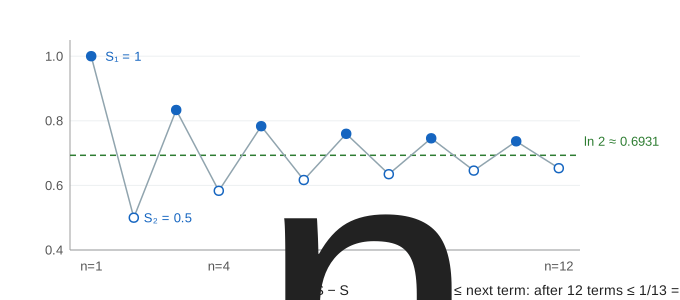
So 1 − 1/2 + 1/3 − 1/4 + … converges, to ln 2 ≈ 0.6931. The test also bounds the error: |S − Sn| ≤ |an+1|. After 20 terms S20 = 0.6688, the bound is 1/21 = 0.0476 and the real error is 0.0244 (Demo: alternating 1 − 1/2 + 1/3 − … → ln 2).
Drop the signs and you get Σ1/n, which diverges. A series that converges only thanks to its signs is conditionally convergent; one where Σ|an| converges too is absolutely convergent. The comparison and ratio tests check absolute convergence, so on 1 − 1/2 + 1/3 − … they say nothing.
Which test to try first
| the terms look like | try |
|---|---|
| do not shrink to 0 | term test: diverges |
| a fraction of powers of n, like 1/(n² + 1) | comparison with a p-series 1/np |
| factorials or cn | ratio test |
| signs + − + − | alternating series test |
| a function you can integrate, like 1/(n ln n) | integral test |
See also Geometric Series for the one series every comparison leans on, and Limits & Continuity for what "settle at a number" means precisely.
What the page leaves out
The root test, the limit comparison test, the integral test as its own test, Raabe's and other finer tests for the case L = 1, proofs of the sums π²/6 and ln 2, the Riemann rearrangement theorem (reordering 1 − 1/2 + 1/3 − … can give any sum), power series and their radius of convergence beyond a mention, and series of functions.