The idea: slower light, shorter waves
Light is a wave (see Electromagnetic Waves). In empty space it travels at c = 3.00 × 10⁸ m/s; in water, glass or diamond it is slower. The refractive index n says by how much:
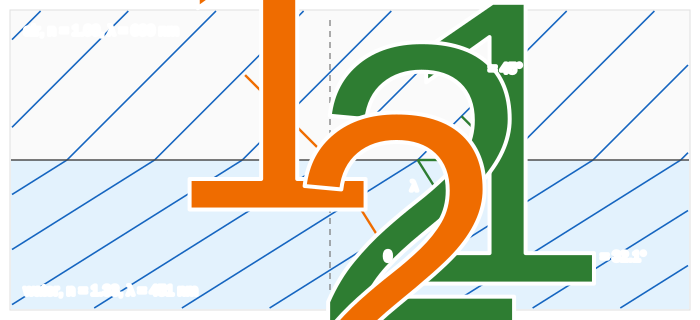
v = c / n λ = λ₀ / n f stays the sameThe frequency cannot change at the boundary: the wave on one side drives the wave on the other, crest for crest. Slower light with the same frequency must have shorter waves. Orange light with λ₀ = 600 nm in air has λ = 451 nm in water and 248 nm in diamond. The canvas draws one blue line per crest, so you can see the crests crowd together below the boundary.
Why it bends: Snell's law from matching crests
Take two neighbouring crests. They hit the boundary a distance d apart. In medium 1 they are one wavelength λ₁ apart, measured at right angles to the crests, and the right triangle between them gives λ₁ = d·sin θ₁. Below the boundary the same two crests are λ₂ apart, so λ₂ = d·sin θ₂. Divide one by the other:
sin θ₁ / sin θ₂ = λ₁ / λ₂ = (λ₀/n₁) / (λ₀/n₂) = n₂ / n₁

n₁ sin θ₁ = n₂ sin θ₂        (Snell's law)
Demo 2: why it bends draws the two triangles in green and plays a period: d slides along the boundary, but the triangles keep their shape.
Toward or away from the normal
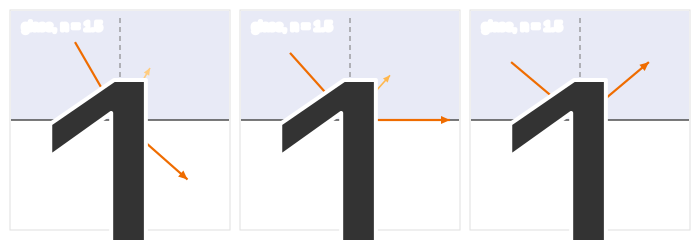
The normal is the line at right angles to the boundary, and the angles are measured from it. Into a slower medium (n₂ > n₁) the wave turns toward the normal; into a faster one it turns away. Straight in (θ₁ = 0) it does not bend at all, it only slows down and its wavelength shrinks (Demo 3).
| Medium | n | v (10⁸ m/s) | λ of 600 nm light | θ₂ for θ₁ = 45° from air |
|---|---|---|---|---|
| air | 1.00 | 3.00 | 600 nm | 45.0° |
| water | 1.33 | 2.25 | 451 nm | 32.1° |
| glass | 1.50 | 2.00 | 400 nm | 28.1° |
| diamond | 2.42 | 1.24 | 248 nm | 17.0° |
Total internal reflection and the critical angle
Going from glass into air, sin θ₂ = 1.5·sin θ₁ grows faster than sin θ₁. At θ₁ = 41.8° it reaches 1: the refracted wave skims along the boundary. Past that critical angle θc = arcsin(n₂/n₁) no refracted wave fits at all, and every bit of the light is reflected back: total internal reflection (Demo 6). Optical fibres trap light this way over thousands of kilometres, and a diamond's small critical angle (24.4°) is why it sparkles.
How much is reflected
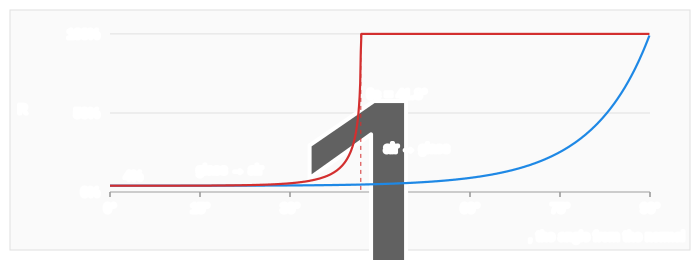
Even when the light gets through, a little bounces off. The Fresnel equations give the fraction R; the page averages the two polarizations, as for sunlight or a lamp. Head-on, air → water reflects 2% and air → glass 4%, which is why you see faint reflections in a window. Toward grazing incidence R climbs to 100% (Demo 7): a lake at sunset is a mirror.
Where you meet it
| What you see | Why |
|---|---|
| A straw looks broken in a glass of water | Light from the straw bends away from the normal leaving the water |
| Lenses and glasses focus light | A curved surface bends each ray by a different amount (see Lens Ray Diagrams) |
| Optical fibres | Total internal reflection keeps the light in the glass core |
| Diamonds sparkle | n = 2.42: small critical angle, most light bounces around inside before it leaves |
| Rainbows and prisms | n is slightly larger for blue than for red, so colours bend by different amounts |
| Mirages over hot roads | Hot air has a lower n; light curving through it is turned back up |
What the page leaves out
Dispersion (n depends on the colour, which splits white light), absorption, curved boundaries, the evanescent wave that leaks a short way into medium 2 during total internal reflection, the phase shifts on reflection, and the different reflection of the two polarizations (Brewster's angle, where one of them is not reflected at all). Reflected crests are drawn only for total internal reflection, to keep the picture readable.