The idea: a saddle with room for a tail
The monkey saddle is the surface
z = x3 − 3xy2
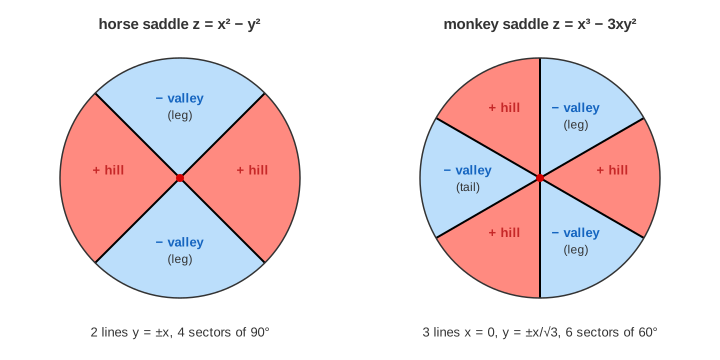
It is the graph of a polynomial of degree 3, so it is a cubic surface, the simplest one after the quadrics. A horse saddle, z = x2 − y2, goes up in two directions and down in two: room for the rider's two legs. The monkey saddle goes up in three directions and down in three: two valleys for the legs and a third one for the tail.
On the canvas the surface is drawn over a disc around the origin, coloured by height: red is high, blue is low. The dropdown n switches to the ordinary saddle (n = 2) or to a saddle with four valleys (n = 4), and a stretches the height, z = a(x3 − 3xy2).
Polar form: r³ cos 3θ
Put x = r cos θ and y = r sin θ. Then
x3 − 3xy2 = r3(cos3θ − 3 cos θ sin2θ) = r3 cos 3θ
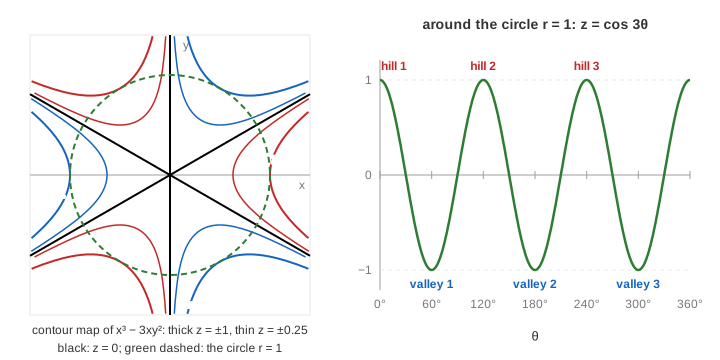
by the triple-angle formula. (It is also the real part of (x + iy)3.) So the distance r only sets the size, and the angle θ decides up or down. Walk once around the origin on a circle: cos 3θ goes up and down three times. The tops are at θ = 0°, 120°, 240° (the hills) and the bottoms at 60°, 180°, 300° (the valleys). The horse saddle is x2 − y2 = r2 cos 2θ: two of each. (Demo 1: walk around: three hills, three valleys)
The cut z = 0: three lines
The polynomial factors:
x3 − 3xy2 = x(x2 − 3y2) = x(x − √3y)(x + √3y)
So z = 0 on three lines through the origin: x = 0 and y = ±x/√3, at 90°, 30° and 150°. They are 60° apart and cut the plane into six sectors where z is positive and negative in turn. For the horse saddle, x2 − y2 = (x − y)(x + y) gives two lines and four sectors. In the panel "the cut z = h, seen from above" the signs + and − mark the sectors.
Cuts z = h: cubic curves with three branches
A cut z = h ≠ 0 is the curve x3 − 3xy2 = h, a cubic curve. In polar form r3 cos 3θ = h, so r = (h / cos 3θ)1/3 wherever cos 3θ has the sign of h. That gives three separate branches: for h > 0 one around each hill, for h < 0 one around each valley. Each branch runs off to infinity along two of the lines of z = 0. As h shrinks to 0, the branches squeeze onto the three lines; past 0 they come out in the other three sectors. (Demo 2: slide the cut z = h from 0.75 to −0.75)
The flat point: the second-derivative test says nothing
For f(x, y) = x3 − 3xy2 the first derivatives are fx = 3x2 − 3y2 and fy = −6xy. Both are 0 at the origin, so it is a critical point and the tangent plane is z = 0. The second derivatives are fxx = 6x, fxy = −6y, fyy = −6x, and all of them are 0 at the origin too. The Hessian is the zero matrix and D = fxxfyy − fxy2 = 0: the second-derivative test says nothing. Such a point is called degenerate. (Demo 3: the flat point: gradient and Hessian are 0)
| horse saddle x2 − y2 | monkey saddle x3 − 3xy2 | |
|---|---|---|
| gradient at 0 | (0, 0) | (0, 0) |
| Hessian at 0 | (2, 0; 0, −2) | all 0 |
| D | −4 < 0: saddle point | 0: the test says nothing |
| along the x-axis | z = x2: a bottom at 0 | z = x3: flat at 0, no bottom, no top |
| near 0, |z| is at most | r2 | r3: much flatter |
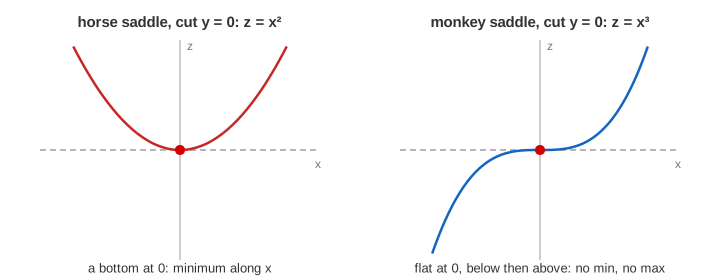
So the answer has to come from looking at the function itself. Along y = 0 the surface is z = x3: it rises on one side and falls on the other, so the origin is no maximum and no minimum. It is a saddle point, just one that the test cannot see. The page Critical Points and Singular Points shows this same point as a contour map, next to ordinary maxima, minima and saddles.
The family rⁿ cos nθ
The same pattern works for any n: z = rn cos nθ, the real part of (x + iy)n, has n hills and n valleys, and its cut z = 0 is n lines through the origin.
| n | z in x, y | hills, valleys | cut z = 0 | Hessian at 0 |
|---|---|---|---|---|
| 2 | x2 − y2 | 2, 2 | y = ±x | not 0: saddle point |
| 3 | x3 − 3xy2 | 3, 3 | x = 0, y = ±x/√3 | 0 |
| 4 | x4 − 6x2y2 + y4 | 4, 4 | y = ±(√2 − 1)x, y = ±(√2 + 1)x | 0 |
All of them are harmonic: fxx + fyy = 0 everywhere (for the monkey saddle, 6x − 6x = 0). A harmonic function can never have a top or a bottom in the middle of a region, so every one of these flat points is a kind of saddle. The stretch a, in z = a(x3 − 3xy2), makes the hills taller but does not move them. (Demo 4: ordinary saddle → monkey saddle, Demo 5: four valleys: r⁴ cos 4θ)
Facts
| property | z = x3 − 3xy2 |
|---|---|
| degree | 3: a cubic surface, the graph of a polynomial |
| polar form | z = r3 cos 3θ = Re (x + iy)3 |
| symmetry | turning by 120° about the z-axis; mirror in the plane y = 0; turning by 60° flips the sign of z |
| critical points | only the origin, degenerate (Hessian 0) |
| cut z = 0 | three lines x = 0, y = ±x/√3 |
| cut z = h ≠ 0 | a cubic curve with three branches |
See also Hyperbolic Paraboloid (the horse saddle, with its two families of straight lines), Level Curves (contour maps of other functions) and Quadric Surfaces (all surfaces of degree 2). Other surfaces of degree 3 and 4 are on Cubic Surface, Cayley's Nodal Cubic, Kummer Surface and Quartic Surface, and all of them side by side on Surfaces by Degree.
What the page leaves out
The curvature of the monkey saddle (negative everywhere except at the origin, where it is 0), higher-order tests for degenerate critical points, other cubic graphs such as z = x3 + y3, and the hidden-line drawing of the surface: the wireframe shows the back of the surface through the front.