The idea: a cubic surface with four cone points
A cubic surface is the set of points where a polynomial of degree 3 in x, y, z is zero. Most cubic surfaces are smooth. Some have nodes: points where the surface stops being smooth and looks like the apex of a double cone. A cubic surface can have at most four nodes, and the one with four is Cayley's nodal cubic. In projective coordinates it is 1/x + 1/y + 1/z + 1/w = 0. This page uses a symmetric form in ordinary coordinates:
4(x2 + y2 + z2) + 16xyz = 1.
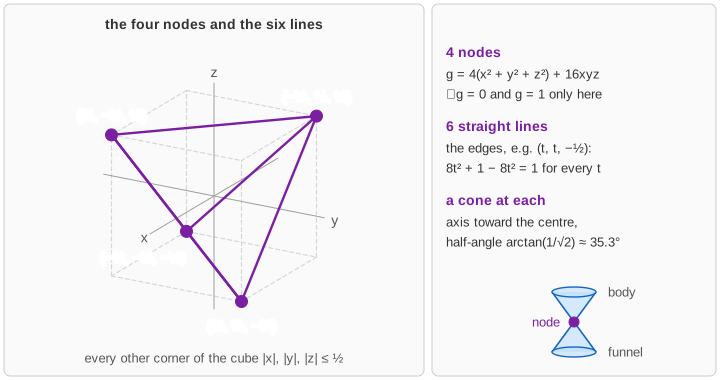
Its four nodes are (−½, −½, −½), (½, ½, −½), (½, −½, ½) and (−½, ½, ½), the corners of a regular tetrahedron. The middle of the surface is a rounded tetrahedron, and four funnels go out to infinity from its corners. The canvas clips the surface to the box |x|, |y|, |z| ≤ 1.2.
x³ + y³ + z³ − 3xyz = 0 is a plane and a line
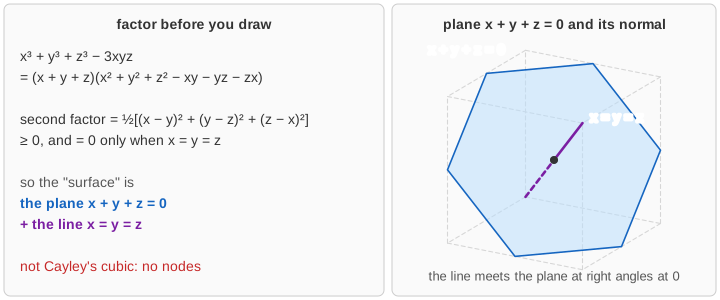
Pictures online often put the name "Cayley surface" next to the equation x3 + y3 + z3 − 3xyz = 0. Factor it first:
x3 + y3 + z3 − 3xyz = (x + y + z)(x2 + y2 + z2 − xy − yz − zx).
The second factor is ½[(x − y)2 + (y − z)2 + (z − x)2]. A sum of squares is 0 only when every square is 0, so only when x = y = z. A product is 0 when one of its factors is 0, so the solutions are the plane x + y + z = 0 together with the line x = y = z. The line is the plane's normal through the origin. That is not a cubic surface with nodes: it is not Cayley's cubic. (Demo 1: x³ + y³ + z³ − 3xyz = 0 is a plane and a line)
Finding the four nodes
Write g = 4(x2 + y2 + z2) + 16xyz. A node is a point of g = 1 where the gradient is zero:
∇g = (8x + 16yz, 8y + 16zx, 8z + 16xy) = 0, so x = −2yz, y = −2zx, z = −2xy.
Multiply the first by x, the second by y, the third by z: x2 = y2 = z2 = −2xyz. Apart from the origin (where g = 0, not 1), this gives |x| = |y| = |z| = ½ with xyz = −⅛: an odd number of minus signs. There are exactly four such points, and at each one g = 4·¾ + 16·(−⅛) = 3 − 2 = 1, so they are on the surface. (Demo 2: the four nodes and the six lines)
Near a node the surface is a cone
Move a small step (X, Y, Z) away from the node (−½, −½, −½). Expanding gives
g − 1 = 4(X2 + Y2 + Z2) − 8(XY + YZ + ZX) + 16XYZ.
There is no first-order term: that is what a node means. The second-order part is zero on a cone. Split the step into a part a along the direction (1, 1, 1) toward the centre and a part r at right angles to it; the quadratic part is 8r2 − 4a2. It is zero when r = a/√2, so near the node the surface is a round double cone with its axis toward the centre and half-angle arctan(1/√2) ≈ 35.3°. One nappe is a corner of the middle body, the other is a funnel. This is the apex of the elliptic cone again, now inside a cubic. (Demo 5: near a node the surface is a cone)
Six straight lines
Put the line (t, t, −½) into g: 4(2t2 + ¼) + 16·t2·(−½) = 8t2 + 1 − 8t2 = 1 for every t. So the whole line through the nodes (−½, −½, −½) and (½, ½, −½) lies on the surface. By symmetry all six lines through two nodes do: the six edges of the tetrahedron. On the canvas they are the slices x, y, z = ±½. Three more lines lie at infinity (where the cubic part 16xyz is zero), so Cayley's cubic has 9 lines; a smooth cubic surface has 27.
Cuts z = h are conics that pinch at the nodes
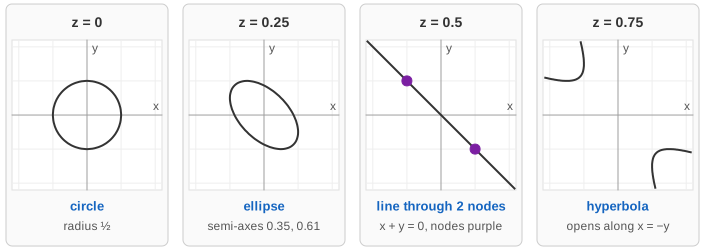
z3 never appears, and z appears in 16xyz only to the first power, so for a fixed z = h the equation is quadratic in x and y: every cut is a conic. Turn the axes by 45° with u = (x + y)/√2, v = (x − y)/√2; then xy = (u2 − v2)/2 and the cut is
(4 + 8h)u2 + (4 − 8h)v2 = k − 4h2 (k = 1 for Cayley's cubic).
| cut z = h (k = 1) | conic | on the surface |
|---|---|---|
| h = 0 | circle x2 + y2 = ¼ | the waist of the body |
| 0 < |h| < ½ | ellipse, semi-axes √(1 − 2h)/2 and √(1 + 2h)/2 | the body, flatter as |h| grows |
| h = ½ | the line x + y = 0 | the edge through (½, −½, ½) and (−½, ½, ½) |
| h = −½ | the line x = y | the edge through (−½, −½, −½) and (½, ½, −½) |
| |h| > ½ | hyperbola | two funnels |
As h grows to ½ the ellipse flattens onto the segment between two nodes, and just above ½ the hyperbola's two branches start at those same nodes. At h = ½ the inside and the outside of the cut touch at two points: the surface pinches there. (Demo 3: slide the cut z = h through two nodes)
Change k: gap, node, neck
Put any number k on the right: 4(x2 + y2 + z2) + 16xyz = k. Near a node the equation becomes 8r2 − 4a2 ≈ k − 1, the same family as the hyperboloids and the cone:
| k | near each corner | the whole surface |
|---|---|---|
| k < 1 | a gap (like a hyperboloid of two sheets) | smooth: a closed rounded tetrahedron plus four separate funnels |
| k = 1 | a node (a cone) | Cayley's nodal cubic, four nodes |
| k > 1 | a neck (like a hyperboloid of one sheet) | smooth: one piece |
The four nodes exist only at k = 1, because the gradient of g is zero only at the origin (value 0) and at the four corners (value 1). At other k the six edges are not on the surface: g is 1 along them, not k. (Demo 4: k < 1, k = 1 (nodes), k > 1)
Facts at a glance
| property | value |
|---|---|
| equation | 4(x2 + y2 + z2) + 16xyz = 1; projectively 1/x + 1/y + 1/z + 1/w = 0 |
| degree | 3 (a cubic surface) |
| nodes | 4, the most a cubic surface can have, at (−½, −½, −½), (½, ½, −½), (½, −½, ½), (−½, ½, ½) |
| near a node | a round double cone, half-angle ≈ 35.3° |
| straight lines | 9: the 6 tetrahedron edges and 3 at infinity |
| symmetry | any swap of x, y, z, and two sign changes at once; the symmetry group of the tetrahedron |
| cuts z = h | conics (4 + 8h)u2 + (4 − 8h)v2 = 1 − 4h2 |
| bounded | no: four funnels go to infinity |
See also Critical Points and Singular Points for where a gradient is zero, Level Curves and Contour Maps for slicing a surface into curves, The Plane Ax + By + Cz + D = 0 for the plane x + y + z = 0 and its normal, and Elliptic Cone for the cone at each node. The other pages on surfaces beyond quadrics are Monkey Saddle, Cubic Surface, Kummer Surface, Quartic Surface and Surfaces by Degree.
What the page leaves out
The projective picture: the plane at infinity, the three lines there, and why four nodes is the most a cubic surface can have. The 27 lines of a smooth cubic and how they merge into 9 when the nodes appear, the 11 tritangent planes, and the other singular cubics (fewer nodes, or worse singularities). Cuts by tilted planes, which are cubic curves, some with a node. Shading and hidden lines: the canvas draws the slices as a see-through wireframe.