The idea: up one way, down the other
The hyperbolic paraboloid is the surface
z = x2/a2 − y2/b2
The two squares pull in opposite directions. Walk along the x-axis and z = x2/a2 goes up on both sides. Walk along the y-axis and z = −y2/b2 goes down on both sides. The result is a saddle: a horse's saddle, a mountain pass, a Pringles chip.
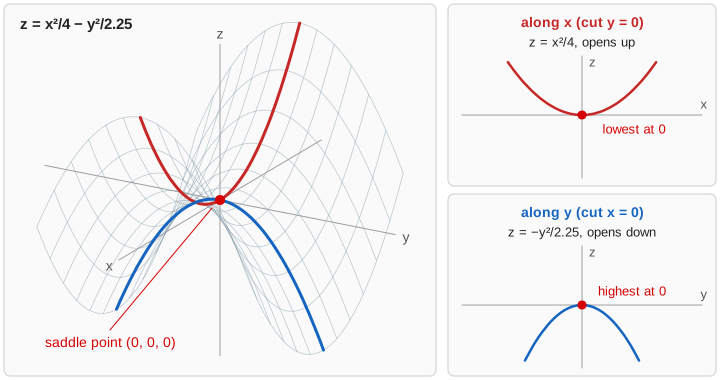
a stretches the surface along x and b along y. Unlike the other quadrics there is no c: z appears only to the first power, so the height is already set by x and y.
The saddle point
The origin is on the surface (z = 0) and the surface is flat there: the tangent plane is z = 0. But it is not a top and not a bottom.
- The cut y = 0 is z = x2/a2, a parabola opening up. Along x the origin is the lowest point.
- The cut x = 0 is z = −y2/b2, a parabola opening down. Along y the origin is the highest point.
A point where the surface is flat but is a minimum in one direction and a maximum in another is a saddle point. In calculus, f(x, y) = x2/a2 − y2/b2 has gradient 0 at the origin, and the second derivatives 2/a2 > 0 and −2/b2 < 0 have opposite signs: the second-derivative test says "saddle". In machine learning, training can stall near such points (Gradient Descent). (Demo 1: the saddle point)
Cuts z = h: the hyperbola flips
Put z = h. What is left is a curve in x and y:
x2/a2 − y2/b2 = h
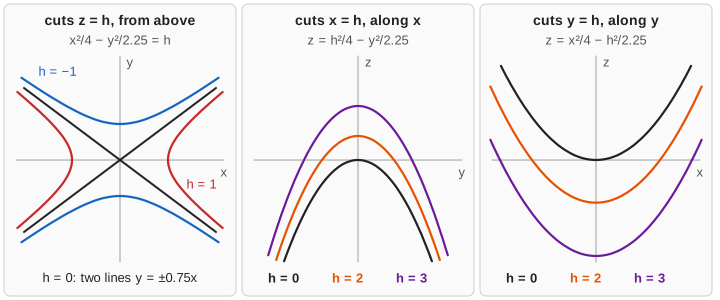
- h > 0: divide by h. x2/(a2h) − y2/(b2h) = 1 is a hyperbola opening along x (z > 0 needs |x| big).
- h = 0: x2/a2 = y2/b2, so y = ±(b/a)x, two lines crossing at the saddle point.
- h < 0: y2/(b2|h|) − x2/(a2|h|) = 1, a hyperbola opening along y.
All of them share the asymptotes y = ±(b/a)x. As h goes down to 0 the hyperbola squeezes into its own asymptotes, then comes out on the other side. These cuts are the contour lines of a mountain pass. (Demo 2: slide the cut z = h from 2 to −2)
Cuts x = h and y = h: one parabola, shifted
Put x = h: z = h2/a2 − y2/b2. In the y-z plane this is a parabola opening down. The h only adds the constant h2/a2, so every cut x = h is the same parabola, lifted to the height h2/a2. (Demo 3: cut x = h: parabolas opening down)
Put y = h: z = x2/a2 − h2/b2, the same parabola opening up each time, lowered by h2/b2. (Demo 4: cut y = h: parabolas opening up) So the saddle can be built by sliding one up-parabola along a down-parabola, keeping its vertex on it.
| cut | curve | equation |
|---|---|---|
| z = h > 0 | hyperbola, opens along x | x2/(a2h) − y2/(b2h) = 1 |
| z = 0 | two crossing lines | y = ±(b/a)x |
| z = h < 0 | hyperbola, opens along y | y2/(b2|h|) − x2/(a2|h|) = 1 |
| x = h | parabola opening down, the same for every h | z = h2/a2 − y2/b2 |
| y = h | parabola opening up, the same for every h | z = x2/a2 − h2/b2 |
Straight lines on a curved surface
The difference of two squares factors:
z = (x/a − y/b)(x/a + y/b)
Fix the first factor: x/a − y/b = t. Then z = t(x/a + y/b) is linear, and the two linear equations together are a straight line that lies entirely on the surface. Each t gives one line: the first family, written x/a − y/b = t, x/a + y/b = z/t. Fixing the other factor, x/a + y/b = t, gives z = t(x/a − y/b) and a second family.
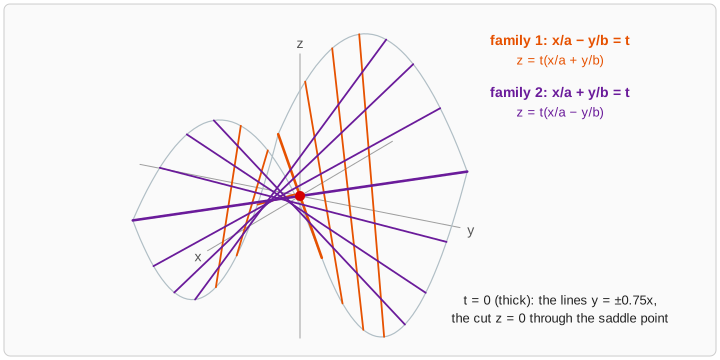
Every point of the saddle has exactly one line of each family through it, so the surface is doubly ruled. The two lines through the saddle point are the cut z = 0. This is why builders like it: a curved roof made of straight beams. The roof of the Warszawa Ochota railway station and many shell roofs by Félix Candela are hyperbolic paraboloids. The hyperboloid of one sheet is the only other doubly ruled quadric. (Demo 5: straight lines on the saddle)
Turned 45°: z = xy
Take a = b = √2, so z = (x2 − y2)/2. Turn the axes by 45°: u = (x − y)/√2, v = (x + y)/√2. Then x2 − y2 = (x − y)(x + y) = 2uv, and
z = uv
So the graph of a plain product is the same saddle, turned. In z = uv the up-and-down directions are the diagonals, and the cut z = 0 is the two axes u = 0 and v = 0. Any a = b gives z = (2/a2)uv; with a ≠ b the factored form above still writes it as a product. (Demo 6: turned 45°, it is z = uv) The same rotation of axes in the plane is on Rotate and Scale 2D.
Facts
| property | z = x2/a2 − y2/b2 |
|---|---|
| general form | x2/a2 − y2/b2 − z = 0: one square +, one −, z to the first power |
| saddle point | (0, 0, 0), tangent plane z = 0 |
| pieces, bounded? | one piece, unbounded both up and down |
| symmetry | mirror in the planes x = 0 and y = 0 |
| straight lines | two families: x/a − y/b = t, x/a + y/b = z/t and x/a + y/b = t, x/a − y/b = z/t |
| a = b = √2, turned 45° | z = uv |
See also Quadric Surfaces (all nine side by side), the bowl with the same signs, Elliptic Paraboloid, and the other doubly ruled quadric, Hyperboloid of One Sheet.
The monkey saddle z = x³ − 3xy² has three hills and three valleys instead of two, see Monkey Saddle.
What the page leaves out
Saddles that are shifted or turned in other ways (the general form with xy, x, y terms), the monkey saddle z = x3 − 3xy2 (not a quadric), the curvature of the surface (negative everywhere), and the proof that there are no other straight lines on it.