The idea: a magnet pushes sideways on a moving charge
An electric field pushes a charge along the field. A magnetic field does something stranger: it pushes only on a charge that moves, and it pushes sideways, at right angles both to the motion and to the field. This sideways push is the magnetic part of the Lorentz force. Because it is always at right angles to the motion, it bends the path into a circle without ever speeding the charge up or slowing it down.
The canvas is a simple mass spectrometer. An ion source on the left fires one particle at a time down a tube. There is no field in the tube, so it flies straight. At the slit it enters a uniform field B, turns half a circle and hits the detector plate at a distance d = 2r from the slit. Every shot leaves its track and a row in the detector readings, so you can compare them.
F = qv × B
F = q v × B |F| = |q| v B sin θθ is the angle between v and B. On the canvas v is always at right angles to B (B points into or out of the page, v lies in the page), so sin θ = 1 and F = |q|vB. For a proton at 2.0 × 10⁶ m/s in 0.10 T that is 1.6 × 10⁻¹⁹ × 2.0 × 10⁶ × 0.10 = 3.2 × 10⁻¹⁴ N. A charge moving along B feels no force at all.
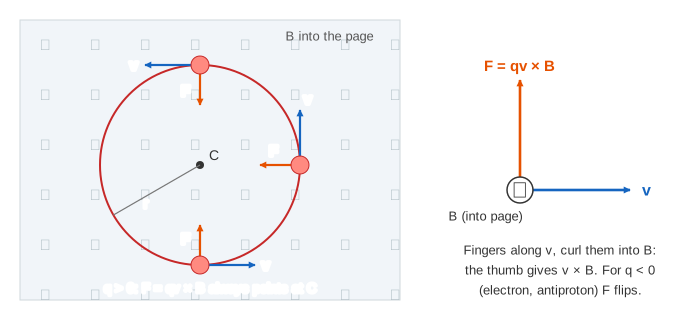
The direction comes from the cross product (see Vectors and the Dot Product for cross products): point your right-hand fingers along v, curl them towards B, and your thumb gives v × B. For a positive charge that is the direction of F; for a negative charge F points the other way. With v to the right and B into the page, v × B points up, so a proton bends up (Demo: one proton, half a circle) and an antiproton, with the same mass but charge −e, bends down by the same amount (Demo: a negative charge bends the other way). Flipping B to point out of the page flips the bend too (Demo: flip B, flip the bend).
Why the path is a circle
A force at right angles to the motion does no work (W = F · d = 0, because F ⟂ d at every moment), so the kinetic energy and the speed never change. The force has the same size |q|vB all the time and keeps turning v. That is exactly the centripetal force of a circle, so set them equal:
|q| v B = m v² / r → r = m v / (|q| B)The canvas shows the circle's centre C and draws v (blue) and F (orange) as the particle turns. At every step F points at C and v has the same length.
What sets the radius
| Change | Radius r = mv/(|q|B) | On the canvas |
|---|---|---|
| Twice the speed | twice as big | proton at 1.0 then 2.0 × 10⁶ m/s: d = 20.9 then 41.8 cm |
| Twice the field | half as big | proton in 0.10 then 0.20 T: d = 41.8 then 20.9 cm |
| Twice the mass, same charge | twice as big | deuteron: d = 83.5 cm |
| Twice the mass and twice the charge | about the same | alpha: d = 82.9 cm |
| Opposite charge | same size, other side | antiproton: 41.8 cm below the slit |
See Demo: double the speed, double the radius and Demo: double B, half the radius. The radius is also the particle's momentum divided by |q|B, so r = p/(|q|B): measuring the curve of a track in a known field is how particle detectors measure momentum.
The time for a turn does not depend on the speed
One full turn is a distance 2πr at speed v, so it takes
T = 2π r / v = 2π m / (|q| B) f = 1/T = |q| B / (2π m)The v cancels. A faster particle runs a bigger circle in exactly the same time. For a proton in 0.10 T, T = 0.66 µs, so every half circle takes 0.33 µs at either speed: compare the last column of the detector readings in Demo: double the speed, double the radius. The frequency f is the cyclotron frequency, 1.5 MHz here.
This is what makes a cyclotron work. Two hollow D-shaped electrodes ("dees") sit in a strong field with a gap between them. An AC voltage across the gap gives the particle a kick each time it crosses. Inside a dee it turns half a circle, a little bigger each time, but always in T/2, so an AC supply at the fixed frequency f stays in step all the way out.
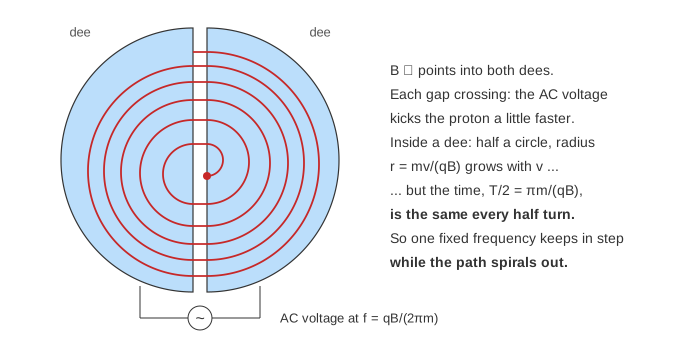
The trick breaks down near the speed of light, where the mass in r = mv/(qB) effectively grows by γ (see Special Relativity) and the particle falls behind the voltage; synchrocyclotrons and synchrotrons change the frequency or the field to keep up.
The mass spectrometer
Give every ion the same speed (real instruments use a velocity selector, crossed E and B fields that let through only v = E/B) and the landing distance d = 2mv/(|q|B) is proportional to m/q. The plate sorts ions by mass-to-charge ratio. In Demo: mass spectrometer: proton, deuteron, alpha the proton (m/q = 1.01 u/e) lands at 41.8 cm; the deuteron (2.01 u/e) and the alpha particle (4.00 u for 2e, so 2.00 u/e) land almost on top of each other, 83.5 and 82.9 cm. They are only 0.6% apart because nuclear binding energy makes the alpha a little lighter than two deuterons. Telling them apart needs a high-resolution instrument, and that same small difference is how mass spectrometers weigh binding energies and separate isotopes such as uranium-235 and 238.
Where you meet the Lorentz force
| Where | What the force does |
|---|---|
| Mass spectrometer | Sorts ions by m/q: d = 2mv/(qB) |
| Cyclotron (medical isotopes, proton therapy) | Holds particles on circles while an AC voltage speeds them up |
| Particle detectors | Curves tracks; the radius gives the momentum, the side gives the sign of q |
| Old CRT televisions | Coils steer the electron beam across the screen |
| Aurora, Van Allen belts | Earth's field makes solar-wind particles spiral along field lines towards the poles |
| Electric motor | The same force on the moving charges in a wire, F = I L × B, turns the rotor |
See also Faraday's Law, where the same q v × B on the charges in a moving wire is what drives the induced current, Maxwell's Equations for where B comes from, and Electromagnetic Waves for E and B travelling together.
What the page leaves out
The full Lorentz force is F = q(E + v × B); the page has no electric field, so no velocity selector and no accelerating voltage. The field is perfectly uniform with a sharp edge at the plate, and the motion is non-relativistic (2 × 10⁶ m/s is under 1% of c). A charge with a velocity part along B would spiral in a helix instead of a circle; on the canvas v is always at right angles to B. Electrons are left out because at these speeds and fields their circle would be under a millimetre wide: m/q is 1836 times smaller than for a proton. Radiation from the circling charge (synchrotron radiation) and collisions with gas in the chamber are ignored.
See where this page fits on the Physics & Circuits mind map.