The idea: trap the circle between two polygons
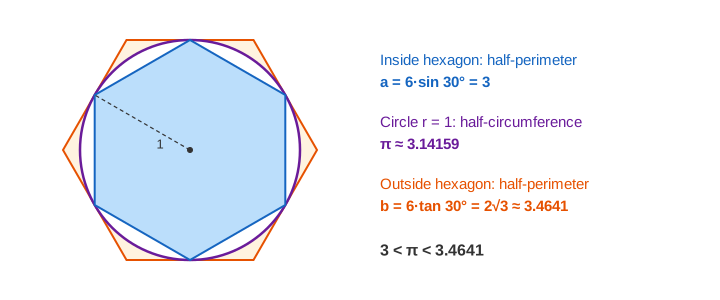
Nobody can lay a ruler along a circle, but a polygon has straight sides. Around 250 BC Archimedes put a regular polygon inside a circle, with its corners on the circle, and another one outside, with its sides touching the circle. The inside polygon is shorter than the circle and the outside one is longer, so the circle's length is trapped between two numbers he could work out. Take a circle of radius 1: half of it is π long, so half of each perimeter gives a bound on π.
One side: sin against tan
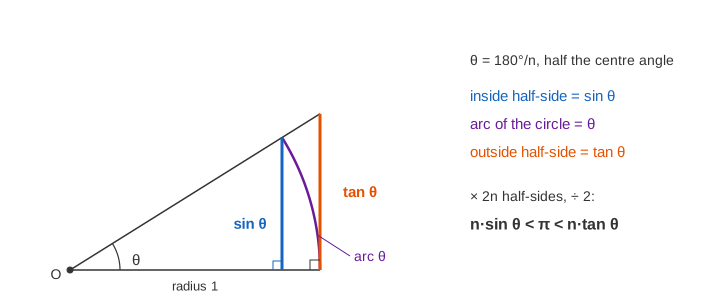
Cut a regular n-gon into n slices from the centre. Each slice has the angle 360°/n at the centre; halve it to get θ = 180°/n. For the inside polygon, half a side is sin θ. For the outside polygon, half a side is tan θ, because it stands on the radius at a right angle. Adding up the 2n half-sides and halving:
a = n·sin(180°/n) < π < n·tan(180°/n) = b.
This is the same as sin θ < θ < tan θ, the inequality that also gives sin x / x → 1 on the L'Hôpital's Rule page and appears as areas on Proofs Without Words. On the canvas one side of each polygon is red when it is drawn. (Demo: hexagon gives 3 < π < 2√3)
Doubling the sides
Press Double n and every arc is cut in half. The new points do two jobs. The inside polygon bends out to them, so each side becomes two shorter sides that together are longer: the inside perimeter grows. The tangent line at each new point cuts a corner off the outside polygon: the outside perimeter shrinks. Both stay on their side of the circle, so the bracket only gets tighter.
Archimedes had no sine table. He worked from the two numbers he already had. With a and b for n sides, the values for 2n sides are
| New value | Formula | Name | 6 → 12 |
|---|---|---|---|
| outside b′ | 2ab / (a + b) | harmonic mean of a and b | 3.21539 |
| inside a′ | √(a · b′) | geometric mean of a and b′ | 3.10583 |
Only adding, multiplying, dividing and square roots. Archimedes did the square roots by hand with fractions, always rounding the inside value down and the outside value up so the bounds stayed true. On the canvas each formula appears under the table and flies into the new row. (Demo: Archimedes, hexagon → 96 sides)
How fast the bracket closes
For a small angle, sin θ ≈ θ − θ³/6 and tan θ ≈ θ + θ³/3. So the inside value is short of π by about π³/(6n²) and the outside value is over by about twice that. Both errors fall like 1/n²: each doubling makes the gap about 4 times smaller, which the gap ÷ column shows.
| n | inside a | outside b | gap b − a | gap ÷ |
|---|---|---|---|---|
| 6 | 3.00000 | 3.46410 | 0.46410 | — |
| 12 | 3.10583 | 3.21539 | 0.10956 | 4.24 |
| 24 | 3.13263 | 3.15966 | 0.02703 | 4.05 |
| 48 | 3.13935 | 3.14609 | 0.00674 | 4.01 |
| 96 | 3.14103 | 3.14271 | 0.00168 | 4.00 |
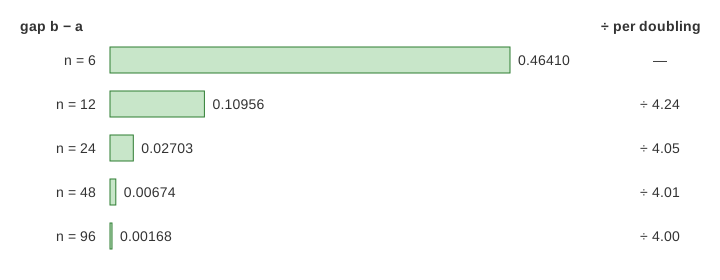
Two number lines on the canvas show the bracket [a, b] around π: the whole view, and a zoom ×20 that only catches the bracket from 24 sides on. A start from a square or a pentagon is further away at first, but the same factor 4 takes over after a doubling or two. (Demo: the gap shrinks 4× per doubling; Demo: start from a square, 4 → 128; Demo: pentagon, 5 → 80)
Archimedes' 96-gon and later records
Archimedes stopped at 96 sides and wrote the bounds as fractions: 3 10/71 < π < 3 1/7, that is 3.14085 < π < 3.14286. His fractions are a little wider than the exact 96-gon values because he rounded safely at every square root. 22/7 is still a common school value for π. Liu Hui in China ran the same doubling to 3072 sides, Zu Chongzhi found 3.1415926 < π < 3.1415927 in the 5th century, and Ludolph van Ceulen spent years on polygons with 2⁶² sides to get 35 digits. After that, infinite series were far faster.
For a way to estimate π with random dots instead of polygons, see Monte Carlo π: there the error shrinks only like 1/√n. Measuring a curve with chords in general is on Arc Length, and sin and tan as lengths on the Unit Circle page.
What the page leaves out
Archimedes' own fractions and his hand-rounded square roots (such as 265/153 < √3 < 1351/780); the areas of the polygons, which trap π the same way; the proof that the inside perimeter always grows and the outside one always shrinks; Richardson extrapolation, which combines two rows to cancel the 1/n² error; and the infinite series and algorithms that later computed π to trillions of digits.