The idea: a point on a rolling wheel
Paint a dot on the rim of a bicycle wheel and ride along a straight road. Seen from the side, the dot does not go round in a circle: it traces a row of arches, touching the road once per turn. That curve is the cycloid. It is the classic first parametric curve: there is no neat y = f(x), but x and y are both simple functions of one number t, the angle the wheel has turned.
The formula, in two moves
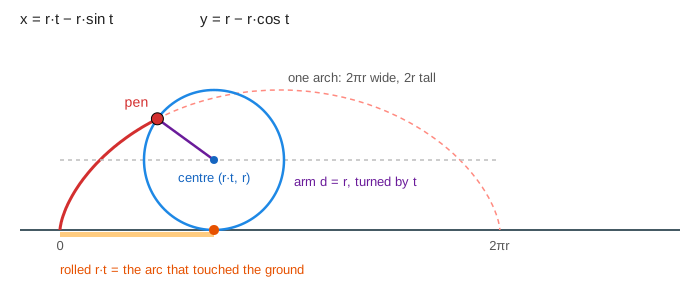
Two things happen at once. The wheel slides: because it rolls without slipping, after turning by t radians its centre has moved the arc length r·t, so the centre is at (r·t, r). And the wheel spins: the pen started straight below the centre, and its arm has turned clockwise by t. Add the two:
centre:  (r·t, r)          arm:  (−d·sin t, −d·cos t)
pen:     x(t) = r·t − d·sin t        y(t) = r − d·cos t

pen on the rim (d = r):   x = r(t − sin t)    y = r(1 − cos t)
d is the distance from the centre to the pen. With d = r this is the cycloid. (Demo: roll two turns, pen on the rim.) The same "centre plus a turning arm" idea on a circle instead of a line gives the curves on Spirograph: Hypotrochoids and Epitrochoids; the arm itself is the unit circle point (sin t, cos t) scaled by d.
One arch: 2πr wide, 2r tall, 8r long
One turn of the wheel (t from 0 to 2π) draws one arch, from one touch of the ground to the next.
| quantity | value | why |
|---|---|---|
| width | 2πr ≈ 6.28r | one turn rolls out one circumference |
| height | 2r | at t = π the pen is at the top of the wheel |
| arc length | 8r | ∫ 2r·sin(t/2) dt from 0 to 2π |
| area under it | 3πr² | three times the wheel itself |
The length is a nice surprise: a whole number of radii, 8r, although the base is the irrational 2π·r. Christopher Wren found it in 1658. The area, three wheels, was found by Roberval and by Galileo, who is said to have weighed paper cut-outs. (Demo: one arch.) How a curve's length comes from its speed is on Arc Length.
Speed and the cusp
Differentiate: x′ = r − d·cos t, y′ = d·sin t, so the pen's speed is v·√(1 + h² − 2h·cos t), where v is the speed of the centre and h = d/r. On the rim this is 2v·|sin(t/2)|:
- at the ground (t = 0, 2π, …) the speed is 0. The point of the wheel touching the road is not moving at all, which is what rolling without slipping means. The curve comes in vertically, stops and leaves vertically: a cusp.
- at the top (t = π) the speed is 2v: the top of a car's tyre moves twice as fast as the car.
The "pen speed" row of the canvas shows this number at every frame.
Pen inside or past the rim: trochoids
Move the pen and the same formula gives a trochoid. Inside the rim (d < r) the pen never reaches the ground and never stops: a smooth curtate wave. Past the rim (d > r), like the flange of a train wheel, the pen dips below the rail at the bottom and moves backwards there, at v·(h − 1): a prolate curve with loops. So a train always has some point moving backwards.
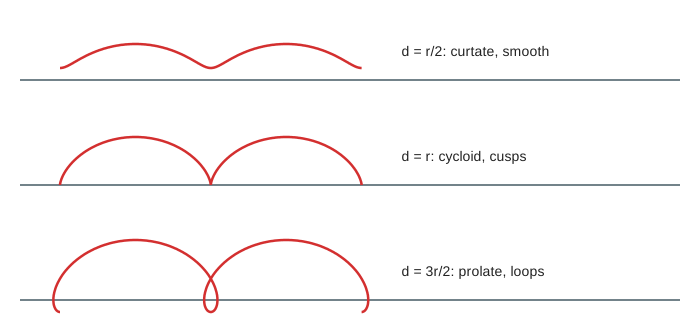
| pen | curve | lowest y | slowest speed | length of 2 turns |
|---|---|---|---|---|
| d = r/2 | curtate trochoid | 0.5r | 0.5v | 13.36r |
| d = r | cycloid | 0 | 0 (cusp) | 16r |
| d = 3r/2 | prolate trochoid | −0.5r | 0.5v backwards | 21.01r |
(Demo: pen inside the rim, Demo: pen past the rim.)
Upside down: the fastest slide
In 1696 Johann Bernoulli asked: a bead slides without friction from A down to a lower point B. Which shape of wire gets it there fastest? Not the straight line, though it is shortest. The answer, found by Bernoulli, Newton, Leibniz and l'Hôpital, is an upside-down cycloid: the brachistochrone ("shortest time"). It drops steeply at first, so the bead gains speed early, and speed √(2g·depth) is what pays for the longer path.
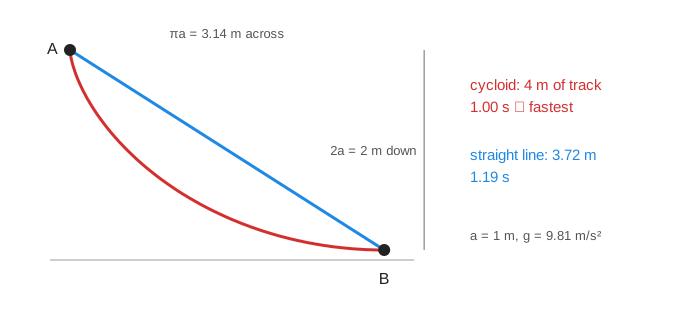
With a generating radius a = 1 m and g = 9.81 m/s², A is the cusp and B the bottom, πa across and 2a down. On the cycloid the angle grows at a constant rate, θ = t·√(g/a), so the bead is at B after π√(a/g) = 1.003 s. The straight line has length √(π² + 4)·a = 3.72 m and takes 1.189 s. (Demo: brachistochrone.)
Same time from anywhere: the tautochrone
Let a bead go from rest anywhere on the upside-down cycloid: it reaches the bottom in the same time, π√(a/g), whatever the start. Measure s, the distance along the track to the bottom; on a cycloid s = 4a·cos(θ/2), and the pull of gravity along the track is exactly (g/4a)·s. A pull proportional to the distance is a perfect spring, so s(t) = s₀·cos(t·½√(g/a)): a higher start just scales the swing, it does not change its timing. That is the tautochrone ("same time"), found by Christiaan Huygens in 1659. (Demo: tautochrone.)
A circle does not do this: an ordinary pendulum swings a little slower when it swings wider (see Simple Pendulum). Huygens built a clock whose string wraps between two cycloid-shaped cheeks, so the bob moves on a cycloid and keeps the same time at any amplitude.
What the page leaves out
The calculus of variations that proves the brachistochrone is fastest, Bernoulli's light-refraction argument, friction and the bead's rolling, end points B that are not at the bottom of the arch, the cycloid's evolute (another cycloid, the reason Huygens' cheeks work), and wheels rolling on curves (see Spirograph). The pen distance takes three values, r/2, r and 3r/2.