The idea: four ways to find the centre of a triangle
A circle has one centre. A triangle has several, and each answers a different question. Draw three lines of the same kind, one from each corner or side, and they always meet in one point. The page uses the triangle A = (0, 0), B = (14, 0), C = (5, 12), with sides 13, 14 and 15 and area 84, and lets you move C to other positions.
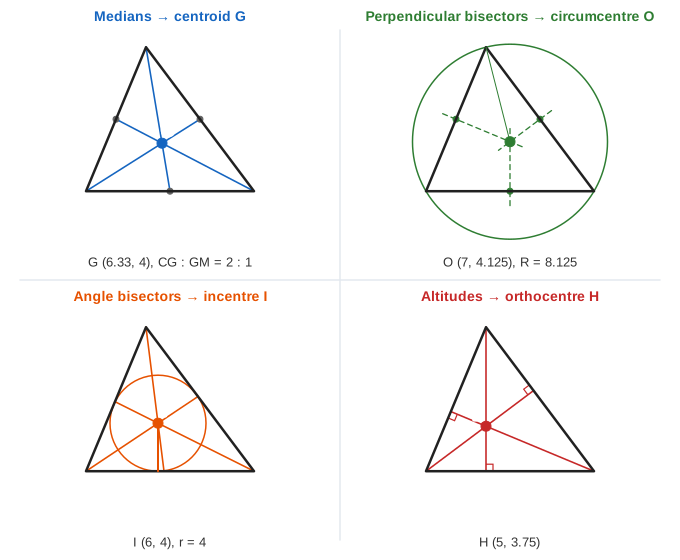
| centre | three lines | what is special about it | 13-14-15 triangle |
|---|---|---|---|
| centroid G | medians: corner → midpoint of the opposite side | balance point; cuts each median 2 : 1 | (6.33, 4) |
| circumcentre O | perpendicular bisectors of the sides | same distance R from the three corners | (7, 4.125), R = 8.125 |
| incentre I | angle bisectors | same distance r from the three sides | (6, 4), r = 4 |
| orthocentre H | altitudes: corner → opposite side at 90° | on the Euler line with O and G | (5, 3.75) |
Centroid: where the medians meet
A median joins a corner to the midpoint of the opposite side. The three medians meet at the centroid G, and G sits two thirds of the way along each median from the corner: the median from C to M = (7, 0) is 12.17 long, with CG = 8.11 and GM = 4.06 (Demo: medians meet at the centroid).
G is simply the average of the corners: ((0 + 14 + 5)/3, (0 + 0 + 12)/3) = (6.33, 4). That is why it is the balance point of a cardboard triangle, and why the "centroid" of a cluster in k-means is the average of its points. The three medians also cut the triangle into six small triangles of equal area (84 / 6 = 14 each).
Circumcentre: equally far from the corners
The points that are as far from A as from B form a line: the perpendicular bisector of AB, which crosses AB at its midpoint at 90°. Where the bisectors of AB and BC cross, a point is equally far from A, B and C, so it is on the third bisector too. That point is the circumcentre O, and the circle with centre O through the three corners is the circumscribed circle. Its radius is R = abc / (4 · area) = 15 · 13 · 14 / 336 = 8.125 (Demo: circumcentre and its circle).
Incentre: equally far from the sides
The points that are as far from side AB as from side AC lie on the angle bisector at A. The three angle bisectors meet at the incentre I, the same distance r from all three sides, so the circle with centre I and radius r touches each side once: the inscribed circle. Cutting the triangle into three triangles IAB, IBC, ICA, all of height r, gives area = r · s, where s is half the perimeter, so r = 84 / 21 = 4 (Demo: incentre and its circle). Unlike the other three, I is always inside the triangle.
Orthocentre: where the altitudes meet
An altitude goes from a corner to the opposite side, meeting it at 90°. The foot of the altitude is the projection of the corner onto that side (see vectors and dot product). The three altitudes meet at the orthocentre H = (5, 3.75). In vector form H = A + B + C − 2O (Demo: altitudes meet at the orthocentre).
The Euler line
In 1765 Euler showed that O, G and H always lie on one line, with G between them and GH = 2 · OG. For C = (2, 12): O = (7, 5), G = (5.33, 4), H = (2, 2), OG = 1.94 and GH = 3.89. Move C and the line turns, but the ratio stays 1 : 2 (Demo: Euler line while C moves).
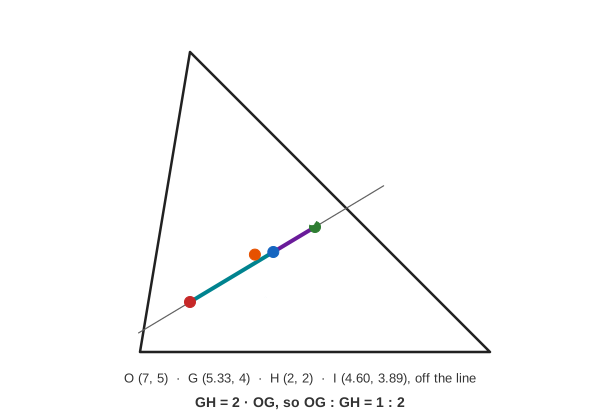
Why it works: join the midpoints of the sides to get a smaller triangle. It is the big triangle turned half a turn about G and shrunk to half. Its altitudes are the perpendicular bisectors of the big triangle, so its orthocentre is O. Shrinking by ½ about G takes H to O, so O is on the line HG on the other side of G, half as far. The incentre I is in general not on this line.
Right, obtuse, isosceles, equilateral
With A and B fixed and C moving along the line y = 12, the area stays 84, so G slides along y = 4 and O along the bisector x = 7. The shape decides where the centres are:
| triangle | O | H | on the page |
|---|---|---|---|
| acute | inside | inside | C = (5, 12) |
| right angle at A | midpoint of the hypotenuse BC | at A | C = (0, 12): O = (7, 6), R = BC/2 = 9.22 |
| obtuse at A | outside, beyond BC | outside, beyond A | C = (−2, 12): O = (7, 7.33), H = (−2, −2.67) |
| isosceles | all four centres on the axis of symmetry | C = (7, 12): all on x = 7 | |
| equilateral | all four centres are the same point | C = (7, 7√3): (7, 4.04), R = 2r | |
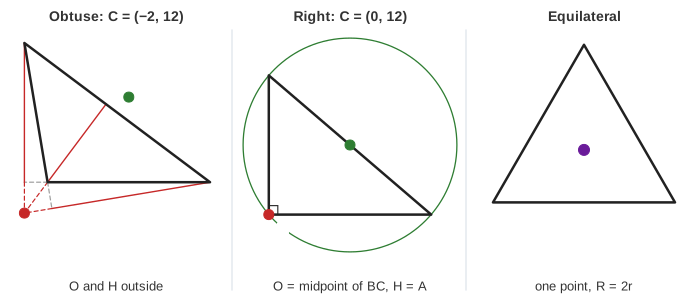
The right-angle case is Thales' theorem: the hypotenuse is a diameter of the circumscribed circle (see the Pythagorean theorem). In the obtuse case the altitudes from B and C land on the sides extended past A, and only the extended altitudes meet (Demos: right triangle, obtuse triangle, isosceles then equilateral).
What the page leaves out
The nine-point circle: its centre is the midpoint of OH, its radius is R/2, and it passes through the three side midpoints, the three feet of the altitudes and the midpoints of AH, BH, CH. Euler's formula OI² = R² − 2Rr, which gives R ≥ 2r with equality only for an equilateral triangle. The three excentres, the Fermat point and the many other centres (Kimberling's encyclopedia lists tens of thousands). Proofs that the lines meet (Ceva's theorem), barycentric coordinates, and dragging the corners freely. For more on shapes made from points, see convex hull; for angles and circles, the unit circle and proofs without words.