The idea: stretch one axis, squash the other by the same factor
A squeeze mapping pulls the plane longer in one direction and makes it thinner in the other by exactly the same factor. With factor k it moves each point (x, y) to (k·x, y/k): x is stretched by k and y is squashed by 1/k. Think of a ball of dough rolled out: it gets longer and thinner, but there is just as much of it.
On the canvas only the first quadrant is drawn, where the hyperbolas live. The grey grid is where the points were before the change and the blue grid is where they are now. The light-blue lines in the unit square are its "cards", the orange F shows the shape getting wider and flatter, and the purple curves are the hyperbolas xy = 1, 2 and 4. They never move (Demo: stretch 2, squash ½: area stays 1).
The matrix: where î and ĵ land
The columns of the matrix are where î = (1, 0) and ĵ = (0, 1) land. î is stretched to (k, 0) and ĵ is squashed to (0, 1/k), so
It is a scaling matrix [a 0; 0 b] with the special choice b = 1/a. Row times column: with k = 2 and v = (2, 1), row 1 gives 2·2 + 0·1 = 4 and row 2 gives 0·2 + ½·1 = ½, so v lands at (4, ½). The point panel works this out for the vector you pick.
Area stays, the shape changes: det = 1
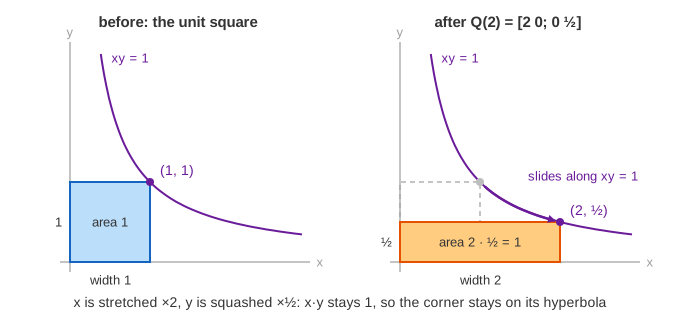
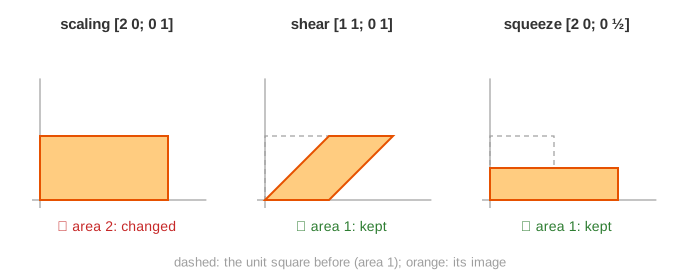
The unit square becomes a rectangle k wide and 1/k tall. Its area is k · 1/k = 1, the same as before, and the determinant says the same for every shape: det Q(k) = k · 1/k − 0 · 0 = 1. It is positive, so nothing is flipped. But the shape is not kept: a square becomes a long thin rectangle and a circle becomes an ellipse. The table compares the three kinds of map that act along the axes or slide them.
| Map | Matrix | det (area factor) | Eigen-directions |
|---|---|---|---|
| scaling | [a 0; 0 b] | a·b: area changes | both axes (λ = a, b) |
| shear | [1 k; 0 1] | 1: area kept | only the x-axis (λ = 1 twice) |
| squeeze | [k 0; 0 1/k] | 1: area kept | both axes (λ = k, 1/k) |
Every point rides its own hyperbola
Multiply the new coordinates: (k·x) · (y/k) = x·y. The product x·y never changes, so a point on the hyperbola xy = c stays on it. The curve as a whole does not move; its points slide along it. Bigger k pushes them out toward the x-axis, k < 1 pushes them up toward the y-axis. The corner (1, 1) of the unit square rides xy = 1 and the grid corner (2, 2) rides xy = 4.
The canvas splits each change of k into steps of at most a factor √2 (k = 1, ≈ 1.41, 2), so you can watch the points follow the curves instead of cutting straight across. In the middle frame v = (2, 1) is at about (2.83, 0.71), and 2.83 · 0.71 ≈ 2 (Demo: points ride their hyperbola: (2, 1) → (4, ½) → (1, 2), all on xy = 2). With k < 1 the roles swap: Q(⅓) squashes x and stretches y, and (2, 1) lands at (⅔, 3) (Demo: k < 1 squashes x instead).
The axes are the eigenvectors
Q(k) is already a diagonal matrix, so its eigenvectors are î and ĵ: det(Q − λI) = (k − λ)(1/k − λ) = 0 gives λ = k on the x-axis and λ = 1/k on the y-axis. Their product is det = 1. Every other direction turns toward the stretched axis: (2, 2) goes to (4, 1) under Q(2) (Demo: eigenvectors: the axes). Unlike a shear, which keeps area but has only one eigen-direction, a squeeze has two, and in any basis it is the diagonal matrix of the diagonalization P Q(k) P−1.
Squeezes multiply: the hyperbolic angle adds
To undo a squeeze, squeeze back: Q(k)−1 = Q(1/k), which multiplies x by 1/k and y by k (Demo: undo with 1/k). Two squeezes in a row multiply their factors (Demo: squeezes multiply: 2 then 3/2 = 3):
So squeezes commute, and with logarithms the product becomes a sum: ln 2 + ln 3/2 = ln 3. The number u = ln k is the hyperbolic angle: writing k = eu, Q(eu)·Q(ew) = Q(eu + w), just like two rotations add their angles. The hyperbolic angle also measures area: the region between the hyperbola xy = 1, the line to (1, 1) and the line to (k, 1/k) has area ln k. Chaining maps like this is the topic of Composing Transforms and Matrix Multiplication; the inverse in general is on Inverse Matrix.
Turned 45°: a Lorentz boost
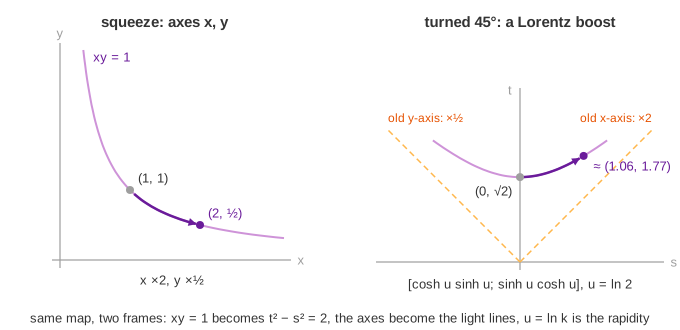
Look at the squeeze in a frame turned by 45°, where the old axes become the diagonals. Then the hyperbolas xy = c become t² − s² = 2c, and the matrix becomes
That is the Lorentz boost of special relativity in one space dimension, with time t, position s and the speed of light 1. The diagonals (the light rays s = ±t) are the squeeze's axes, stretched by k and squashed by 1/k (the Doppler factor), and the hyperbolic angle u is the rapidity. Rapidities add when you change frames twice, exactly as the factors of two squeezes multiply.
See also the overview Linear Transformations (columns, change of basis, singular maps) and the other basic transforms: Scaling Matrix, Shear Matrix, Rotation Matrix, plus Determinant, Eigenvectors and Diagonalization.
What the page leaves out
Only the first quadrant is drawn: the map keeps every quadrant, and the other three are mirror images (the hyperbolas xy = c with c < 0 sit in the second and fourth). k stays between ¼ and 4 so the grid fits the panel; a negative k (a squeeze times a half-turn) is not shown. Squeezes along other pairs of lines (P Q(k) P−1), the full Lorentz group with more space dimensions, and squeeze mappings in other fields (the area-preserving flows of mechanics, squeezed states of light, the scale invariance of ∫ dx/x behind logarithms) are only named here.