The idea: undoing sin has too many answers
sin takes an angle and gives a number: sin 30° = 1/2. An inverse should go back: given 1/2, return the angle. The trouble is that many angles give 1/2. On the graph, the line y = 1/2 crosses y = sin θ at π/6, 5π/6, and again every 2π, forever.
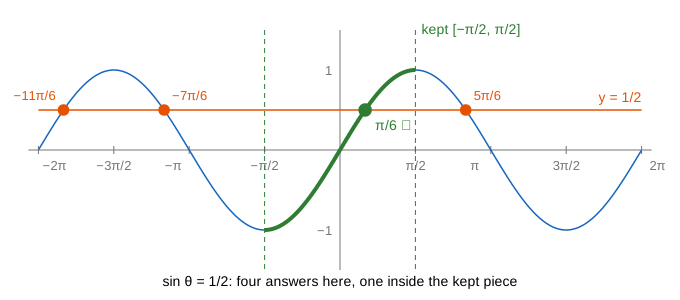
A function must give one output for each input, so "the angle whose sine is 1/2" has to pick one of them. Every calculator picks the same one, π/6 = 30°, because of one agreed rule: keep a single piece of the graph (Demo: sin θ = 1/2, many angles, arcsin picks one).
The horizontal line test
A function can be undone only if no value comes out twice. On a graph that means every horizontal line meets it at most once: the horizontal line test. sin, cos and tan are periodic, so they fail it badly; each horizontal line between −1 and 1 meets the sine wave infinitely often.
Restrict the domain: keep one piece
So we cut the function down to an interval where it takes every value exactly once, and undo only that piece. The interval chosen for each function is the range of its inverse:
| Function | Kept piece (range of the inverse) | On the unit circle | Domain of the inverse |
|---|---|---|---|
| sin θ → arcsin x | [−π/2, π/2] | right half | −1 ≤ x ≤ 1 |
| cos θ → arccos x | [0, π] | upper half | −1 ≤ x ≤ 1 |
| tan θ → arctan x | (−π/2, π/2) | right half, no ends | every x |
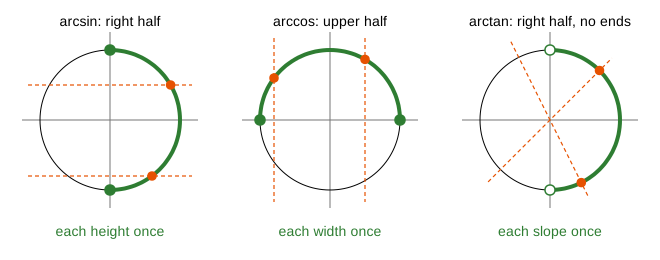
Why these pieces? They contain 0 (or start at 0 for cos), they are as simple as possible, and on each one the function rises or falls without turning back. The answers have signs you can read off the circle: arcsin and arctan of a negative number are negative angles below the x-axis, arcsin(−1/2) = −π/6 (Demo: arcsin(−1/2) is negative). arccos never gives a negative angle; a negative x lands in the second quadrant, arccos(−1/2) = 2π/3 = 120° (Demo: cos θ = −1/2, arccos lives in [0, π]).
sin and cos never leave [−1, 1], so arcsin 2 and arccos 2 do not exist: the line y = 2 misses the circle and the graph (Demo: sin θ = 2 has no answer). tan reaches every number, so arctan takes any input (Demo: tan θ = 1, arctan).
Flip across y = x
Undoing a function swaps input and output: the point (x, y) on y = sin x becomes (y, x). Swapping coordinates is a mirror across the line y = x. Mirror the whole sine wave and you get a sideways wave that a vertical line meets several times, so it is not a function. Mirror only the kept piece and you get the graph of y = arcsin x (Demo: flip sin into arcsin).
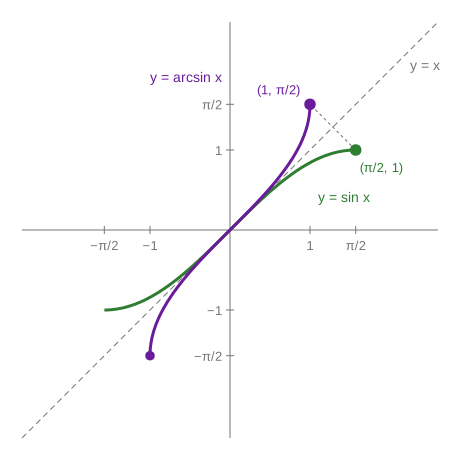
The mirror swaps domain and range, which is why arcsin is defined only for −1 ≤ x ≤ 1 and returns values in [−π/2, π/2]. For tan the vertical asymptotes x = ±π/2 turn into the horizontal asymptotes y = ±π/2 of arctan: arctan x creeps towards π/2 as x grows but never reaches it (Demo: flip tan, asymptotes turn flat).
arcsin(sin θ) is not always θ
Going there and back works one way round only:
- sin(arcsin x) = x for every x in [−1, 1]: arcsin finds an angle with sine x, so its sine is x.
- arcsin(sin θ) = θ only when θ is in [−π/2, π/2]. Otherwise arcsin returns the kept angle with the same sine: sin 150° = 1/2, and arcsin(1/2) = 30°, not 150° (Demo: arcsin(sin 150°) = 30°, not 150°).
To get every solution of sin θ = v, start from θ₀ = arcsin v and add the other one in the same turn and the period: θ = θ₀ + 2kπ or π − θ₀ + 2kπ. For cos it is θ = ±θ₀ + 2kπ, for tan θ = θ₀ + kπ. The Numbers panel shows these after each solve.
Notation: sin⁻¹ x is not 1/sin x
arcsin x is also written sin⁻¹ x, the name on calculator keys. Here the −1 means "inverse function", not a power: sin⁻¹ x is not 1/sin x (that one is csc x). The name "arc" comes from the unit circle: arcsin x is the length of the arc, the angle in radians, whose sine is x.
See also The Unit Circle: sin, cos, tan for the functions being undone, Tangent Graphs for the asymptotes of tan, Function Composition for f(g(x)) and inverses in general, Polar Coordinates where θ = atan2(y, x) picks the right quadrant, and Right Triangle Trigonometry where arcsin and arctan turn side lengths back into angles.
What the page leaves out
The other three inverses arcsec, arccsc and arccot (whose ranges books do not agree on); atan2(y, x), which uses the signs of both coordinates to return an angle in (−π, π]; the derivatives d/dx arcsin x = 1/√(1 − x²) and d/dx arctan x = 1/(1 + x²); inverse functions of complex numbers; and the identity arcsin x + arccos x = π/2, which you can see on the flip graphs but which is not proved here.