The idea: a hyperbola slid along z
The hyperbolic cylinder is the surface
x2/a2 − y2/b2 = 1
in 3D. The letter z is missing. So a point (x, y, z) is on the surface exactly when (x, y) is on the hyperbola x2/a2 − y2/b2 = 1, whatever z is. Take the hyperbola in the floor z = 0 and slide it straight up and down: that is the whole surface.
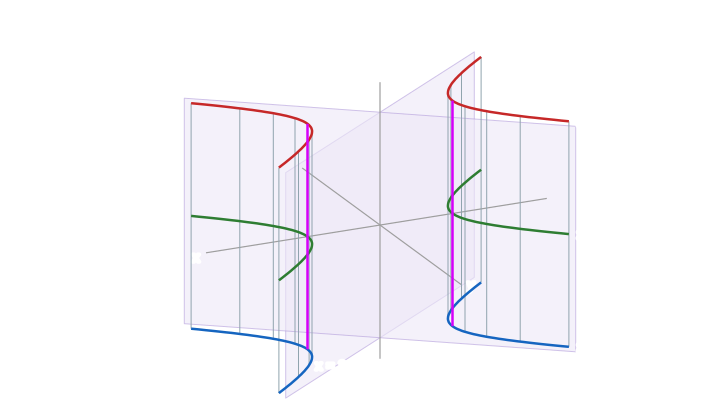
Every point of the hyperbola gives a whole vertical line on the surface, called a ruling. The surface is made of these straight lines, which is why it is called a cylinder, even though it is not round. (Demo 1: slide the hyperbola along z)
Two walls, nothing between
Write the equation as x2/a2 = 1 + y2/b2. The right side is at least 1, so x2 ≥ a2: every point has x ≥ a or x ≤ −a. The surface is two separate curved walls, one on each side, and the slab −a < x < a is empty. Each wall comes closest to the z-axis along the vertical line x = ±a, y = 0. (Demo 5: a and b reshape the walls)
The cut z = h: the same hyperbola every time
Put z = h into the equation. Nothing happens, because there is no z to replace. Every level cut is the same hyperbola x2/a2 − y2/b2 = 1, just at a different height. (Demo 2: slide the cut z = h, nothing changes)
The asymptotic planes y = ±(b/a)x
Far from the origin the 1 on the right hardly matters, and the equation is almost x2/a2 = y2/b2, that is y = ±(b/a)x. In 2D those are the asymptotes of the hyperbola. In 3D, with z free, they become two vertical asymptotic planes through the z-axis. The walls get closer and closer to them but never touch. The slope b/a decides how fast the walls open: b/a > 1 gives steep planes and wide walls, b/a < 1 flat planes and narrow walls, and a = b gives planes at right angles. (Demo 4: the asymptotic planes y = ±(b/a)x)
Upright cuts x = h and y = h: lines
The planes x = h and y = h stand upright, parallel to the z-axis like the rulings. So they can only meet the walls in vertical lines.
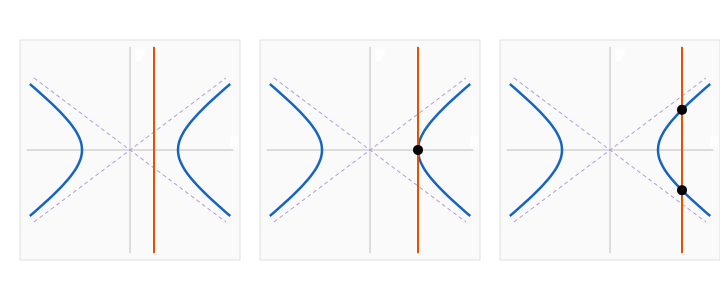
- x = h: y2/b2 = h2/a2 − 1. For |h| < a the right side is negative: nothing, the plane passes between the walls. At |h| = a it is 0: one line y = 0, the edge of a wall. For |h| > a: two parallel lines y = ±b√(h2/a2 − 1). (Demo 3: cut x = h: none → one line → two lines)
- y = h: x2/a2 = 1 + h2/b2, always positive: always two lines x = ±a√(1 + h2/b2), one on each wall.
| cut | equation left | what you get |
|---|---|---|
| z = h | x2/a2 − y2/b2 = 1 | the same hyperbola for every h |
| x = h, |h| < a | y2/b2 = negative | nothing |
| x = h, |h| = a | y2 = 0 | one line y = 0 |
| x = h, |h| > a | y2/b2 = h2/a2 − 1 | two lines y = ±b√(h2/a2 − 1) |
| y = h | x2/a2 = 1 + h2/b2 | two lines x = ±a√(1 + h2/b2) |
Swapping the signs turns the walls
In −x2/a2 + y2/b2 = 1 the minus sign sits on x instead. Now y2 ≥ b2, so the walls are y ≥ b and y ≤ −b: the same kind of surface turned 90° about the z-axis. The asymptotic planes y = ±(b/a)x do not change, and the roles of the two upright cuts swap: y = h can miss, x = h always gives two lines. The variable with the plus sign names the axis the walls open along. (Demo 6: swap the signs, the walls turn 90°)
Facts
| property | x2/a2 − y2/b2 = 1 |
|---|---|
| pieces | two walls, x ≥ a and x ≤ −a |
| closest lines to the axis | x = ±a, y = 0 (any z) |
| asymptotic planes | y = ±(b/a)x |
| bounded | no |
| ruled | yes: vertical lines |
| general form | (1/a2)x2 − (1/b2)y2 − 1 = 0, no z at all |
See also Quadric Surfaces (all nine shapes on one page), Elliptic Cylinder (the same idea with an ellipse: one round tube) and Hyperbolic Paraboloid (the saddle, whose level cuts are these hyperbolas, but changing with h).
What the page leaves out
Tilted cuts (a slanted plane cuts a hyperbola or two lines), a hyperbolic cylinder along another axis (x missing or y missing), shifted or rotated versions with xy and linear terms, and the parabolic cylinder y = ax2, the third kind of quadric cylinder.