The idea: a map of the classes and how they know each other
A class diagram is a picture of the code's structure. Each class is a box. Each line between two boxes says how the two classes are tied together: one keeps a field of the other, one extends the other, or one only uses the other for a moment. The diagram does not show what happens when the program runs; a sequence diagram does that.
The canvas has a small shop with eight classes. Their boxes are there from the start; the lines are not. Pick a relationship and press Show: the Java code that makes it appears at the bottom left, the key piece of code flies to the class that holds it, and the line grows between the two boxes. The panel at the bottom right is the running program, with real objects. Drop removes a reference there, so you can see what each kind of line means for an object's life.
Reading a class box
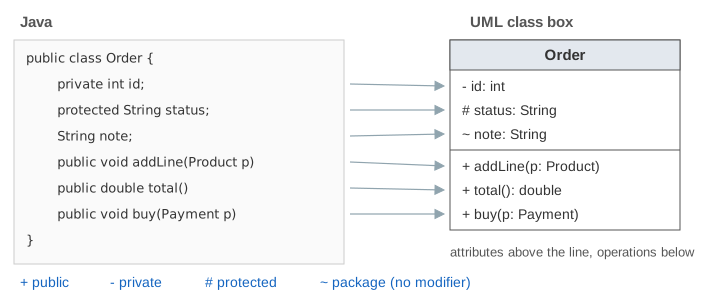
The box has three compartments: the class name, the attributes (fields) and the operations (methods). UML writes the name first and the type after a colon, the other way round from Java: - id: int for private int id. Method bodies are never shown. Demo 1: a class box, visibility + - # ~.
| Sign | Visibility | Java | Who can use it |
|---|---|---|---|
+ | public | public | every class |
- | private | private | only the class itself |
# | protected | protected | the class and its subclasses (in Java also its package) |
~ | package | no modifier | classes in the same package |
An interface gets the word «interface» above its name, like Shippable. An abstract class gets {abstract} (or its name in italics), like Payment. In the Order box, 3 attributes are private, protected and package, and all 4 operations are public. Private fields and public methods is the usual shape: encapsulation you can see at a glance.
Association, multiplicity and navigability
An association is a field that keeps a reference to another class. Customer has List<Order> orders and Order has Customer customer, so a solid line joins the two boxes. When both sides keep a field, the line has no arrowhead. When only one side does, an open arrowhead points to the class that is known: OrderLine has a Product field, Product has nothing back, so the arrow points to Product. That is navigability. Demo 2: association and multiplicity.
The small numbers at the ends are the multiplicity. Read them across the line: the number next to a class says how many objects of that class one object at the other end is linked to. Next to Order it says 0..*: one customer has any number of orders. Next to Customer it says 1: one order has exactly one customer. The field's type usually tells you: a single field is 1 (or 0..1 if it can be null), a list is 0..*.
| Multiplicity | Means | Typical Java |
|---|---|---|
1 | exactly one | a field set in the constructor, never null |
0..1 | none or one | a field that may be null |
0..* (or *) | any number | List<T> that may be empty |
1..* | at least one | a list that is never empty (a rule in the code) |
Aggregation and composition: who owns the parts
Both are associations between a whole and its parts. The diamond sits at the whole.
- Aggregation, a hollow diamond: the whole holds parts that were made elsewhere and can be shared.
Catalog.add(Product p)takes a product someone else made, and one product can be in many catalogs (0..*at both ends). - Composition, a filled diamond: the whole makes its parts and never hands them out.
Order.addLine(p)doesnew OrderLine(p)and keeps it in a private list. A line belongs to exactly one order: the multiplicity next toOrderis1. Demo 3: aggregation vs composition.
The real difference is lifetime. Java has no delete: an object lives while something the program can still reach points at it, and the garbage collector takes the rest. In the objects panel, main() holds c1 and cat. c1.removeOrder(1) drops the only reference to o1. Nothing else points at l1 and l2, because only the order ever had them, so they go with it: 3 objects are collected and 4 of 7 stay alive. The products stay, because the catalog still holds them. Demo 6: drop the Order, its lines go too.
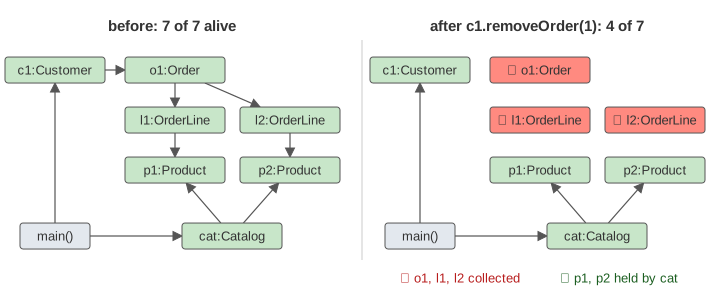
cat = null drops the catalog instead. Only cat is collected (6 of 7 alive): p1 and p2 are still reached through the order's lines. That is what the hollow diamond allows: the parts do not depend on the whole. Demo 7: drop the Catalog, products live on. If you drop both, the products go too, because nothing holds them any more. A Java object never dies "with" its whole by magic; composition is a promise in the design that no one else keeps a reference to the part.
Generalization and realization
Generalization is extends: a solid line with a hollow triangle at the parent. CardPayment extends Payment, so a card payment is a payment and gets amount from it. Realization is implements: the same triangle on a dashed line. Order implements Shippable, so Order must have weight(). Neither line has multiplicities: they tie classes together, not objects. Demo 4: generalization and realization. Whether to use inheritance at all is a design question; Inheritance vs Composition plays it out.
Dependency: used, not kept
A dependency is a dashed line with an open arrow. Order.buy(Payment p) uses a payment that comes in as a parameter and keeps no field of it. If Payment changes, Order may have to change too, but an Order object does not hold a Payment. It is the weakest line. Parameters, local variables and calls to static methods give dependencies. Demo 5: dependency, a parameter not a field.
From a line of Java to the right UML line
To draw a class diagram from code, look at each class and ask a few questions in order. The figure is the same check as a flow.
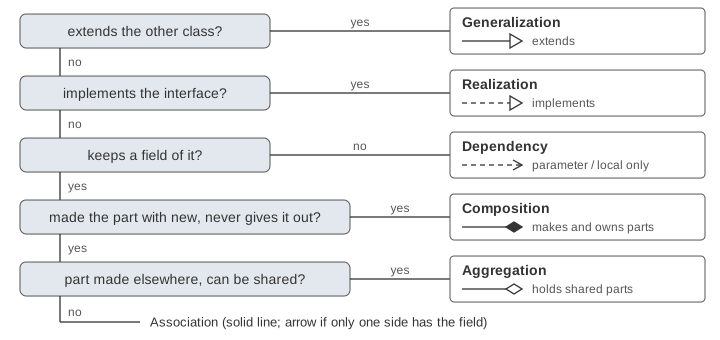
| Line | Drawn as | Java on the canvas |
|---|---|---|
| Association | solid line, multiplicity at both ends | List<Order> orders / Customer customer |
| Directed association | solid line, open arrow | Product product in OrderLine only |
| Aggregation | hollow diamond at the whole | List<Product> products + add(Product p) |
| Composition | filled diamond at the whole | lines.add(new OrderLine(p)) |
| Generalization | solid line, hollow triangle | class CardPayment extends Payment |
| Realization | dashed line, hollow triangle | class Order implements Shippable |
| Dependency | dashed line, open arrow | void buy(Payment p) { p.pay(); } |
The whole shop has 7 lines and 8 multiplicity labels: the four associations (plain, directed, aggregation, composition) carry two each, the other three carry none. Demo 8: the whole diagram, 7 lines. Few lines and few boxes with many lines is what low coupling looks like on paper. Design rules such as "depend on an interface, not a class" are easy to check on the diagram: see SOLID.
See also UML state machine and activity diagrams for how one object of a class changes state over its life, and how a process flows across swimlanes.
What the page leaves out
Static members (underlined in UML), default values and constraints in braces such as {ordered}, role names and association names on the lines, association classes, qualified associations, n-ary associations with a diamond in the middle, generic (template) classes, enumerations, nested classes and packages. Object diagrams underline the object names (o1:Order); the panel does not. UML 2 does not define the meaning of aggregation precisely, so teams use it differently, and some leave it out. The objects panel uses plain Java reachability: a real collector runs later and decides itself when to free the memory, see Java garbage collection. State and activity diagrams are on another page.