The idea: many disks that look like one
A RAID (redundant array of independent disks) takes several disks and
shows the operating system one bigger disk. On Linux the md driver does it
in software; a hardware RAID card does the same in firmware. The level
decides where each logical block goes: spread over the disks for speed, copied for
safety, or protected by a parity block that can rebuild any one lost block.
The page uses 4 disks with 4 rows each, and 4-bit blocks so you can do the XOR by eye.
RAID 0: striping
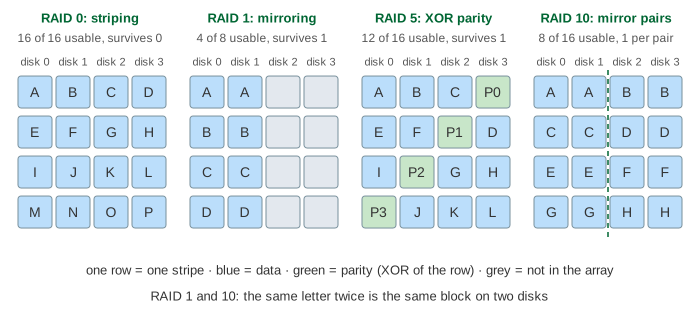
Striping puts block A on disk 0, B on disk 1, C on disk 2, D on disk 3, then starts the next row, the next stripe. A large read keeps all four disks busy at once, and all the capacity is usable. But nothing is stored twice: when one disk dies, every fourth block is gone, and so is nearly every file. Four disks fail four times as often as one. (Demo: RAID 0 striping, then a disk dies)
RAID 1 and RAID 10: mirroring
RAID 1 writes every block to two disks. A read can come from either copy; a write costs two disk writes. When a disk dies, the other copy serves everything, and the rebuild simply copies the survivor onto the new disk. (Demo: RAID 1 mirror survives a failure)
RAID 10 stripes across mirror pairs: disks 0 + 1 are one pair, disks 2 + 3 another. It survives one dead disk in each pair, but not two in the same pair. (Demo: RAID 10 loses one disk per pair)
RAID 5: XOR parity that rotates
RAID 5 gives up one block per stripe to parity:
P = A ⊕ B ⊕ C, the bitwise XOR. XOR has two handy properties: x ⊕ x = 0,
and all four blocks of a stripe XOR to 0000. So any one missing block is the XOR
of the other three, whether it held data or parity.
The parity block rotates: stripe 0 keeps it on disk 3, stripe 1 on disk 2, and so on. Otherwise one disk would take the parity write of every write in the array. The page uses Linux md's default left-symmetric layout, where the data of a stripe starts on the disk right after its parity.
Losing a disk: degraded mode and rebuild
When one disk dies the array is degraded, not down. A read of a block on the dead disk reads the other 3 blocks of its stripe and XORs them: 3 reads instead of 1. A new disk is then rebuilt stripe by stripe, which reads every block of every surviving disk. On real multi-terabyte disks that takes hours, and a second failure (or one unreadable sector) during that time loses data. That is why large arrays use RAID 6, which keeps two independent parity blocks per stripe; its second parity is not a plain XOR but Reed-Solomon arithmetic, shown on Reed-Solomon Erasure Coding. (Demo: RAID 5 disk failure, degraded read, rebuild)
The small-write penalty
Writing one block on RAID 5 also changes its stripe's parity. Reading the whole stripe would
be costly, so md uses read-modify-write: read the old data and the old
parity, compute P' = P ⊕ D ⊕ D' (XOR-ing the old data takes it out of the
parity, XOR-ing the new data puts it in), then write the new data and the new parity.
One logical write costs 4 disk I/Os. (Demo: RAID 5 small write = 4 disk I/Os)
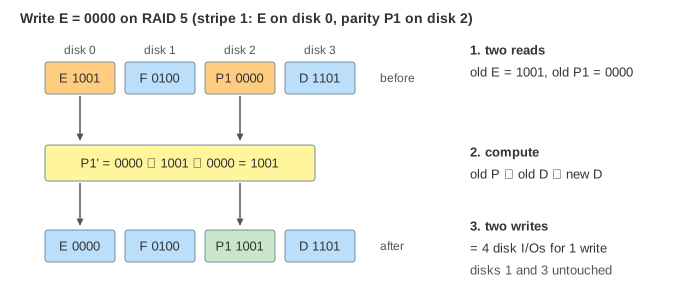
A full-stripe write (all 3 data blocks at once) avoids the reads: the parity is computed from the new data alone. That is why RAID 5 is fine for large sequential writes and slow for small random ones, such as a database's.
| level | usable (4 disks) | survives | disk I/Os per small write |
|---|---|---|---|
| RAID 0 | 100% | no failure | 1 |
| RAID 1 | 50% | 1 disk | 2 |
| RAID 10 | 50% | 1 disk per pair | 2 |
| RAID 5 | 75% | 1 disk | 4 (2 reads + 2 writes) |
| RAID 6 | 50% | any 2 disks | 6 (3 reads + 3 writes) |
The write hole
The data write and the parity write go to two different disks, and they don't land at the same instant. If the power fails between them, the stripe's parity no longer matches its data. Nothing looks wrong: every block reads back fine. The damage shows only later, when a disk dies and md rebuilds a block from that stale parity: the result is wrong, and nothing reports it. This is the write hole. (Demo: RAID 5 write hole)
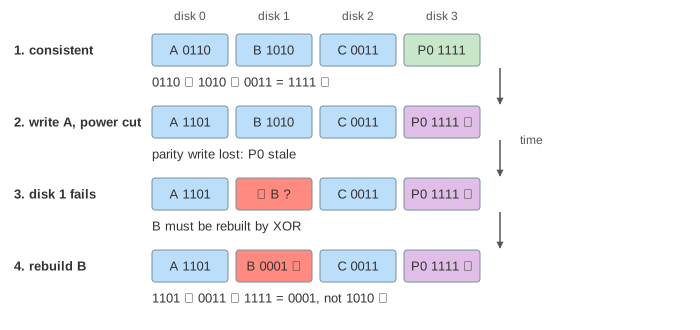
The fixes all make the two writes atomic or recoverable: a battery-backed cache on a hardware RAID card, a resync of every stripe after an unclean shutdown (md's write-intent bitmap limits it to recently written regions), md's journal device or partial parity log, or a copy-on-write file system such as ZFS RAID-Z that never overwrites a stripe in place. A mirror has a milder form of the same problem: after a crash the two copies can disagree.
For how a single disk serves these reads and writes, see How a Hard Disk Reads and Writes Data and How an SSD Reads and Writes Data.
What the page leaves out
Real arrays use chunks of 64–512 KiB, not single blocks, and many more stripes. md also
chooses between read-modify-write and reconstruct-write (read the other data blocks
instead) by which needs fewer reads, keeps a stripe cache, can use hot spares that start
rebuilding on their own, runs periodic scrubs (check) that find stale parity
and bad sectors before a disk fails, and lets you grow or reshape an array. RAID 6's second
parity, nested levels like RAID 50 and 60, and the rebuild speed limits are left out too.
References
Linux kernel documentation: RAID arrays (md)
Patterson, Gibson and Katz (1988): A Case for Redundant Arrays of Inexpensive Disks (RAID)
Operating Systems: Three Easy Pieces, chapter 38: Redundant Arrays of Inexpensive Disks
Linux kernel documentation: Partial Parity Log (RAID 5 write hole)