The idea: two players, one choice, a bad outcome
Two players each choose, at the same time and without talking, to cooperate (C) or defect (D). The points each one gets depend on both choices. The page uses the classic numbers from Axelrod's tournaments: T = 5 (temptation: I defect, you cooperate), R = 3 (reward: we both cooperate), P = 1 (punishment: we both defect) and S = 0 (sucker's payoff: I cooperate, you defect).
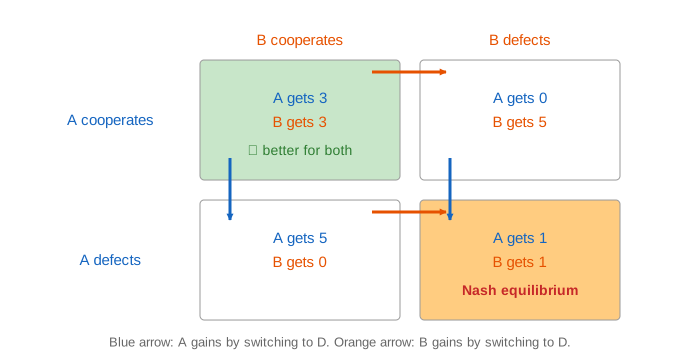
The game is a dilemma because of the order T > R > P > S. Each player does better by defecting, whatever the other does. But when both follow that reasoning, both get 1 instead of 3. The name comes from a story of two suspects questioned in separate rooms: each is offered a lighter sentence for betraying the other.
Pick strategies for A and B and press Play Round to see one round in detail: each choice flies to its row or column, the cell lights up and the points fly back. Play 10 Rounds plays faster. Each square in the match history shows the move and the points it got.
Best responses and the Nash equilibrium
A best response is the move that pays most against a given move of the other player. If B cooperates, A gets 3 for C and 5 for D, so D is best. If B defects, A gets 0 for C and 1 for D, so D is best again. A move that is best whatever the other does is a dominant strategy (Demo 1).
A Nash equilibrium is a pair of moves where each move is a best response to the other: nobody gains by changing alone. Here the only one is (D, D). It is not Pareto efficient: (C, C) is better for both players. That gap between what is good for each player and what is good for the group is the whole point of the game.
| Cell | A gets | B gets | Can one player gain by switching? |
|---|---|---|---|
| (C, C) | 3 | 3 | Yes: either one gets 5 by defecting |
| (C, D) | 0 | 5 | Yes: A gets 1 by defecting |
| (D, C) | 5 | 0 | Yes: B gets 1 by defecting |
| (D, D) | 1 | 1 | No: this is the Nash equilibrium |
Where it shows up
- Cartels: OPEC members agree on output quotas to keep the price high. Each member earns more by quietly pumping above its quota, and if all do, the price falls for everyone.
- Price wars: two shops would both earn more at a high price, but each wins customers by undercutting the other. Compare the single-market view in Supply and Demand.
- Advertising and arms races: each side spends to keep up with the other; if both stopped, both would save.
- Shared resources: overfishing and emissions are the many-player version, the tragedy of the commons.
Repeated games: the shadow of the future
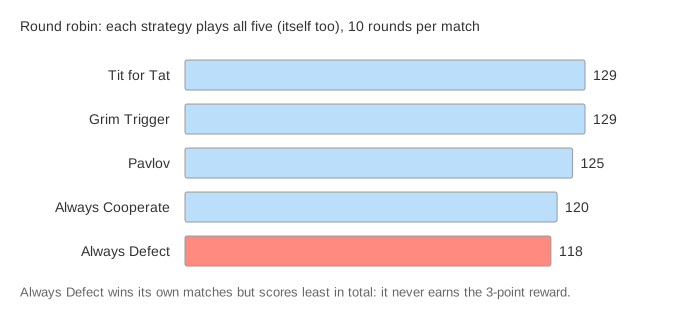
Real competitors meet again and again. In a repeated game, today's defection can be punished tomorrow, so cooperating can pay. Tit for Tat cooperates first and then copies the other player's last move. Two Tit for Tats cooperate in every round and get 30 points each in 10 rounds (Demo 3). Against Always Defect, Tit for Tat is exploited only once, then defects back: 9 against 14 (Demo 4). Always Cooperate gets nothing against Always Defect: 0 against 50 (Demo 2).
Grim Trigger cooperates until the other player defects once, then defects forever. Against Random it cooperates for three rounds, sees the first D, and never forgives: 29 against 14 (Demo 5). If the game continues after each round with probability δ, Grim Trigger keeps cooperation stable when δ ≥ (T − R) / (T − P) = 2 / 4 = 0.5: the 2 points gained by defecting once are worth less than the 2 points lost in every later round. If both players know the exact last round, defecting in it is safe, and by working backward cooperation unravels from the start. That is why the page never tells the strategies when the match ends.
In 1980 Robert Axelrod ran a computer tournament of strategies sent in by game theorists. Tit for Tat, the shortest program, won. The winners were nice (never defect first), retaliating (punish a defection) and forgiving (go back to C when the other does).
Mistakes and forgiveness
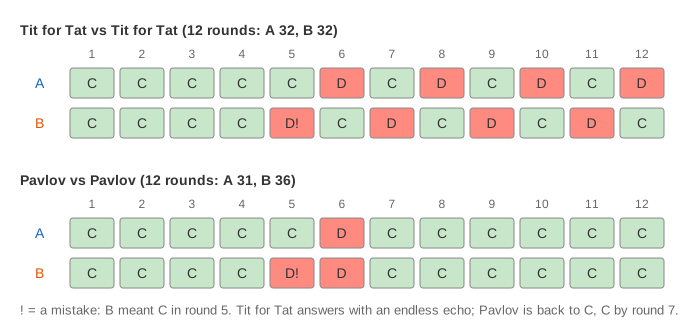
Real players make mistakes: a misread signal, a late shipment that looks like a price cut. The noise setting in Options flips each intended move with a small probability. With 5% mistakes, B's move in round 5 is flipped to D. Tit for Tat answers with D, the other answers that, and the two fall into an echo: C and D alternate for the rest of the match, about 2.5 points a round each instead of 3 (Demo 6). Grim Trigger is worse: one mistake ends cooperation for good.
Pavlov (win-stay, lose-shift) repeats its last move after a good result (3 or 5 points) and switches after a bad one (0 or 1). After the same mistake, the cheated player switches to D, the cheater stays at D, both get 1, and both switch back to C: cooperation returns two rounds later (Demo 7).
| Strategy | Nice | Retaliates | Forgives | After one mistake |
|---|---|---|---|---|
| Always Cooperate | yes | no | yes | keeps cooperating, easy to exploit |
| Always Defect | no | yes | no | no cooperation to lose |
| Tit for Tat | yes | yes | yes | echo of C and D |
| Grim Trigger | yes | yes | no | D forever |
| Pavlov | yes | yes | yes | back to C after one round of D, D |
See also Minimax for games where one player's gain is the other's loss (zero-sum), Stable Matching for another kind of equilibrium where no pair wants to switch, and Multi-Armed Bandit for learning which choice pays by trying them.
What the page leaves out
Mixed strategies and games with more than one equilibrium (chicken, stag hunt); many-player versions such as the public goods game; the full proof of the folk theorem; evolutionary dynamics where strategies spread by their scores; other strategies such as Generous Tit for Tat and zero-determinant strategies; and how real cartels detect cheating.