The idea: bend a flat rectangle onto the surface
An equation like x2/9 + y2/4 + z2/4 = 1 says which points are on a surface, but it does not tell you how to visit them. A parametrization does: a map r(u, v) = (x(u, v), y(u, v), z(u, v)) that sends each point of a flat rectangle of (u, v) values to one point of the surface. The rows of the rectangle (v fixed) become one family of curves on the surface, the u-curves; the columns (u fixed) become the other, the v-curves. On the canvas both grids use the same height colours, so a row of the rectangle has the colour of its ring.
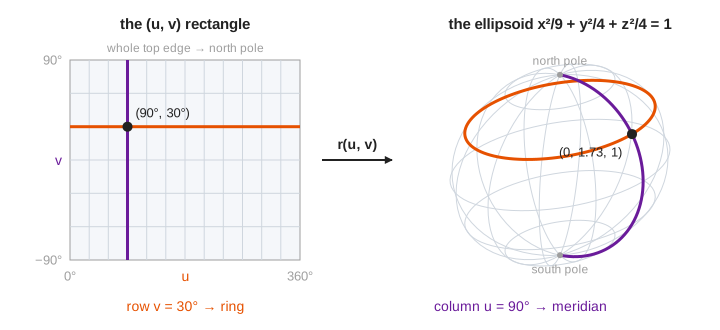
For every quadric round the z-axis the angle u does the same job: (cos u, sin u) goes once round a circle as u runs from 0° to 360°, so each row closes into a ring. The only question is what to multiply it by and what height to give it, and that is where the right identity comes in. (Demo 1: ellipsoid from cos and sin)
Ellipsoid: cos and sin, because cos² + sin² = 1
Use v as a latitude from −90° to 90°:
r(u, v) = (a cos v cos u, b cos v sin u, c sin v)
Plug it into x2/a2 + y2/b2 + z2/c2: the a, b, c cancel and you get cos2v cos2u + cos2v sin2u + sin2v = cos2v + sin2v = 1 for every u and v. That identity is the proof that every r(u, v) lies on the ellipsoid. On the page a = 3, b = 2, c = 2; at (u, v) = (90°, 30°) the map gives r = (0, 1.73, 1), and 0 + 0.75 + 0.25 = 1.
Hyperboloids: cosh and sinh, because cosh² − sinh² = 1
The hyperboloid of one sheet x2/a2 + y2/b2 − z2/c2 = 1 has a minus sign, so cos and sin no longer fit. The hyperbolic functions cosh v = (ev + e−v)/2 and sinh v = (ev − e−v)/2 satisfy cosh2v − sinh2v = 1, the same identity with the sign flipped. Just as (cos t, sin t) runs round the circle x2 + y2 = 1, (cosh t, sinh t) runs along the hyperbola x2 − y2 = 1.
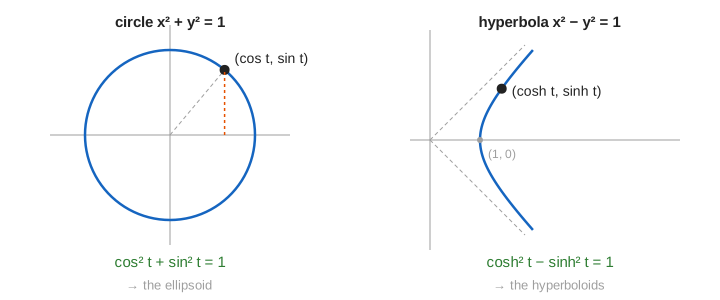
So the ring radius grows like cosh v and the height like sinh v: r = (a cosh v cos u, b cosh v sin u, c sinh v), and x2/a2 + y2/b2 − z2/c2 = cosh2v − sinh2v = 1. At v = 0 the ring is the waist (radius a). (Demo 2: hyperboloid of one sheet: cosh and sinh)
The hyperboloid of two sheets z2/c2 − x2/a2 − y2/b2 = 1 swaps the roles: the height is cosh v and the radius sinh v, r = (a sinh v cos u, b sinh v sin u, ±c cosh v) with v ≥ 0. cosh v is never below 1, so |z| ≥ c: the gap between the sheets. One rectangle cannot cover two separate pieces with one smooth map, so each sheet gets its own patch, the + one and the − one; the canvas stacks them in the rectangle with a gap. (Demo 3: two sheets: one patch each, ±c cosh v)
Cone and paraboloid: no special function
When the right side is 0 or the height is a plain function, the radius can just be v. The cone x2/a2 + y2/b2 = z2/c2 is (a v cos u, b v sin u, c v), and the paraboloid z = x2/a2 + y2/b2 is (a v cos u, b v sin u, v2). Both check with cos2u + sin2u = 1 alone. (Demo 6: paraboloid: the height is v²)
| surface | r(u, v) | identity used |
|---|---|---|
| ellipsoid | (a cos v cos u, b cos v sin u, c sin v) | cos² + sin² = 1 |
| hyperboloid, one sheet | (a cosh v cos u, b cosh v sin u, c sinh v) | cosh² − sinh² = 1 |
| hyperboloid, two sheets | (a sinh v cos u, b sinh v sin u, ±c cosh v) | cosh² − sinh² = 1 |
| cone | (a v cos u, b v sin u, c v) | cos² + sin² = 1 |
| elliptic paraboloid | (a v cos u, b v sin u, v²) | cos² + sin² = 1 |
Tangents rᵤ, rᵥ, the normal and the area factor
Differentiate the map. rᵤ = ∂r/∂u is the velocity along the u-curve and rᵥ = ∂r/∂v along the v-curve; both lie in the tangent plane, so their cross product rᵤ × rᵥ is a normal. A tiny du × dv patch of the rectangle becomes a tiny parallelogram with sides rᵤ du and rᵥ dv, whose area is |rᵤ × rᵥ| du dv. That is why parametric forms are needed: surface area is ∬ |rᵤ × rᵥ| du dv, and a surface integral is ∬ f(r(u, v)) |rᵤ × rᵥ| du dv. (The page measures u and v in radians for the derivatives.) For a sphere of radius R, |rᵤ × rᵥ| = R2 cos v, and integrating gives 4πR2.
| point | rᵤ | rᵥ | |rᵤ × rᵥ| |
|---|---|---|---|
| ellipsoid (90°, 30°) | (−2.6, 0, 0) | (0, −1, 1.73) | 5.2 |
| one sheet (45°, 0.5) | (−1.59, 1.59, 0) | (0.74, 0.74, 2.26) | 5.6 |
| two sheets (30°, 0.8), top | (−0.89, 1.54, 0) | (2.32, 1.34, 1.78) | 5.7 |
| cone (60°, 1) | (−1.73, 1, 0) | (1, 1.73, 2) | 5.66 |
| paraboloid (240°, 1.5) | (2.6, −1.5, 0) | (−1, −1.73, 3) | 10.82 |
When rᵤ × rᵥ = 0
At the ellipsoid's poles (v = ±90°) the whole top row of the rectangle is squeezed to one point, so moving u does not move the point: rᵤ = 0 and rᵤ × rᵥ = 0. The same happens at the vertex of the paraboloid and of each sheet of the two-sheet hyperboloid (v = 0). This is a fault of the map, not of the surface: the surface is smooth there and has the tangent plane z = constant. At the cone's apex rᵤ × rᵥ = 0 too, but there the surface has a real tip: no tangent plane exists, however you parametrize it. (Demo 4: the pole: rᵤ = 0 but the surface is smooth, Demo 5: cone apex: a real tip)
| point | rᵤ × rᵥ | surface there |
|---|---|---|
| ellipsoid pole (0°, 90°) | 0 | smooth, plane z = 2 |
| two-sheet vertex (0°, 0) | 0 | smooth, plane z = 2 |
| paraboloid vertex (0°, 0) | 0 | smooth, plane z = 0 |
| cone apex (0°, 0) | 0 | a tip: no tangent plane |
| one-sheet waist (0°, 0) | (4, 0, 0), length 4 | smooth, no fault |
See also
Quadric Surfaces shows the whole family from its equations, with separate pages for the ellipsoid, the hyperboloid of one sheet, the hyperboloid of two sheets, the cone and the paraboloid. Surfaces of Revolution spins a curve round the z-axis, which is the u of this page. The normal from the equation instead of the map is on Tangent Plane to a Quadric; the cross product itself on Cross Product, and cos and sin on the unit circle.
What the page leaves out
The saddle z = x2/a2 − y2/b2 (simplest as the graph (a u, b v, u2 − v2), or (a v cosh u, b v sinh u, v2) on the part |x/a| > |y/b|), cylinders, quadrics not centred on the axes (shift and rotate the map), the rational parametrizations that avoid trig functions, the two families of straight lines on the one-sheet hyperboloid, and the actual integrals for surface area: the ellipsoid's area has no elementary formula.