The idea: a recurrence is a tree of costs
A divide-and-conquer algorithm splits its input, calls itself on the parts and then does some work of its own to split or combine. Its running time is written as a recurrence: T(n) = a·T(n/b) + f(n). Read it as a picture. Draw the first call as a box. It makes a calls, each on an input b times smaller, so it gets a children. Each child does the same, down to inputs of size 1. That picture is the recursion tree. Write each box's own work f(size) next to it, add up each level, and add up the levels. The sum is T(n).
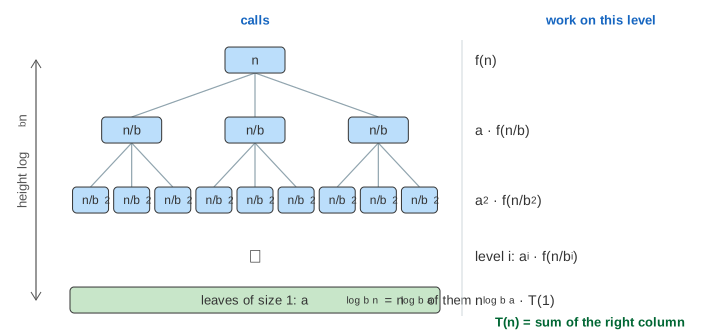
Reading a, b and f(n)
- a is the number of recursive calls per call: the number of children of each box.
- b is how much smaller each call's input is: the size drops from n to n/b to n/b² as you go down.
- f(n) is the work a call does outside its recursive calls: merging in merge sort, one comparison in binary search.
The size reaches 1 after logb n halvings, so the tree has logb n + 1 levels. The canvas uses n = 16 and b = 2: levels 0 to 4.
Sum the work per level
Level i has ai calls, each on size n/bi, so the level costs ai · f(n/bi). The bottom level has alogb n = nlogb a leaves, each costing T(1). When f(n) = nk, each level costs exactly r = a / bk times the level above. So T(n) is a geometric series with ratio r, and the shape of that series decides the answer (Demo: merge sort, every level equal).
The three cases of the master theorem
Compare k with the critical exponent logb a. It is the same test as r against 1.
| Case | Test | Level sums | T(n) |
|---|---|---|---|
| 1 | k < logb a (r > 1) | grow toward the leaves | Θ(nlogb a): the leaves dominate |
| 2 | k = logb a (r = 1) | all the same | Θ(nk log n): one level's work times the height |
| 3 | k > logb a (r < 1) | shrink toward the leaves | Θ(f(n)): the root dominates |
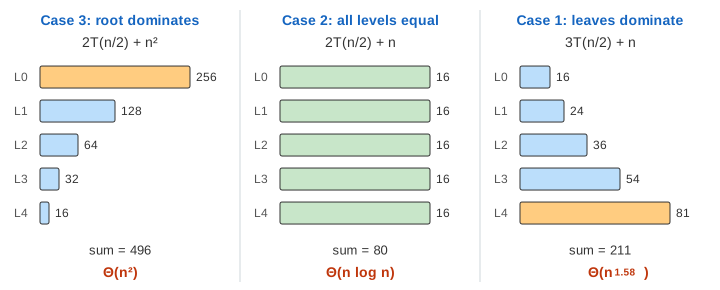
In a geometric series with r ≠ 1 the biggest term is a constant fraction of the whole, so only the biggest level counts. With r = 1 nothing shrinks, and all log n + 1 levels count. On the canvas, 3T(n/2) + n sums to 211, and its leaf level alone is 81 (Demo: 3T(n/2)+n, the leaves dominate). 2T(n/2) + n² sums to 496, less than twice its root's 256 (Demo: 2T(n/2)+n², the root dominates).
Worked examples
| Algorithm | Recurrence | k vs logb a | T(n) |
|---|---|---|---|
| Binary search | T(n/2) + 1 | 0 = log₂ 1 | Θ(log n), case 2 |
| Merge sort | 2T(n/2) + n | 1 = log₂ 2 | Θ(n log n), case 2 |
| Karatsuba multiplication | 3T(n/2) + n | 1 < log₂ 3 ≈ 1.58 | Θ(n1.58), case 1 |
| Block matrix multiply, 8 products | 8T(n/2) + n² | 2 < log₂ 8 = 3 | Θ(n³), case 1 |
| Strassen, 7 products | 7T(n/2) + n² | 2 < log₂ 7 ≈ 2.81 | Θ(n2.81), case 1 |
| Quickselect with a good pivot | T(n/2) + n | 1 > log₂ 1 = 0 | Θ(n), case 3 |
Binary search is the thinnest tree: one call per level, each doing one comparison, so the sum is just the height (Demo: binary search, one call per level). Strassen's trick is all in case 1: one fewer product per call lowers a from 8 to 7, and with it the exponent of the leaf count.
When the theorem does not apply, the tree still works
The master theorem needs equal-size calls, a fixed a ≥ 1 and b > 1. T(n) = T(n−1) + n (insertion sort, a bad quicksort pivot) shrinks by subtraction, not division: its tree is a path of n levels costing n, n−1, …, 1, which sums to Θ(n²). T(n) = T(n/3) + T(2n/3) + n has unequal parts, but each full level still costs at most n and the longest path has log3/2 n levels, so T(n) = Θ(n log n). The general form of the theorem for f(n) that is not a power of n also needs a regularity condition in case 3, and has a gap: 2T(n/2) + n/log n fits none of the three cases.
See also Quick Sort vs Merge Sort (the merge sort tree at work), Searching a Sorted List (binary search), Big-O Growth Race (how n log n, n1.58 and n² compare), Plain Recursion vs Memoization vs Tabulation (a recursion tree with repeated subtrees) and Tail Calls and Tail-Call Optimization (the call stack of one path through the tree).
Karatsuba multiplication is case 1 with a = 3, b = 2: three half-size products give O(n^1.585).
The closest pair of points algorithm has the merge-sort recurrence T(n) = 2T(n/2) + O(n): linear strip work on each of log n levels.
What a Θ bound means, with c₁, c₂ and n₀ drawn as curves around f(n): see Big-O, Omega, Theta.
What the page leaves out
The canvas fixes n = 16, b = 2, T(1) = 1 and f(n) = nk with constant 1, so every level sum is exact. It leaves out floors and ceilings when n is not a power of b, the extended case 2 for f(n) = nk logp n, the regularity condition, the substitution method for proving a guess, and the Akra–Bazzi method for unequal splits.
See where this page fits on the Recursion mind map.