The idea: a figure eight from two foci
Put two points, the foci, at F₁ = (−a, 0) and F₂ = (a, 0). Take every point P whose distances to them multiply to a²:
d₁ · d₂ = a² d₁ = |PF₁|, d₂ = |PF₂|The result is a figure eight through the origin, the lemniscate (from the Latin lemniscus, a ribbon). Jacob Bernoulli described it in 1694. In x and y it is
(x² + y²)² = 2a² (x² − y²)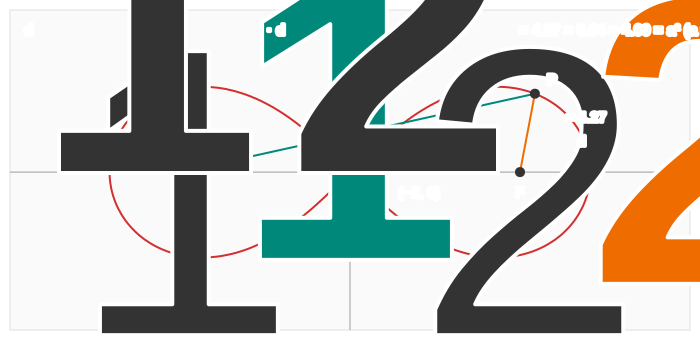
From x, y to r, θ
The equation gets much simpler in polar coordinates (see Polar Coordinates). With x = r cos θ and y = r sin θ:
x² + y² = r²
x² − y² = r² (cos²θ − sin²θ) = r² cos 2θ

(r²)² = 2a² · r² cos 2θ      divide by r²:      r² = 2a² · cos 2θ
Dividing by r² drops r = 0, but the origin is on the curve anyway (put θ = 45°). So for each angle θ, the curve is at distance r = a·√(2 cos 2θ) from the origin. At θ = 0 that is r = a√2, the far tip.
Where the curve exists: cos 2θ ≥ 0
r² can't be negative, so there is a point only where cos 2θ ≥ 0. That is θ from −45° to 45° (the right lobe) and from 135° to 225° (the left lobe). For every θ in between, a ray from the origin misses the curve completely (Demo: no point where cos 2θ < 0).
| θ | cos 2θ | r² = 8 cos 2θ (a = 2) | r |
|---|---|---|---|
| 0° | 1 | 8 | 2.83, the tip |
| 15° | 0.87 | 6.93 | 2.63 |
| 30° | 0.5 | 4 | 2, the highest point (1.73, 1) |
| 40° | 0.17 | 1.39 | 1.18 |
| 45° | 0 | 0 | 0, the origin |
| 60° | −0.5 | −4 | none |
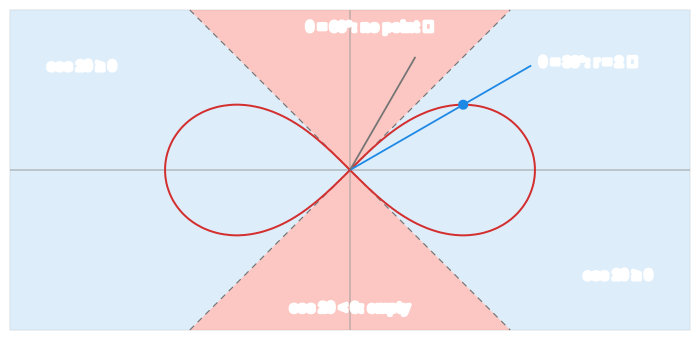
Turning θ from 0° to 360° (Demo: trace it in polar) draws the upper half of the right lobe (0° to 45°, from the tip into the origin), then nothing for 90°, then the whole left lobe (135° to 225°), nothing again, and finally the lower half of the right lobe (315° to 360°). The two lobes cross at the origin along the lines y = ±x, the boundaries of the sectors.
The product of distances
Why does d₁·d₂ = a² give the same curve? Square both distances and multiply:
d₁² · d₂² = ((x + a)² + y²) · ((x − a)² + y²) = (x² + y² + a²)² − 4a²x²Set it equal to a⁴ and expand: (x² + y²)² + 2a²(x² + y²) − 4a²x² = 0, which is (x² + y²)² = 2a²(x² − y²). Two points to check by hand: at the origin d₁ = d₂ = a; at the tip d₁ = a√2 + a and d₂ = a√2 − a, and (a√2 + a)(a√2 − a) = 2a² − a² = a² (Demo: d₁·d₂ = a² at every point).
Two other famous curves are defined the same way, with a sum and a difference instead of a product:
| rule for d₁ and d₂ | curve |
|---|---|
| d₁ + d₂ = constant | ellipse: see Ellipse Coefficients |
| |d₁ − d₂| = constant | hyperbola: see Hyperbola Coefficients |
| d₁ · d₂ = constant | Cassini oval; the lemniscate when the constant is a² |
Cassini ovals: the lemniscate is the boundary
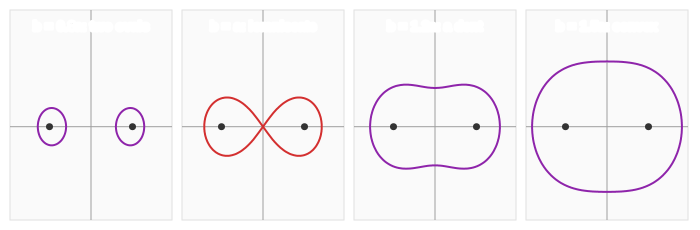
Giovanni Cassini studied the whole family d₁·d₂ = b² in 1680. With the same foci (±a, 0) it is (x² + y²)² − 2a²(x² − y²) = b⁴ − a⁴. The origin has d₁·d₂ = a·a = a², so it is on the curve only when b = a. Change b and the curve changes type there (Demo: Cassini ovals, b from 0.5a to 1.5a):
| b | shape |
|---|---|
| b < a | two separate ovals, one around each focus |
| b = a | the lemniscate: the two ovals meet at the origin |
| a < b < a√2 | one curve with a dent at the top and bottom |
| b ≥ a√2 | one convex oval |
Size: what a does
a only scales the curve: double a and every length doubles, every area grows four times (Demo: a from 1 to 2.5).
| quantity | formula | a = 2 |
|---|---|---|
| half-width (the tips) | a√2 | 2.83 |
| highest points, at θ = ±30° | (±a√3/2, ±a/2) | (±1.73, ±1) |
| area of both lobes | 2a² (½∫r² dθ = a² per lobe) | 8 |
| length of the curve | ≈ 7.416a | ≈ 14.83 |
The length needs an elliptic integral; its number 2.622… (the lemniscate constant ϖ) led Gauss and others to the theory of elliptic functions. Other polar curves made from cos(kθ): The Rose Curve r = cos kθ.
What the page leaves out
Negative r (with it, θ from −45° to 45° alone draws both lobes), the arc length integral, the slope and curvature, other figure eights such as the lemniscate of Gerono x⁴ = x² − y², and the 3D surfaces they come from. The window is fixed at x ∈ [−5, 5], y ∈ [−4.5, 4.5], a from 0.5 to 2.5 and b from 0.5a to 1.5a.