The idea: a stretched circle
This page is about the ellipse in standard form:
(x − h)²/a² + (y − k)²/b² = 1 (a, b > 0)Start from the unit circle x² + y² = 1. Stretch it by a along x and by b along y, then slide it so its centre is at (h, k). That is the whole equation: every point of the ellipse is (h + a·cos t, k + b·sin t) for some angle t.
| coefficient | what it changes |
|---|---|
| a | the half-width: the ellipse reaches a left and right of the centre |
| b | the half-height: it reaches b above and below the centre |
| h | slides it left or right: the centre's x |
| k | slides it up or down: the centre's y |
a and b: half-width and half-height
Put y = k into the equation: (x − h)² = a², so x = h ± a. The ellipse is 2a wide and, the same way, 2b high. The longer of the two is the major axis and its ends are the vertices; the shorter one is the minor axis. x²/25 + y² = 1 is 10 wide and only 2 high. (Demo 1: a and b stretch) Swapping a and b turns the ellipse by 90°: with a = 2, b = 3 the major axis is vertical, the vertices are (0, ±3) and the foci move onto the y-axis. (Demo 3: swap a and b, the major axis turns)
a = b: a circle
With a = b = r the equation is (x − h)² + (y − k)² = r², the circle of radius r: every point is r from the centre. There is no major axis, c = 0, both foci sit on the centre and the eccentricity is 0. x² + y² = 9 has area 9π. (Demo 2: a = b, a circle) The unit circle itself is on The Unit Circle.
The foci and c² = a² − b²
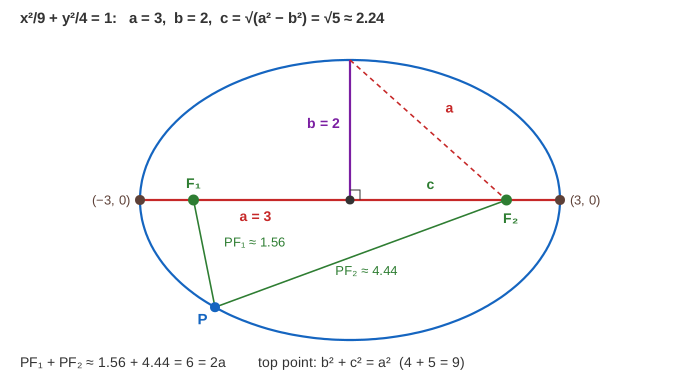
An ellipse is also the set of points whose distances to two fixed points, the foci F₁ and F₂, add up to the same number. At a vertex that sum is plainly the length of the major axis, so for every point P:
PF₁ + PF₂ = 2a (a ≥ b; use 2b when b > a)At the top point (h, k + b) both distances are equal, so each is a. That point, the centre and a focus form a right triangle with sides b and c and long side a, so by Pythagoras:
c² = a² − b² c = √|a² − b²|, foci (h ± c, k) or (h, k ± c)For x²/9 + y²/4 = 1: c = √5 ≈ 2.24. A point P walking around it keeps PF₁ + PF₂ = 6: at t = 60°, P = (1.5, 1.73), PF₁ ≈ 4.12 and PF₂ ≈ 1.88. (Demo 6: the focal sum PF₁ + PF₂ = 2a) This is the "two pins and a string" way to draw an ellipse.
Eccentricity: how flat
The eccentricity e = c / max(a, b) says how far the foci are from the centre compared with the vertices. It is always 0 ≤ e < 1: 0 is a circle, close to 1 is long and flat.
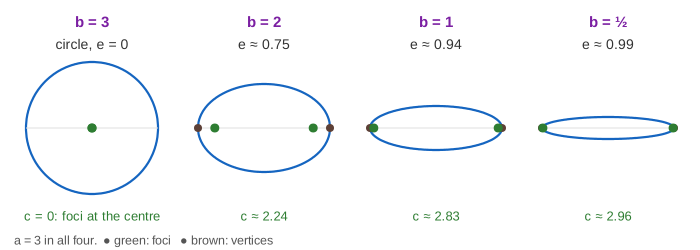
Shrinking b from 3 to 0.5 with a = 3 turns the circle into a flat ellipse: c = √(9 − b²) grows from 0 to ≈ 2.96 and e from 0 to ≈ 0.99. (Demo 5: b from 3 to 0.5 in steps of 0.1) With a = 0.5 and b = 5 the ellipse is a needle: e ≈ 0.995 and the foci (0, ±4.97) nearly touch the vertices (0, ±5). (Demo 7: edge case, a needle) Planet orbits are ellipses with the Sun at one focus; Earth's has e ≈ 0.017, nearly a circle, Halley's comet's e ≈ 0.97.
h and k: sliding without changing the shape
Replacing x by x − h moves every point h to the right; y − k moves it k up. The centre goes to (h, k), and the foci and vertices go with it, but a, b, c, e and the area πab stay the same. (Demo 4: h and k slide it) The same rule for graphs of functions is on Function Transformations.
The general form
Multiply out b²(x − h)² + a²(y − k)² = a²b² and you get
Ax² + Cy² + Dx + Ey + F = 0 A = b², C = a², D = −2b²h, E = −2a²k, F = b²h² + a²k² − a²b²For centre (3, −2), a = 3, b = 2: 4x² + 9y² − 24x + 36y + 36 = 0. A and C have the same sign (A = C is a circle) and there is no xy term because the axes are parallel to the x- and y-axes. To go back, complete the square in x and in y (Quadratic Equations). The other conics have their own pages: Parabola (only one squared term) and Hyperbola (A and C of opposite sign).
Multiply out and every ellipse becomes Ax² + Cy² + Dx + Ey + F = 0 with A and C of the same sign; turned ellipses also get a Bxy term. How the six numbers of the general equation pick the type and the turn is on Conic Sections: What A, B, C, D, E, F Do.
The superellipse |x|ⁿ + |y|ⁿ = 1 runs from a diamond through the circle to a square; it is one case of the superformula.
What the page leaves out
Rotated ellipses (an xy term in the general form), the directrices x = h ± a/e, the perimeter (no simple formula; Ramanujan's approximation is close), polar form r = a(1 − e²)/(1 + e cos θ) from a focus (Polar Coordinates), tangent lines and the reflection property, and ellipses bigger than the window x ∈ [−8, 8].