The idea: keep only the head of each list in a heap
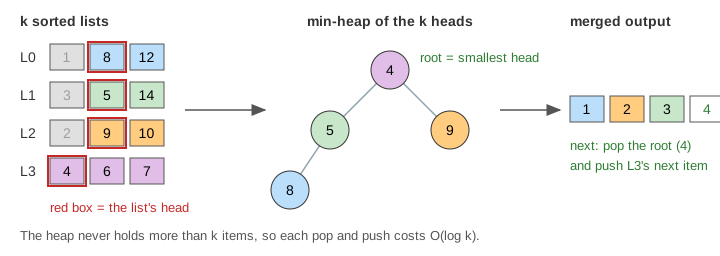
You have k lists, each already sorted, with n items in all, and you want one sorted list. The next output item is always one of the k list heads (the first item not yet taken from each list). So put the heads in a min-heap: the root is the smallest head, which is the next output item. The heap holds at most k entries, never n.
The algorithm
heap = empty
for each list i:  push (first item of i, i)          # build: k pushes
while heap not empty:
    (v, i) = pop the root                             # smallest head
    output v
    if list i has another item w:  push (w, i)        # refill from the SAME list
Each entry is a pair (value, list number), so the page can tell where a popped item came from. The colours on the canvas show the same thing: every item keeps its list's colour from the list, through the heap, into the output (Demo: merge 4 sorted lists: 26 comparisons for 12 items).
Why the root is always next
Every item still waiting in list i is at least list i's head, because the list is sorted. Every head is at least the root, because the heap is a min-heap. So nothing waiting anywhere is smaller than the root. This is why the heap only needs the heads: the rest of each list cannot win yet.
Pop and refill: replace the top
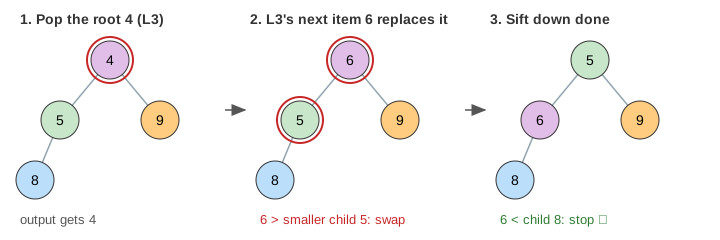
After the root is popped, only its own list lost a head, so only that list has a new candidate. Libraries do
the pop and the push as one operation: the new item goes straight into the root and sifts down
(Python's heapq.heapreplace does exactly this). Sift-down compares the two children (1 comparison), then the smaller child with the item (1
more), and stops as soon as the item is not bigger, so it costs at most 2 log2 k comparisons
(Demo: one Next).
When a list runs out
If the popped item was the last of its list, there is nothing to push. The heap shrinks by one: its last entry moves to the root and sifts down, exactly like a heap's remove-min. The heap ends empty when every list is used up (Demo: a list runs out).
Equal keys and stability
When two heads are equal, the page compares the list numbers too, so the item from the lower list goes first. If the lists are in their original order (as the runs of a merge sort are), equal items come out in their original order: the merge is stable. Comparing values alone would still give a sorted output, but equal items from different lists could come out in any order (Demo: equal keys).
Cost: O(n log k)
Every item is pushed once and popped once, and each costs O(log k) because the heap never holds more than k entries. Building the heap costs O(k log k) here (or O(k) with a bottom-up build).
| Method | Time | Extra space |
|---|---|---|
| Scan all k heads for every item | O(n k) | O(1) |
| Merge pairs of lists, log2 k rounds | O(n log k) | O(n) per round |
| Heap of the k heads (this page) | O(n log k) | O(k) |
| Concatenate everything and sort | O(n log n) | O(n) |
With k = 8 runs of 2 the heap used 61 comparisons, where scanning 8 heads for every item would use 16 × 7 = 112 (Demo: k = 8 runs of 2). With k = 2 the heap has just two entries, and each step is the single comparison of the merge step in merge sort (Demo: k = 2: 7 comparisons for 8 items).
Where it is used
- External merge sort: sort chunks that fit in memory into runs on disk, then merge all runs in
one pass, with one input buffer per run and a heap of the buffers' heads. A database sorting a big
ORDER BYdoes this. - LSM-tree compaction: several sorted files (SSTables) are merged into one, newest version of a key first.
- Merging sorted streams:
sort -m, Python'sheapq.merge, merging time series or log files by timestamp, "merge k sorted linked lists". - Search engines: walking several sorted posting lists in document order.
See also: the heap itself, with sift-up and sift-down, on Heaps and Priority Queues; sorting with a heap on Heap Sort; the two-way merge inside merge sort on Quick Sort vs Merge Sort; and sorted runs being merged on LSM Tree vs B-Tree.
Merging runs two at a time in passes, instead of all at once with a heap, is shown on Bottom-up Merge Sort.
What the page leaves out
The loser tree (tournament tree), which external sorts often use instead of a heap because it needs only log2 k comparisons per item; the bottom-up O(k) heap build; disk buffers, read-ahead and how many runs fit in one merge pass; replacement selection, which makes runs longer than memory; removing duplicates while merging.
See where this page fits on the Heap-like Data Structures mind map.