The idea: one stack reads, the other writes
The original transformer from 2017 was built for translation. It has two parts. The encoder reads the whole source sentence at once. The decoder writes the target sentence one word at a time. They are joined by cross-attention: at every step the decoder asks a question (a query) and looks up the answer in the encoder's output.
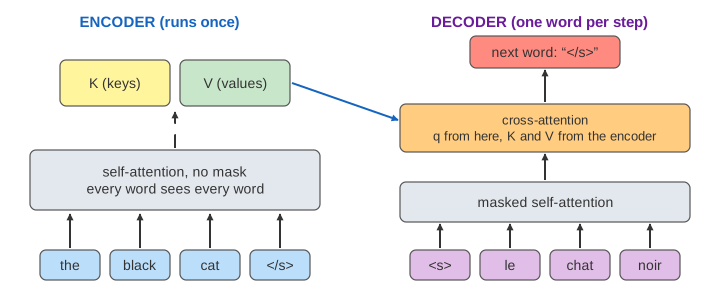
The canvas translates the black cat into le chat noir with vectors of only 4
and 6 numbers, so every score fits on screen. (Demo 1: encode once, then one decoder step)
Self-attention vs cross-attention
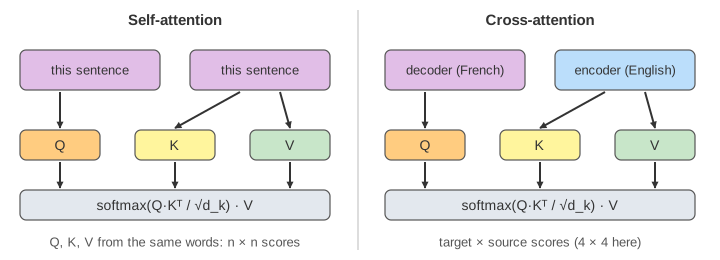
Both use the same formula, softmax(Q·Kᵀ / √d_k) · V. The difference is where Q, K and V
come from.
| Layer | Q from | K and V from | Mask |
|---|---|---|---|
| encoder self-attention | source | source | none: every word sees every word |
| decoder self-attention | target so far | target so far | causal: only earlier words |
| cross-attention | decoder | encoder output | none: the whole source |
A real decoder layer has all three steps in this order: masked self-attention, then cross-attention, then an MLP. The canvas shows the first one as a single box and opens up the cross-attention.
The encoder runs once
The source sentence does not change while the decoder writes, so the encoder runs a single time. Its output is turned into keys and values, often called the memory, and every decoder step reads the same K and V. After Translate the counters read 1 encoder pass and 4 decoder steps. (Demo 2: translate the whole sentence)
A decoder-only model such as GPT has no encoder: the prompt and the answer are one sequence and only self-attention with a causal mask is used. Its KV cache plays the role of the memory, but it grows by one row per token instead of being fixed.
Keys say what a word is, values say what it means
Here each key is the role of a source word: det, adj,
noun or end. Each value is the meaning: one 1 at the French word
it translates to. The decoder's query asks for a role, for example q = [0 1 2 0] after
le: "I need a noun, and a bit of the adjective".
- Scores:
q·kⱼfor the 4 source words =[0 2 4 0]. - Scale by
√d_k = 2:[0 1 2 0]. - Softmax:
[0.08 0.22 0.61 0.08], mostly oncat. - Context
Σ wⱼ·vⱼputs 0.61 onchat, so greedy decoding writes "chat".
Change the source to the white dog and run the same decoder: the queries are identical, but
the values are different, so it writes le chien blanc. The decoder does not know the source
words; it only knows what it can read through cross-attention. (Demo 3: another source, same
decoder)
The weights are an alignment
Each row of the bottom grid is one French word and shows where the decoder looked when it wrote it. In
French the colour comes after the noun, so "chat" looks at cat (column 3) and "noir" looks
at black (column 2): the alignment crosses. Before attention, an
RNN encoder had to squeeze the whole sentence into one vector; attention lets
each output word pick its own source words.
Encoder–decoder vs decoder-only
| Encoder–decoder | Decoder-only | |
|---|---|---|
| examples | original Transformer, T5, BART, Whisper, Marian | GPT, Llama, Claude |
| input is read by | the encoder, no mask | the same causal stack |
| attention kinds | self, masked self, cross | masked self only |
| good fit | input → output tasks: translation, speech to text, summaries | one model for every task through a prompt |
See also Self-Attention for the score, scale, mask and softmax steps on one sentence, How a Large Language Model Works for a whole decoder-only model, and Decoding Strategies for beam search, which real translators use instead of greedy decoding.
What the page leaves out
The numbers are hand-picked so they can be read: real keys and values are dense learned vectors of 64 or
more numbers, made by multiplying the encoder output by W_K and W_V. The page
uses one layer and one head; real models stack 6 to 24 layers with 8 to 16 heads, and every decoder layer
has its own cross-attention to the top encoder layer. Also left out: position encodings, residual
connections and layer norm, the MLP, the output softmax over a vocabulary of tens of thousands of
subword tokens (BPE), padding masks for batches, beam search, and training
with teacher forcing.
See where this page fits on the Machine Learning mind map.