The idea: spare room, and double it when it runs out
A dynamic array (Java ArrayList, C++ std::vector, Python list) is an ordinary fixed-size array plus two numbers: the capacity (how many cells the array has) and the size (how many hold values). A push writes the new value at index size and adds 1 to size. While there is a spare cell, that is one write: O(1).
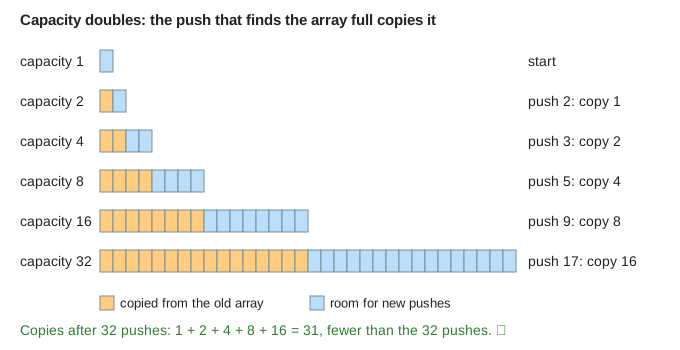
What a push into a full array does
When size == capacity there is no cell for the new value, and an array cannot get longer in place. The push has to:
- allocate a new array of the next capacity (2 × the old one when doubling),
- copy all
sizevalues into it, one write each, - free the old array and use the new one from now on,
- write the new value at index
size.
That one push costs size + 1 writes: it is O(n). With 16 values in a full array of 16, push 17 makes 17 writes, a tall orange bar on the chart (Demo: the push that copies 16).
void push(int v) {
    if (size == capacity) {
        int[] bigger = new int[capacity * 2];       // allocate
        for (int i = 0; i < size; i++)             // copy: size writes
            bigger[i] = a[i];
        a = bigger;  capacity *= 2;                 // the old array is freed
    }
    a[size++] = v;                                  // 1 write
}
Why the average stays under 3 writes
The expensive pushes get rarer exactly as fast as they get dearer. After a copy of 16, the next 15 pushes are cheap before the array fills again. Add up all the work after n pushes (the aggregate method): the copies are 1 + 2 + 4 + … , each half the next, so they add up to less than n. With the n writes of the values themselves, the total is less than 3n writes, under 3 per push. That is what O(1) amortized means: one push may be slow, but any run of n pushes costs O(n) in total (Demo: doubling, first 9 pushes).
The banker's view says the same thing: charge every push 3 coins. One pays for its own write and two go into a savings account. When an array of capacity C fills, the C/2 values pushed since the last copy have saved C coins, exactly enough to copy all C values. The account never goes negative, so 3 per push always covers the bill. The green line on the chart is that 3; the dark ticks (average so far) jump towards it after each copy and then fall away.
| Pushes n | Capacity | Copies | Writes | Writes per push |
|---|---|---|---|---|
| 9 | 16 | 15 | 24 | 2.67 |
| 17 | 32 | 31 | 48 | 2.82 |
| 32 | 32 | 31 | 63 | 1.97 |
Other growth rules
Growing by a constant instead of a factor breaks the argument. With +1 every push after the first finds the array full and copies everything: 1 + 2 + … + (n−1) = n(n−1)/2 copies, O(n) per push on average and O(n²) in total (Demo: grow by one copies every time). Growing by +100 only divides that by 100; it is still quadratic.
Any constant factor above 1 keeps O(1) amortized. Java's ArrayList grows to old + (old >> 1), about ×1.5: it leaves less unused room (at most a third of the array instead of half) and copies a little more, about 4 writes per push at worst (Demo: ×1.5 like Java ArrayList).
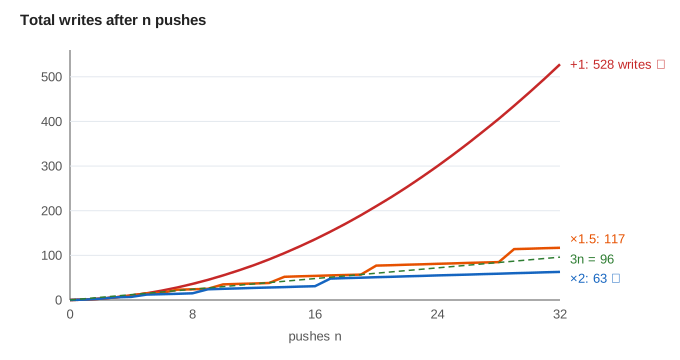
| Growth rule | Capacity after 32 pushes | Copies | Writes | Writes per push |
|---|---|---|---|---|
| ×2 | 32 | 31 | 63 | 1.97 |
×1.5 (old + (old >> 1)) | 42 | 85 | 117 | 3.66 |
| +1 | 32 | 496 | 528 | 16.5 |
In real libraries
- Java
ArrayList: default capacity 10 (allocated on the first add), then ×1.5.ensureCapacity(n)grows once up front. - C++
std::vector: ×2 in GCC's libstdc++ and Clang's libc++, ×1.5 in Microsoft's library.reserve(n)allocates once, so n push_backs then copy nothing. - Python
list: grows by about 1/8 plus a little (still a factor), so appends are amortized O(1).
If you know the final size, reserve it: no copies at all, and no spare room left over. Hash tables use the same trick when they resize: see Java HashMap, which doubles its bucket array. A stack on an array (Stack: Array Implementation) is a dynamic array that only pushes and pops at the end.
See Array vs Linked List for how a growing array compares with a linked list on indexing, inserts and cache misses.
What the page leaves out
Shrinking on pop: a list that halves when it is half empty can thrash at the boundary, so libraries shrink at a quarter full or never. Some allocators can extend a block in place (realloc), skipping the copy. Moving instead of copying objects (C++ move constructors), the memory allocator itself (see Malloc Allocators) and insertions in the middle, which shift elements and are O(n) every time, are not drawn. See Big-O Growth Race for how O(1), O(n) and O(n²) compare.
See where this page fits on the Basics mind map.