The idea: how far does each suffix match the start?
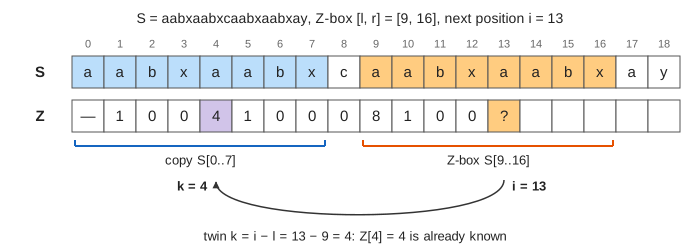
For a string S of length n, the Z value Z[i] is the length of the longest substring starting at i that is also a prefix of S. For S = aabxaabxcaabxaabxay, Z[4] = 4 because aabx starts at 4 and also at 0, and the next characters (c and a) differ. Z[0] would be the whole string and is left undefined. The list of all Z values is the Z array.
Computing each Z value by sliding the prefix under position i and comparing until a mismatch costs O(n²) in the worst case: 105 compares for fifteen as. The Z-algorithm (Gusfield's presentation of an older idea of Main and Lorentz) gets the whole array with fewer than 2n compares by remembering what it has already matched.
The Z-box and its three cases
The algorithm walks i = 1, 2, …, n − 1 and keeps the Z-box [l, r]: of all matches found so far, the one that reaches furthest right. It says S[l..r] = S[0..r − l], so every position inside the box has a twin k = i − l near the start whose Z value is already known.
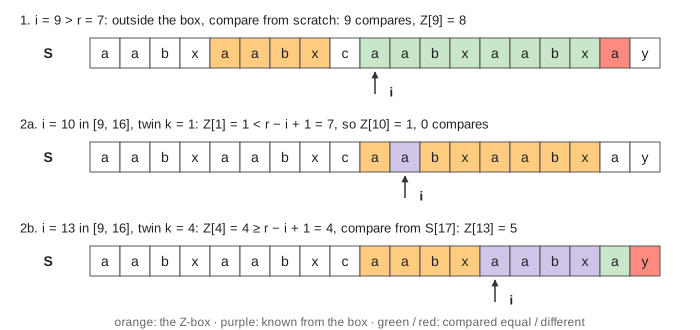
| case | test | what the algorithm does |
|---|---|---|
| 1: outside | i > r | Compare S[0], S[1], … with S[i], S[i+1], … until a mismatch. |
| 2a: copy | Z[k] < r − i + 1 | Z[i] = Z[k] with no compare: the twin's match ends inside the copy, so the match at i ends at the same place. |
| 2b: extend | Z[k] ≥ r − i + 1 | The first r − i + 1 characters are known to match. Compare from S[r + 1] on. |
Whenever a match from i ends past r, the box moves to [i, i + Z[i] − 1]. (Demos: inside the Z-box, copy Z[k], where i = 10 copies Z[1] = 1, and Z[k] reaches the box edge, where i = 13 compares only S[17] and S[18].)
l = r = 0
for i = 1 .. n−1:
    if i > r:                    k = 0                      # case 1
    else if Z[i−l] < r−i+1:      Z[i] = Z[i−l]; continue    # case 2a
    else:                        k = r−i+1                  # case 2b
    while i+k < n and S[k] == S[i+k]: k = k+1
    Z[i] = k
    if i+k−1 > r: l, r = i, i+k−1
Why it is linear
Every compare that finds two equal characters is at a position past the old r, and the box then moves so that r covers it. Since r only moves right and stops at n − 1, there are fewer than n equal compares in total. Each position ends with at most one unequal compare, so fewer than n of those too. The whole Z array costs under 2n compares and O(n) time. On the page: 23 compares for the 19-character string (restarting at every i: 40), and 14 for fifteen as (restarting: 105). (Demos: whole Z array and aaaaaaaaaaaaaaa.)
Searching with P$T
To find a pattern P (length m) in a text T, build S = P + $ + T, where $ occurs in neither string. No match can run past the $, so no Z value exceeds m, and Z[i] = m exactly where the whole pattern starts: at position i − m − 1 of T. Overlapping matches are found too. The cost is O(n + m).
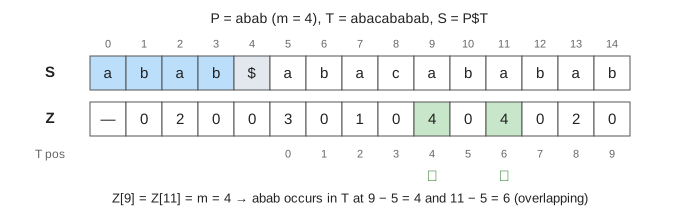
(Demo: search abab in abacababab: matches at text positions 4 and 6.)
Z-algorithm vs KMP
KMP solves the same problem in the same time with its failure table (the prefix function). The two tables carry the same information in different shapes, and each can be computed from the other in linear time.
| Z-algorithm | KMP | |
|---|---|---|
| table | Z[i]: longest prefix starting at i | π[i]: longest proper prefix of S[0..i] that is also its suffix |
| search | Z array of P$T, look for Z = m | table of P, then one pass over T |
| time | O(n + m), under 2(n + m) compares | O(n + m), under 2n + 2m compares |
| memory | the whole P$T and n + m + 1 Z values | m table entries; T can be a stream |
| on this page: abab in abacababab | 18 compares | 3 (table) + 12 (scan) = 15 compares |
KMP is the better fit when the text arrives as a stream or is too large to copy. The Z-algorithm is easier to state and to get right, which is why it is popular in programming contests, and the Z array answers other questions directly: the periods of a string, the number of distinct substrings, and string compression. See String Search Race for KMP, Boyer-Moore and Rabin-Karp on the same text.
What the page leaves out
The page uses short strings over a small alphabet and counts character compares only, not the index arithmetic around them. It skips the conversions between the Z array and KMP's prefix function, the use of the Z-algorithm as the preprocessing step of Boyer-Moore's good-suffix rule, searching without the $ by computing Z values of P and matching T against them, and the Main-Lorentz algorithm for finding repetitions, which is where the idea comes from.