The idea: weights break the greedy
Each job runs from a start time s to a finish time f and has a
weight w (money, priority). Two jobs are compatible when one ends
at or before the other starts. The goal is a set of compatible jobs with the largest total weight. Without
weights, "take the job that ends first" is optimal (see Interval
Scheduling). With weights, every simple greedy rule fails, and a one-row dynamic programming
table solves it.
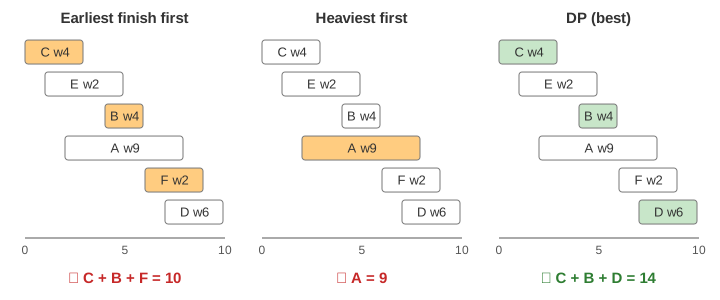
Earliest finish takes the light job F because it ends before D, and then D no longer fits. Heaviest first takes A (w9), which overlaps every other job. (Demo: greedy by earliest finish fails, Demo: greedy by heaviest job fails.)
Sort by finish time, then p(j)
Sort the jobs by finish time and number them 1..n. For job j define
p(j) as the last job, in this order, that finishes by the time job j starts
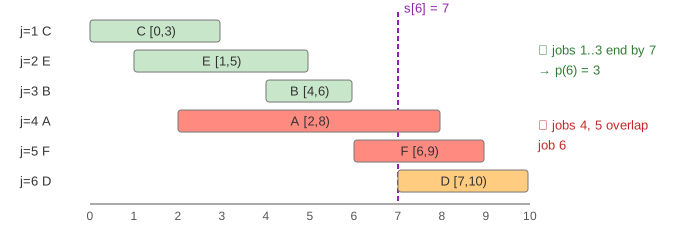
(0 if there is none). Because of the sort, jobs 1..p(j) all end by s[j], and jobs
p(j)+1 .. j−1 all overlap job j: each of them ends after s[j] but no later
than f[j]. The canvas colours them green and red.
Finding p(j) by binary search
The finish times f[1..n] are sorted, so p(j) is the last index with f[i] ≤ s[j]. A
binary search finds it in O(log n) probes: look at the middle of the range; if it ends by
s[j], keep it and search right for a later one, otherwise search left. On the canvas the range is
blue and the probe is orange. A plain scan from j−1 down also works but costs O(n) per job.
lo = 1, hi = j-1, p = 0
while lo <= hi:
    mid = (lo + hi) / 2
    if f[mid] <= s[j]:  p = mid, lo = mid + 1
    else:               hi = mid - 1
The recurrence: take job j or skip it
Let OPT[j] be the best total weight using only jobs 1..j. For job j there
are two choices:
- Skip it: the best is still
OPT[j−1]. - Take it: jobs
p(j)+1 .. j−1overlap it and drop out, so addw[j]to the best of jobs1..p(j).
OPT[0] = 0
OPT[j] = max( OPT[j-1],  w[j] + OPT[p(j)] )
It is the same skip-or-take shape as House Robber, but the "take" arrow jumps
back to p(j) instead of always two cells. For the six jobs, p = 0, 0, 1, 0, 3, 3 and OPT = 0, 4, 4,
8, 9, 10, 14 (Demo: 6 jobs).
Which jobs? The trace back
Walk back from OPT[n]. If OPT[j] = OPT[j−1], job j was skipped: go to
j−1. Otherwise it was taken: go to p(j). For the six jobs: OPT[6] = 14 ≠ 10, take job 6
(D) and go to p(6) = 3; OPT[3] = 8 ≠ 4, take job 3 (B) and go to 1; OPT[1] = 4 ≠ 0, take job 1 (C). Total
4 + 4 + 6 = 14.
Time, and when greedy is enough
| Part | Cost |
|---|---|
| Sort by finish time | O(n log n) |
| p(j) for every job, binary search | O(n log n) |
| Fill OPT[1..n] | O(n) |
| Trace back | O(n) |
Plain recursion on the same recurrence can take exponential time, because OPT(j−1) and
OPT(p(j)) share sub-calls; the table computes each value once. When all weights are equal the DP and
earliest finish give the same count (Demo: all weights 1), which is why the unweighted problem needs no
table.
See also: 0/1 Knapsack (skip or take, with a capacity instead of time overlaps), Longest Increasing Subsequence (another 1-D DP sped up by binary search) and Binary Search.
What the page leaves out
Memoized top-down recursion; jobs with equal finish times beyond a fixed tie order; several machines (interval partitioning, where a weighted version needs min-cost flow); jobs that may move within a window (scheduling with deadlines); the version where p(j) is computed by one merge-like sweep over jobs sorted by start time.
See where this page fits on the Dynamic Programming mind map.