The idea: a proxy next to every pod
Once a system is split into many services, every call between them needs the same things: encryption, a check of who
is calling, load balancing, retries, timeouts, and a way to stop calling a pod that is broken. A service mesh
takes all of that out of the apps. Each pod gets a second container, a proxy called the sidecar (in Istio it is
Envoy). The apps keep speaking plain HTTP to names like reviews:9080; the sidecars do the rest.
The proxies together are the data plane. A control plane, istiod, tells every
proxy what to do and gives each one a certificate.
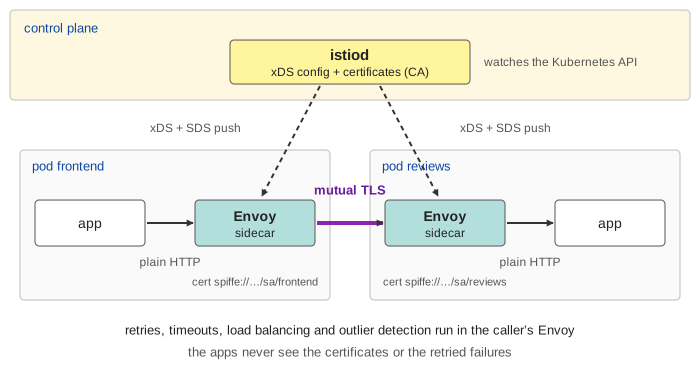
The page has four pods in the namespace shop: frontend, two replicas of reviews,
and a legacy pod that has no sidecar. Every request goes from an app to reviews:9080
(Demo 1: one request through two sidecars).
How traffic gets into the sidecar: iptables
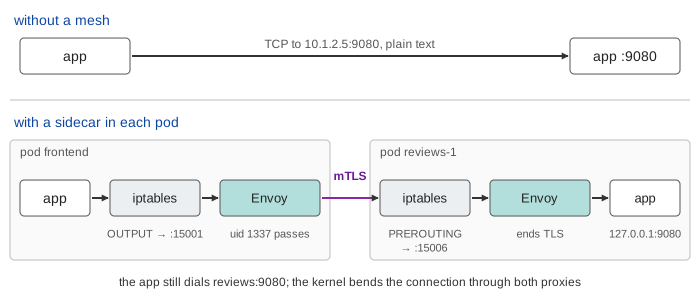
The app doesn't know the proxy is there, so something has to steer its packets. When a pod is created, Istio injects
an init container (istio-init, or the Istio CNI plugin) that writes iptables rules into the pod's
network namespace. The pod's containers share that namespace, so the rules apply to the app too:
- outgoing TCP (
nat OUTPUT → ISTIO_OUTPUT) isREDIRECTed to127.0.0.1:15001, Envoy's outbound listener; - incoming TCP (
nat PREROUTING → ISTIO_INBOUND) is redirected to port15006, Envoy's inbound listener; - traffic from Envoy itself (it runs as uid
1337) is let through, or it would loop back into itself.
So one call crosses two proxies: the caller's sidecar (outbound) and the callee's sidecar (inbound). Envoy reads the
original destination from the redirected socket (SO_ORIGINAL_DST) and the Host header, picks a route and a
cluster, and load-balances over the cluster's endpoints itself, so kube-proxy's Service IP is not used.
Mutual TLS and identities
Between the sidecars the connection is mutual TLS: both sides show a certificate. The certificate does not
name a host but a workload identity in SPIFFE form, built from the pod's service account:
spiffe://cluster.local/ns/shop/sa/frontend. istiod is the certificate authority: the agent in each sidecar
asks for a certificate, and Envoy gets it over SDS. Certificates live about a day and are rotated without
anyone noticing. The receiving sidecar can then apply an AuthorizationPolicy such as
"only sa/frontend may call reviews".
A PeerAuthentication resource sets the mode. PERMISSIVE (Istio's default) accepts both mutual TLS and
plain text, which helps while pods are being moved into the mesh. STRICT accepts only mutual TLS: the
legacy pod's plain request fails the handshake at the inbound sidecar and never reaches the app
(Demo 2: a pod without a sidecar is refused). See Mutual TLS for the handshake itself.
Retries and timeouts in the proxy
A VirtualService sets the retry policy and the timeout of a route. They run in the caller's sidecar,
so a retried failure never reaches the app. The page's policy is
retries: {attempts: 2, perTryTimeout: 1s, retryOn: 5xx} and timeout: 2.5s.
| case | tries | the app sees |
|---|---|---|
| reviews-2 answers 503, no retries | reviews-2 503 | 503 after 5 ms |
| reviews-2 answers 503, retries | reviews-2 503 → reviews-1 200 | 200 after 55 ms |
| reviews-2 slow (5 s), retries | reviews-2 timeout at 1 s → reviews-1 200 | 200 after 1050 ms |
| all pods slow, retries | timeout, timeout, cut at 2.5 s | 504 after 2500 ms |
| all pods slow, no timeout | one try | 200 after 5000 ms |
The per-try timeout lets a retry go to a healthy pod instead of waiting on a stuck one; the route timeout caps the whole call,
retries included (Demo 4: timeouts). The page's starting config (v1) turns retries off with attempts: 0; without any VirtualService, Istio already retries some failures (such as a refused connection) twice. Retries multiply load: with 2 retries a sick service can get 3 times its normal traffic,
so retry only what is safe to repeat (idempotent requests) and keep budgets small. Istio sets no route timeout unless you ask for one.
Circuit breaking: outlier detection
A DestinationRule configures the cluster on the caller's side. Its outlier detection watches each endpoint's
answers: consecutive5xxErrors: 2 ejects a pod that failed twice in a row, for baseEjectionTime: 30s times the
number of times it was ejected. While ejected, the load balancer skips it, so requests stop paying for a failed try first
(Demo 5: outlier detection ejects a pod). maxEjectionPercent keeps part of the pool in service. The other half of Istio's
circuit breaking is the connectionPool limits (http1MaxPendingRequests, maxRequestsPerConnection, …): when
the queue to a cluster is full, Envoy answers 503 at once instead of piling up more work. This is the same idea as the
circuit breaker and bulkhead in a library like Resilience4j, done in the proxy for every language at once.
The control plane and xDS
Nobody edits Envoy's config by hand. istiod watches the Kubernetes API (Services, endpoints, VirtualServices, DestinationRules, …), turns them into Envoy config and streams it to every sidecar over xDS, a family of gRPC discovery APIs. Istio sends them all on one stream (ADS) per sidecar:
| API | carries | on the page |
|---|---|---|
| LDS (listeners) | ports to accept on: 15001, 15006 | LDS row |
| RDS (routes) | host + path → cluster, retries, timeouts | from the VirtualService |
| CDS (clusters) | load-balancing policy, outlier detection, connection pools, TLS | from the DestinationRule |
| EDS (endpoints) | pod IPs behind each cluster | reviews-1, reviews-2 |
| SDS (secrets) | the workload certificate and the root CA | sa/frontend |
A change is pushed, not polled: istiod sends a new version, each Envoy loads it while running and answers with an ACK (a request carrying the version and the response's nonce). A config it can't load gets a NACK and the old one stays in use (Demo 3: istiod pushes retries over xDS). If istiod goes down, the sidecars keep running with the last config they got; only changes stop.
Mesh, library, gateway
| in-app library | service mesh | API gateway | |
|---|---|---|---|
| where | inside each app | a proxy next to each pod | one proxy at the edge |
| traffic | the calls the app makes | service to service (east-west) | client to service (north-south) |
| languages | one library per language | any | any |
| cost | code in every service | two extra hops, memory per pod | one extra hop |
An API gateway handles requests coming into the system; the mesh handles calls inside it, and the two are often used together. Underneath, the packets still travel the pod network shown in the life of a request in Kubernetes. Istio's newer ambient mode drops the per-pod sidecar: a per-node proxy (ztunnel) does mutual TLS, and an optional waypoint proxy does the HTTP features.
What the page leaves out
Real Envoy waits a jittered back-off (25 ms base) between retries and picks among all hosts, not a strict round robin; outlier
detection also runs on a timer (interval) and has success-rate and gateway-error variants. The page skips the sidecar's
startup (certificate signing request, the first xDS fetch), locality and weighted routing (canary v1/v2 splits),
AuthorizationPolicy, telemetry (every sidecar reports metrics and trace spans), HTTP/2 between sidecars, and the
Sidecar resource that limits which config each proxy gets.