The idea: two motions at once
Throw a ball with speed v₀ at an angle θ above the ground. With no air, the only force on it is gravity, and gravity pulls straight down. So split the launch velocity into two parts and follow each one on its own:
- sideways: vx = v₀·cos θ. Nothing pushes sideways, so vx never changes.
- up: vy₀ = v₀·sin θ. Gravity takes g m/s off it every second: vy = vy₀ − g·t.
Steady sideways motion plus a vertical motion that slows, stops and comes back down gives a parabola. On the page the green arrows (vx) stay the same length at every sample point, while the red arrows (vy) shrink, vanish at the top and grow again pointing down.
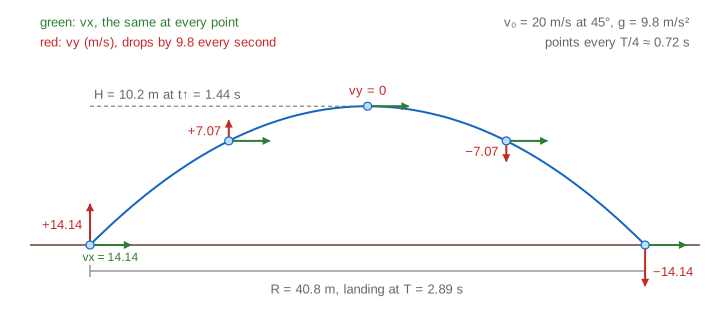
Sideways: constant speed. Up and down: free fall
The two directions do not affect each other. The position at time t is
x(t) = vx·t                       vx = v₀·cos θ
y(t) = h + vy₀·t − ½·g·t²         vy₀ = v₀·sin θ,   vy(t) = vy₀ − g·t
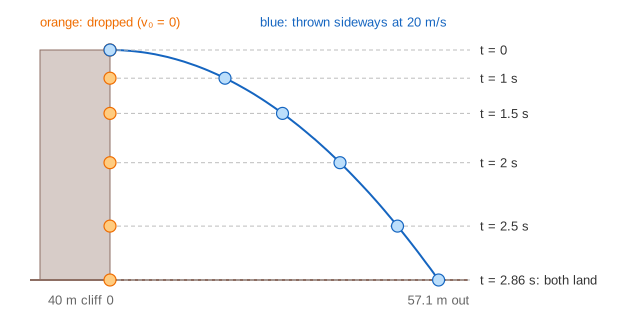
The velocity–time chart under the field shows it plainly: vx is a flat line, vy a straight line going down with slope −g. A ball thrown sideways off a cliff falls exactly like a ball let go from the same height: both hit the ground at the same moment (Demo 6: both take 2.86 s from 40 m).
Time of flight, peak height and range
From flat ground (h = 0):
- The top is where vy = 0: t↑ = v₀ sin θ / g.
- The fall back down takes just as long, so the time of flight is T = 2·v₀ sin θ / g.
- Put t↑ into y(t): the peak height is H = v₀² sin²θ / 2g.
- Sideways the ball goes vx·T = v₀ cos θ · 2 v₀ sin θ / g. Since 2 sin θ cos θ = sin 2θ, the range is R = v₀² sin 2θ / g.
For v₀ = 20 m/s at 45° on Earth (Demo 1): vx = vy₀ ≈ 14.14 m/s, t↑ ≈ 1.44 s, T ≈ 2.89 s, H ≈ 10.2 m, R ≈ 40.82 m. The ball lands with vy ≈ −14.14 m/s: as fast down as it went up.
45° goes farthest; 30° and 60° land together
R = v₀² sin 2θ / g is largest when sin 2θ = 1, that is θ = 45°. Two angles that add up to 90° have the same sin 2θ (sin 60° = sin 120°), so they land at the same spot. The higher one goes up more and stays in the air longer.
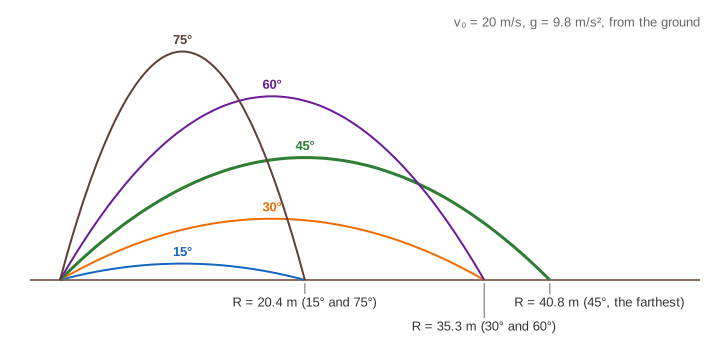
| θ | T | H | R | on the page |
|---|---|---|---|---|
| 15° | 1.06 s | 1.37 m | 20.41 m | Demo 3 |
| 30° | 2.04 s | 5.1 m | 35.35 m | Demo 2 |
| 45° | 2.89 s | 10.2 m | 40.82 m | Demos 1, 3 |
| 60° | 3.53 s | 15.31 m | 35.35 m | Demo 2 |
| 75° | 3.94 s | 19.04 m | 20.41 m | Demo 3 |
| 90° | 4.08 s | 20.41 m | 0 | Demo 5 |
(v₀ = 20 m/s, g = 9.8 m/s², from the ground.) Straight up (90°) gives the greatest height but no range: vx = 0, so the ball comes back to where it started, at the speed it was thrown.
Speed and gravity
H and R grow with v₀²: double the speed and the ball goes four times as far and four times as high, and stays up twice as long (Demo 7: 10 → 20 m/s takes R from 10.2 to 40.82 m). All three numbers go with 1/g, so the same throw on weaker gravity is a scaled-up copy of the Earth path:
| where | g (m/s²) | T | H | R |
|---|---|---|---|---|
| Earth | 9.8 | 2.89 s | 10.2 m | 40.82 m |
| Mars | 3.7 | 7.64 s | 27.03 m | 108.11 m |
| Moon | 1.6 | 17.68 s | 62.5 m | 250 m (Demo 4) |
(v₀ = 20 m/s at 45° from the ground.) 9.8 / 1.6 ≈ 6.1, so on the Moon everything is about 6.1 times bigger.
Launching from a height
From a height h the ball still reaches its top at t↑ = vy₀ / g, now at H = h + vy₀² / 2g, but it has farther to fall. Solving y(T) = 0 gives
T = (vy₀ + √(vy₀² + 2·g·h)) / g R = vx·TThrown sideways (θ = 0), vy₀ = 0 and T = √(2h/g): the same as a dropped ball. From a height the best angle is no longer 45°, because the ball gets extra time on the way down; a lower angle uses that time with more sideways speed (Demo 8: from 40 m at 20 m/s, 45° lands at 65.68 m, 30° at 70.22 m).
See also
The same g sets the period of a Simple Pendulum (T = 2π√(L/g), so a pendulum on the Moon swings 2.5 times slower). Splitting a motion into parts that do not affect each other also helps with the Elastic Collision page, where momentum is kept along the track.
What the page leaves out
Air resistance (real balls fall short of these ranges, and the best angle drops below 45°), spin and the Magnus effect, wind, the Earth's curvature and rotation (they matter only for very long shots), g changing with height, throws aimed below the horizontal, landing on a slope or a raised target, and bounces. The page keeps speeds from 0 to 30 m/s, angles in steps of 15°, three gravities and launch heights up to 40 m.