The idea: a 32-bit clock that wraps around
Every PostgreSQL transaction that writes gets a transaction ID (XID). Each row
version stores the XID that created it in xmin. A row is visible to you only if its
xmin committed before your snapshot. XIDs are 32-bit numbers, so after about
4.29 billion transactions the counter starts again at 3. A busy server can get there in weeks.
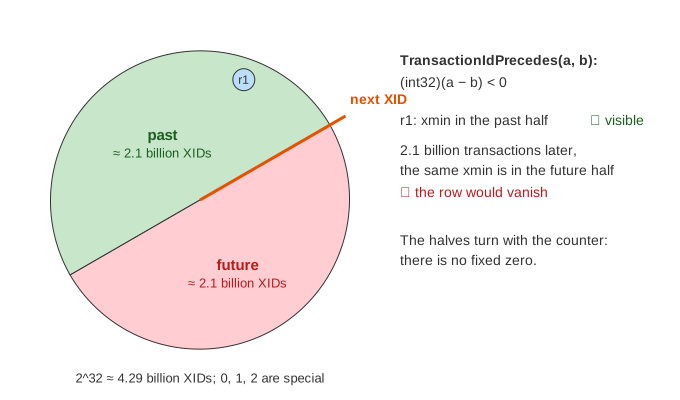
The canvas shrinks the circle to 64 XIDs so you can see it turn. The orange hand is the next XID.
Green cells are in the past, red cells in the future. The blue dots are the rows of table
orders, each placed at its xmin.
Comparing XIDs modulo 232
PostgreSQL never compares XIDs with a plain <. TransactionIdPrecedes(a, b)
computes (int32)(a - b) < 0. So for any XID, the 231 (about 2.1 billion)
XIDs behind it are older and the 231 ahead of it are newer. The comparison has no fixed
"zero": it turns with the counter.
XIDs 0, 1 and 2 are special: InvalidTransactionId, BootstrapTransactionId
and FrozenTransactionId. Normal XIDs start at 3, and after 232 − 1 the counter
skips back to 3.
That is fine for new rows, but a row that stays untouched for 2.1 billion transactions has a
problem. Its xmin does not change, the circle turns, and one day the xmin is
more than half a circle behind. It now compares as newer than every running transaction.
The row would be treated as not yet committed and would vanish from every query
(Demo: no freezing: rows vanish (what if)).
Freezing a row
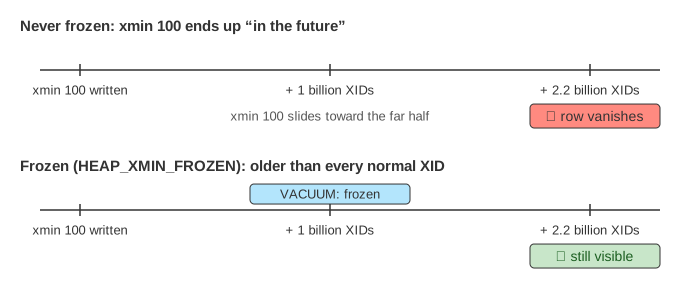
The fix is to freeze old rows. Once every possible snapshot can see a row, VACUUM
marks it frozen: since PostgreSQL 9.4 it sets both HEAP_XMIN_COMMITTED and
HEAP_XMIN_INVALID in the tuple header (together they mean HEAP_XMIN_FROZEN)
and keeps the old xmin for debugging. Older releases overwrote xmin with
FrozenTransactionId (2). Either way a frozen row is older than every normal XID, forever.
On the canvas a frozen row leaves the circle for the frozen shelf.
Which rows does a VACUUM freeze? Those with an xmin older than its
FreezeLimit = next XID − vacuum_freeze_min_age (default 50 million).
Young rows are left alone because they may still be updated or deleted soon, and freezing them would
be wasted work. VACUUM FREEZE uses age 0 and freezes everything it can
(Demo: VACUUM vs VACUUM FREEZE). Nothing can be frozen past the oldest running
transaction's XID (OldestXmin).
relfrozenxid, datfrozenxid and age()
After a VACUUM that scans every page that is not all-frozen, PostgreSQL knows that no
xmin in the table is older than some XID. It stores that in
pg_class.relfrozenxid. pg_database.datfrozenxid is the oldest
relfrozenxid in the database (the canvas has one table, so they are equal).
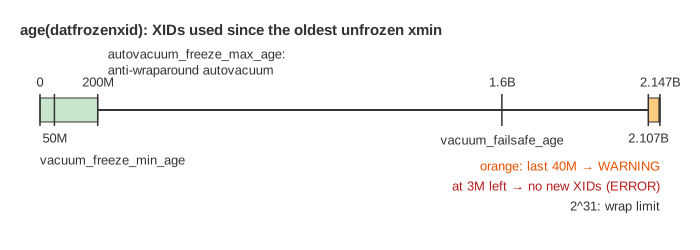
age(relfrozenxid) is how many XIDs have been used since: the distance to trouble.
When a VACUUM moves relfrozenxid forward, the age drops and every limit below moves with it.
The settings and the limits
From the oldest datfrozenxid the server computes four limits
(SetTransactionIdLimit()). The canvas uses smaller numbers in the same order:
| What | Real value | Canvas | What happens |
|---|---|---|---|
vacuum_freeze_min_age | 50,000,000 | 4 | VACUUM freezes rows older than this |
autovacuum_freeze_max_age | 200,000,000 | 16 | an anti-wraparound autovacuum is forced, even with autovacuum = off |
| xidWarnLimit | 40,000,000 XIDs left | 8 left | WARNING: database "app" must be vacuumed within N transactions |
| xidStopLimit | 3,000,000 XIDs left | 3 left | no new XIDs: every write fails |
| xidWrapLimit | datfrozenxid + 231 − 1 | + 31 | where the oldest unfrozen xmin would flip |
In Demo: anti-wraparound autovacuum the age reaches 16 and the autovacuum launcher forces
a VACUUM public.orders (to prevent wraparound). It freezes the old rows and
relfrozenxid jumps forward. Since PostgreSQL 14 the warning starts at 40 million XIDs
left and the stop at 3 million (before: 10 million and 1 million).
vacuum_failsafe_age (1.6 billion) also makes a VACUUM skip index cleanup and
cost-based delays to finish sooner.
What stops freezing in production
Autovacuum usually keeps up. Wraparound trouble almost always means something holds
OldestXmin back, so VACUUM runs but can't freeze or move relfrozenxid:
- a session left idle in transaction for days (Demo: idle transaction: warnings, then stop);
- a forgotten prepared transaction (
PREPARE TRANSACTION, seepg_prepared_xacts); - a stale replication slot, or a standby with
hot_standby_feedback = onholding an old xmin; - a table that autovacuum keeps cancelling or can't finish (huge table, too much throttling).
The fix is the same in every case: end what holds the horizon back, then VACUUM the oldest tables (Demo: fix it: end the idle txn, VACUUM). VACUUM does not need an XID, so it still runs after the stop.
-- how close is each database / table?
SELECT datname, age(datfrozenxid) FROM pg_database ORDER BY 2 DESC;
SELECT relname, age(relfrozenxid) FROM pg_class WHERE relkind = 'r' ORDER BY 2 DESC LIMIT 10;
-- who holds the horizon back?
SELECT pid, state, backend_xid, backend_xmin, xact_start FROM pg_stat_activity
 WHERE backend_xmin IS NOT NULL ORDER BY age(backend_xmin) DESC;
See also How PostgreSQL Runs a Query for xmin, xmax and VACUUM, MVCC and isolation levels for snapshots, pg_xact (CLOG) and hint bits for how commit status is looked up, and the free space map and visibility map for the all-frozen bit that lets VACUUM skip pages.
What the page leaves out
Real XIDs are 232, not 64, and only writing transactions get one (readers use virtual
transaction IDs). The page has one table; a real database has many, and datfrozenxid is the
oldest of them, across all databases including template0. It leaves out
vacuum_freeze_table_age (when a VACUUM becomes aggressive), the visibility map's
all-frozen bit, page-level freezing in PostgreSQL 16, the separate multixact ID counter
(relminmxid, autovacuum_multixact_freeze_max_age), truncation of
pg_xact behind datfrozenxid, and the 64-bit "epoch" that
pg_current_xact_id() adds for display.