The idea: circles that add up to a wave
A periodic signal repeats itself every period. Fourier's claim is that such a signal is a sum of sine waves whose frequencies are whole multiples of the base frequency: one that turns once per period, one that turns twice, three times, and so on. This sum is the Fourier series.
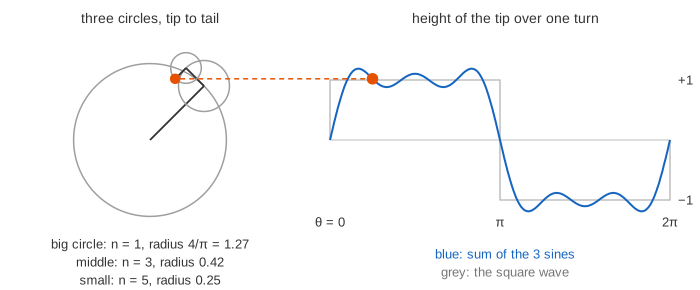
A sine wave is the height of a point that goes round a circle. So a sum of sine waves is a chain of circles: each circle sits on the tip of the one before, circle n turns n times while the first turns once, and the height of the last tip is the sum. Circles riding on circles are called epicycles.
The coefficients are the radii
Write the series as f(θ) = b1·sin θ + b2·sin 2θ + b3·sin 3θ + … The number bn, the coefficient, is the radius of circle n: how much of the frequency n the signal contains. It is found by an average over one period, bn = (1/π)·∫ f(θ)·sin(nθ) dθ.
| signal | terms | radius of circle n | after 8 circles |
|---|---|---|---|
| square wave (±1) | odd n only: 1, 3, 5, … | 4/(πn): 1.273, 0.424, 0.255, … | peak 1.18 |
| sawtooth (π − θ)/π | every n: 1, 2, 3, … | 2/(πn): 0.637, 0.318, 0.212, … | peak 1.07 |
| heart (a 2D shape) | k = −4 … 4 except 0 | 12.5, 3, 2.5, 2.5, 1, 0.5, 0.5, 0.5 | exact |
The square wave is symmetric in a way that cancels every even term. The radii shrink like 1/n, so each new circle is smaller and the sum changes less. (Demo 1: square wave, Demo 3: sawtooth)
The Gibbs overshoot
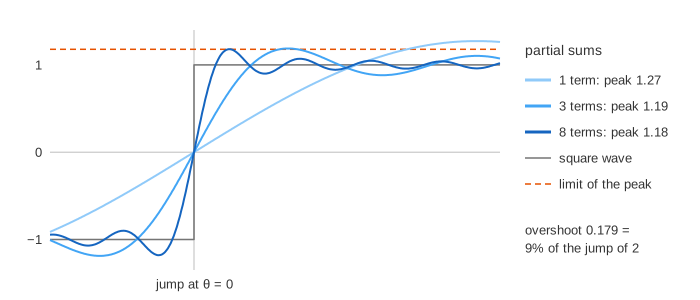
Next to a jump the sum always overshoots. With 1 circle the square wave's sum peaks at 1.27, with 2 at 1.20, then 1.19, 1.18, … and it never gets below 1.179. The overshoot of 0.179 is about 9% of the jump from −1 to +1. More circles only make the bump narrower and push it closer to the jump. This is the Gibbs phenomenon. At every point away from a jump the sum still converges to the wave; it is the largest value that does not. (Demo 2: Gibbs)
Drawing a shape: complex coefficients
A closed curve can be drawn the same way. Read each point (x, y) as one complex number z = x + iy. Then z(θ) = Σ ck·eikθ: each term is a circle of radius |ck| turning k times per turn, anticlockwise for k > 0 and clockwise for k < 0. The coefficient ck is again an average, (1/2π)·∫ z(θ)·e−ikθ dθ.
The heart curve x = 16 sin³θ, y = 13 cos θ − 5 cos 2θ − 2 cos 3θ − cos 4θ is made of only 8 terms, because sin³θ and cos kθ are themselves short sums of e±ikθ. The page adds the largest first: c−1 = 12.5i, then c−3 = −3i, c−2 = c2 = −2.5i, c3 = i, and three of radius 0.5. After 8 circles the drawing is exact. A real drawing needs infinitely many terms; a few dozen look right. (Demo 4: heart)
From the series to the DFT
A computer has samples, not a formula. With N samples x[0] … x[N−1] the coefficient integral becomes a sum, the discrete Fourier transform (DFT):
X[k] = Σ x[n]·e^(−2πi·kn/N) k = 0 … N−1, sum over n = 0 … N−1X[k] says how much of the frequency "k cycles per N samples" the signal contains. Done directly, each of the N outputs is a sum of N products: N² complex multiplications. That is 64 for N = 8, and about a million for N = 1024.
The FFT: split in half, then butterflies
The fast Fourier transform of Cooley and Tukey (1965) splits the samples into the even ones and the odd ones. Each half is a DFT of size N/2, call them E and O, and with the twiddle factor W = e−2πi/N:
X[k]       = E[k] + W^k·O[k]
X[k + N/2] = E[k] − W^k·O[k]          k = 0 … N/2 − 1
One multiplication Wk·O[k] gives two outputs. This pair is drawn as a butterfly: a and b in, a + W·b and a − W·b out. Split the halves again until each piece is one sample. For N = 8 that gives 3 stages of 4 butterflies each, with twiddles W0 in stage 1, W0 and W2 in stage 2, and W0 to W3 in stage 3.
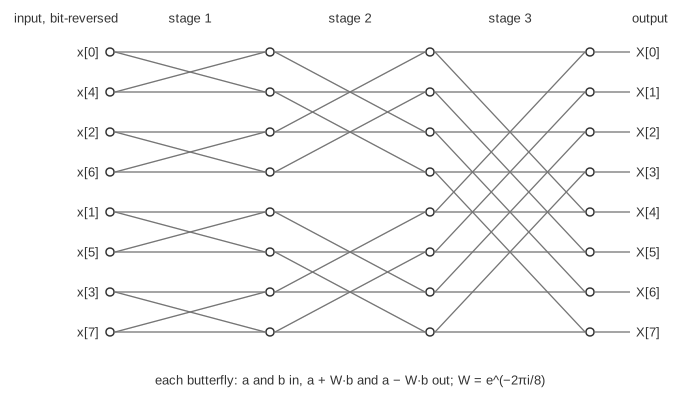
Splitting into even and odd again and again puts the inputs in bit-reversed order: write the index in binary and read it backwards.
| row | binary | reversed | holds |
|---|---|---|---|
| 0 | 000 | 000 | x[0] |
| 1 | 001 | 100 | x[4] |
| 2 | 010 | 010 | x[2] |
| 3 | 011 | 110 | x[6] |
| 4 | 100 | 001 | x[1] |
| 5 | 101 | 101 | x[5] |
| 6 | 110 | 011 | x[3] |
| 7 | 111 | 111 | x[7] |
Counting multiplications
Each of the log2N stages has N/2 butterflies with one multiplication each: (N/2)·log2N in total, against N² for the direct DFT.
| N | direct DFT: N² | FFT: (N/2)·log2N | FFT is faster by |
|---|---|---|---|
| 8 | 64 | 12 | 5× |
| 64 | 4,096 | 192 | 21× |
| 1,024 | 1,048,576 | 5,120 | 205× |
| 1,048,576 | about 1.1 × 10¹² | 10,485,760 | about 100,000× |
The page counts the multiplications by W0 = 1 too, as the formula does; real libraries skip them. The split is the same divide and conquer as merge sort: two halves plus linear work to combine them, so O(N log N) (see Quicksort vs Merge Sort).
Reading the spectrum
For real samples, X[N−k] is the complex conjugate of X[k], so the bars on the right half mirror the left half. A cosine is half e+iωn and half e−iωn, so one cycle per 8 samples puts 4 in bin 1 and 4 in bin 7, the frequency −1. (Demo 5) A single spike, the impulse, contains every frequency equally: all eight |X[k]| are 1. (Demo 6) A cosine of 1.5 cycles does not fit a whole number of times into 8 samples, so no bin matches it and the energy leaks into every bin: 1.00, 2.40, 2.80, 1.19, 1.00, 1.19, 2.80, 2.40. (Demo 7)
The FFT is also how convolution is done fast: transform both, multiply bin by bin, transform back (see Convolution in a CNN). Multiplying by Wk is a rotation by −45°·k, the complex form of a rotation matrix.
Taylor Series builds a function from powers of x that fit at one point, where a Fourier series uses sines that fit the whole period. The twiddle factors are roots of unity: see Complex Numbers for why multiplying by e^(−2πi/N) turns a point round the unit circle.
Each spinning circle is a point going round a circle; The Unit Circle: sin, cos, tan shows how one turn draws a sine and a cosine wave, and what a phase shift is.
Adding two waves of the same frequency that come from two different places, instead of many frequencies at one place, gives bright and dark fringes: see Wave Interference: Two Coherent Sources.
The Fourier transform weighs a signal by a spinning e−iωt; the Laplace transform uses e−st with s = σ + iω, which adds a decay so that even growing signals have a transform. See The Laplace Transform.
For where each coefficient comes from (the area of f·sin nx), cosine terms and a₀, and the Gibbs overshoot measured up to 99 harmonics, see Fourier Series, Harmonic by Harmonic.
JPEG uses a cousin of the DFT, the cosine-only DCT, on 8 × 8 blocks: see JPEG Compression: DCT and Quantization.
Feed the DFT 256 points around a heart, a star or the letter π and every coefficient becomes a spinning circle that helps draw it: see Fourier Epicycles: Drawing a Shape with Spinning Circles.
What the page leaves out
The series uses sine terms only; a general signal also has cosine terms and a constant a0, and the page does not show when a series converges. The circles move between 16 positions per turn in straight lines, so the small fast circles jump. The FFT is the plain radix-2 version for N = 8 with separate columns; real libraries (FFTW, cuFFT) work in place, use real-input, radix-4 and split-radix variants, handle any N (Bluestein), and skip trivial twiddles. The inverse FFT, windowing against leakage and rounding errors are not shown.