The idea: push at the right rate
A mass on a spring has its own rate, the natural angular frequency ω₀ = √(k/m). Here m = 1 kg and k = 16 N/m, so ω₀ = 4 rad/s. Air or oil slows it down with a damping rate γ. Now push it with a force F₀·cos ωt that goes back and forth at a rate ω of our choice. After a while the mass swings at the driver's rate ω, not its own, with a steady amplitude A that depends hugely on how close ω is to ω₀. That big swing near ω₀ is resonance.
The equation and its steady answer
Newton's law for the mass, with the spring force −kx, a drag force −2mγ·v and the drive:
m·x″ + 2mγ·x′ + k·x = F₀·cos ωt or x″ + 2γx′ + ω₀²x = (F₀/m)·cos ωtOn the page the drive is the far end of the spring: a driver plate that moves d·cos ωt with d = F₀/k = 6.25 cm. The spring then pulls with k·(d·cos ωt − x), which is the same equation. Try a steady answer x = A·cos(ωt − δ) and you get
A(ω) = (F₀/m) / √((ω₀² − ω²)² + (2γω)²)
tan δ = 2γω / (ω₀² − ω²)        δ from 0° to 180°
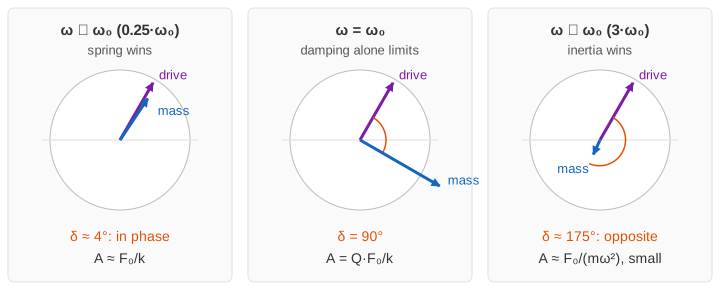
A is the steady-state amplitude, δ the phase lag: the mass reaches its peak a fraction δ/360° of a cycle after the driver does. The two arrows in the phasor circle on the canvas turn at ω, δ apart; the shadow of each arrow on the axis is the plate's and the mass's position.
Three regimes
| drive | who wins | A | δ | on the page (γ = 0.5) |
|---|---|---|---|---|
| ω ≪ ω₀ | the spring | ≈ F₀/k, the static stretch | ≈ 0°, in phase | Demo 1: ω = 0.25·ω₀, A ≈ 6.65 cm, δ ≈ 3.8° |
| ω = ω₀ | nobody: spring and inertia cancel, damping is left | Q·F₀/k | 90° | Demo 2: A = 25 cm, δ = 90° |
| ω ≫ ω₀ | the mass's inertia | ≈ F₀/(mω²), tiny | → 180°, opposite | Demo 3: ω = 3·ω₀, A ≈ 0.78 cm, δ ≈ 174.6° |
At resonance the lag of 90° means the mass moves fastest exactly when the push is strongest, so the force does positive work in every part of the cycle. Below and above ω₀ the force pushes against the motion for part of each cycle and gives some energy back.
Q, peak height and width
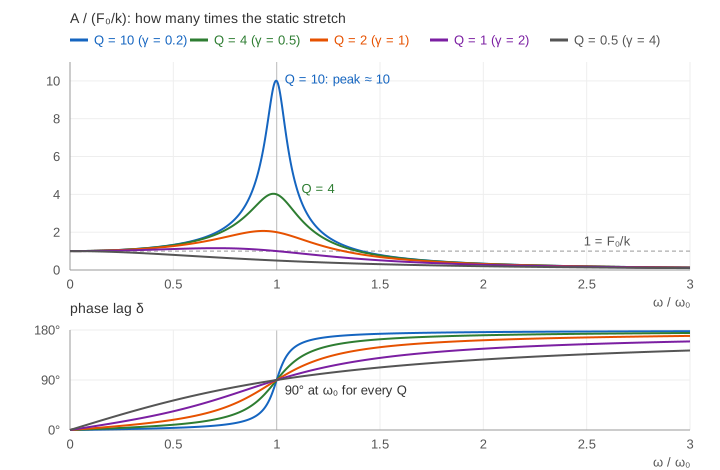
The quality factor Q = ω₀/(2γ) sums up the damping. For small damping:
- the peak is Q times the static stretch: A_max ≈ Q·F₀/k;
- the peak is 2γ wide: between the two ω where A drops to A_max/√2 (half the power), Δω ≈ 2γ = ω₀/Q;
- left alone, the oscillation rings for about Q cycles before its amplitude falls to e^(−π) ≈ 1/23.
The exact peak sits a bit below ω₀, at ω_r = √(ω₀² − 2γ²). With heavy damping, γ ≥ ω₀/√2 (Q ≤ 0.71), there is no peak at all: A is biggest at ω = 0 and falls from there.
| γ (1/s) | Q | A at ω₀ | width Δω (green bracket) | demo |
|---|---|---|---|---|
| 0.2 | 10 | 62.5 cm | ≈ 0.4 rad/s | Demo 4: tall, narrow |
| 0.5 | 4 | 25 cm | ≈ 1 rad/s | the start |
| 1 | 2 | 12.5 cm | ≈ 2 rad/s | |
| 2 | 1 | 6.25 cm | too wide | |
| 4 | 0.5 | 3.125 cm | no peak | Demo 5: less than F₀/k |
Changing γ keeps the old curve in grey so you can compare. Demo 7 walks ω across the peak at Q = 4: the orange dot climbs from 8.2 cm to 25 cm and falls to 2.1 cm while δ goes from 9.5° to 170.5°.
From rest: transient + steady state
The page starts the mass at rest, so x(0) = 0 and v(0) = 0. The steady answer alone does not fit that start, so a free, damped oscillation is added, the transient:
x(t) = A·cos(ωt − δ) + e^(−γt)·(C₁·cos ω_d t + C₂·sin ω_d t), ω_d = √(ω₀² − γ²)C₁ and C₂ are chosen so that x(0) = 0 and x′(0) = 0. The transient swings at the natural rate and dies as e^(−γt), the same envelope as on Damped Oscillation; after a few 1/γ only the steady swing is left. At resonance the swing simply grows toward A. Near resonance the two rates are close and the sum beats: the two parts drift in and out of step every 2π/|ω_d − ω| (Demo 6: ω = 3.6 rad/s, ω_d ≈ 3.995 rad/s, beats about every 15.9 s, fading as the transient dies).
Resonance in the real world
- A child on a swing: small pushes, timed at the swing's own rate, build a big swing.
- A wine glass rings for a long time when tapped (high Q). A singer who holds its note loud enough can make the swing so big that the glass breaks.
- Bridges: the Millennium Bridge in London (2000) swayed sideways when walkers fell into step with it; it was fixed by adding dampers, which lower Q. The Tacoma Narrows collapse (1940) was wind flutter, a related but self-excited effect rather than a simple periodic push.
- Tuned mass dampers in tall buildings are a second, damped oscillator tuned to the building's ω₀ that soaks up the swing.
- Radio tuning: an LC circuit obeys the same equation; a high Q lets one station through and rejects its neighbours.
See also
Without damping or a drive this is the Spring Oscillator, x = A·cos(ωt + φ) with ω = √(k/m). The transient on this page is the decaying wave of Damped Oscillation.
What the page leaves out
Overdamped transients (γ > ω₀; the page stops at critical damping γ = ω₀ = 4), drives that are not a pure cosine (any periodic push is a sum of cosines, and each gets its own A and δ), the power the driver feeds in (biggest exactly at ω₀), springs that stop obeying Hooke's law at big swings (nonlinear resonance and jumps), parametric resonance (pumping a swing by standing up and squatting), and coupled oscillators such as a tuned mass damper. The mass, spring and push stay fixed at 1 kg, 16 N/m and 1 N.