The idea: a DP is a path through its subproblems
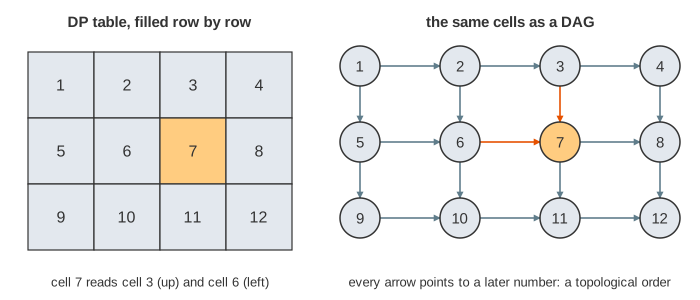
Every dynamic program has subproblems, and each one is solved from a few others. Draw each subproblem as a vertex and draw an edge u→v when v reads u. There can be no cycle, because a value cannot wait for itself. So the subproblems form a DAG (directed acyclic graph), and the DP's answer is the best path through it: the longest one for a max problem, the shortest one for a min problem. The order in which a table is filled is a topological order of that DAG: every vertex comes after all the vertices it reads.
The recurrence
Let dist[v] be the length of the longest path that ends at v. The last edge of that path
comes from some predecessor u, and the part before it must itself be a longest path to u. So:
dist[s] = 0                 (the start)
dist[v] = max over edges u→v of  dist[u] + w(u→v)
dist[v] = −∞                when no path reaches v
In the animation a vertex reads one box per edge coming in, the boxes fly to the reading row, and the
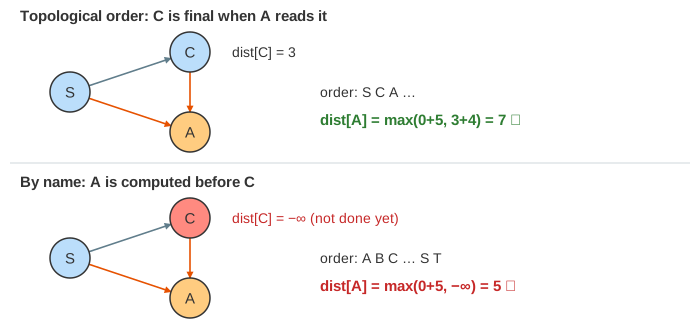
vertex keeps the largest. On the sample DAG, A reads 0+5 from S and 3+4 from C, so
dist[A] = 7. At the end dist[T] = 18 (Demo: sample DAG).
Why topological order
The rule only works if dist[u] is final when v reads it. In a topological
order every edge points forward, so all of v's predecessors are done before v: one pass over the
vertices, each in-edge read once. You get such an order with
Kahn's algorithm (keep taking a vertex with no edge left coming in) or
with depth-first search (reverse finishing order).
Take the vertices in another order and the pass can fail. By name, A comes before C, so A reads
dist[C] = −∞ and settles for 5 instead of 7. Nothing goes back to fix A, and the error spreads:
B, D, E and T are all too small, and T ends at 16 instead of 18 (Demo: wrong order).
Which path? Follow the parent pointers
The pass gives numbers, not the path. So each vertex also keeps the in-edge that won, its parent pointer (blue in the animation). After the pass, start at T and follow the blue edges back: T ← E ← D ← A ← C ← S, so the longest path is S → C → A → D → E → T, of length 3 + 4 + 4 + 3 + 4 = 18. Greedy fails here: taking the heaviest edge out of each vertex goes S → A → D → E → T and gets only 16.
Longest or shortest: change max to min
Nothing else changes. With min the same pass finds the shortest path: S → A → B → T,
5 + 1 + 5 = 11 (Demo: min instead of max). Negative edge weights are fine too, because the order,
not the weights, guarantees each value is final.
Cycles are what break it. In a graph with a cycle there is no topological order: some vertex would have to wait for itself. For shortest paths there are other algorithms. For the longest simple path on a general graph there is no fast algorithm known: the problem is NP-hard, since a path through all n vertices would be a Hamiltonian path. The DAG is what makes it easy.
| Graph | Longest path | Shortest path |
|---|---|---|
| DAG (this page) | O(V + E), one pass | O(V + E), one pass |
| General graph | NP-hard (simple paths) | Dijkstra, Bellman-Ford |
A grid path sum is a longest path
Walk from the top-left cell to the bottom-right, moving right or down, and add the numbers. Every cell is
a vertex with an edge from the cell above and the cell to its left, and the weight sits on the vertex. The
rule best[cell] = value + max(best[up], best[left]) is the same recurrence, and filling the
table row by row is the topological order. The best sum is 18 (Demo: grid), and with
min it is the classic minimum path sum, 11. See Grid Paths for
the table view.
LIS is a longest path
In the array 2 5 1 6 3 7 make each element a vertex and add an edge i→j when i < j and
a[i] < a[j]. An increasing subsequence is then a path, and the longest one is the
longest increasing subsequence. Each vertex counts 1 and a
path may start anywhere, so L[j] = 1 + max(0, L[i] for every edge i→j). The animation finds
L = 4 for 2 5 6 7 (Demo: LIS). Here there is no fixed end: the answer is the best L anywhere.
Time and space
The topological sort and the pass are both O(V + E): every vertex is processed once and every edge is read once, when its head is processed. The values and parent pointers take O(V). For a DP this is the usual "number of subproblems times the work per subproblem": LCS has n·m vertices with 3 edges each, LIS has n vertices and up to n²/2 edges. The same view explains memoization vs tabulation: memoization is a depth-first search of the DAG, and tabulation walks it in a topological order fixed in advance. DP on trees uses post-order, which is a topological order of the tree.
The same pass in push form, compared with Dijkstra and Bellman-Ford, is on shortest paths in a DAG.
What the page leaves out
Computing the topological order step by step (see the topological sort pages); detecting a cycle when Kahn's algorithm gets stuck; the push form of the same pass (relax each vertex's out-edges instead of reading its in-edges); the critical path method for project scheduling, which is this longest path with tasks as edges; counting paths in a DAG; and all-pairs versions.
See where this page fits on the Dynamic Programming mind map.