The idea: a function moves the plane
A real function y = f(x) can be drawn as a curve. A complex function w = f(z) can't: its input z = x + iy and its output w = u + iv are both points of a plane, so a graph would need four dimensions. Instead, draw two planes side by side, the z-plane (input) and the w-plane (output), and watch where f sends each point. A grid is the easiest thing to follow: every point z of every grid line moves to f(z), and the lines bend with it.
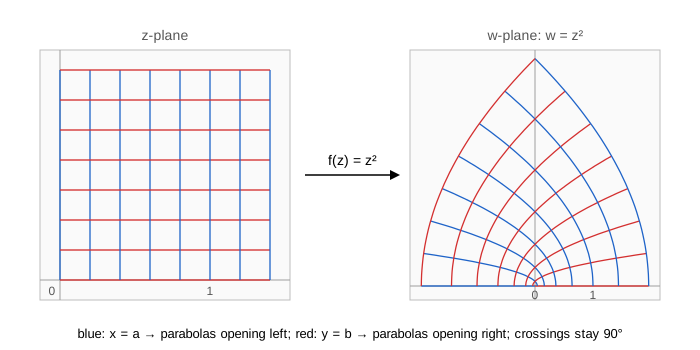
Reading the four maps
The page has four functions. Each one has its own grid, chosen so that the picture stays on the canvas.
| f(z) | blue lines x = a become | red lines y = b become |
|---|---|---|
| z² | parabolas opening left: u = a² − v²/(4a²) | parabolas opening right: u = v²/(4b²) − b² |
| 1/z | circles through 0, centre 1/(2a) | circles through 0, centre −i/(2b) |
| e^z | circles |w| = e^a | rays from 0 at angle b |
| (z − i)/(z + i) | arcs of circles through 1 | circles inside the unit disk, touching it at 1 |
Two facts explain most of it. Squaring a complex number squares its length and doubles its angle (see complex numbers), so z² opens the first quarter of the plane into the whole upper half. And e^(x + iy) = e^x·(cos y + i sin y): x sets the distance from 0 and y the angle, so e^z turns a rectangle grid into polar coordinates (Demo: e^z, lines become circles and rays). 1/z and (z − i)/(z + i) are Möbius maps (az + b)/(cz + d): they send lines and circles to lines and circles. The second one folds the whole upper half-plane into the unit disk; the real axis lands on the unit circle (Demo: (z − i)/(z + i), half-plane into the disk).
Conformal: right angles stay right angles
Look at any crossing after the map: the parabolas, circles and rays still meet at 90°. This is not luck. Near a point z₀ a complex function acts like multiplication by one complex number, its derivative:
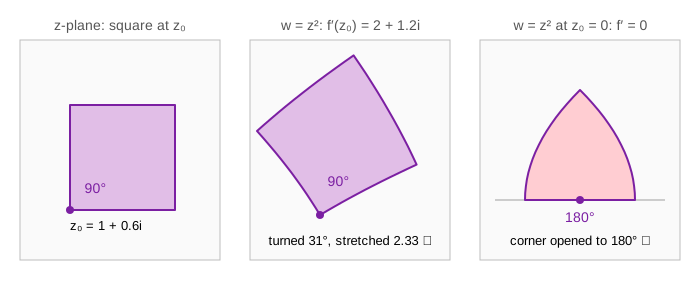
f(z₀ + Δz) ≈ f(z₀) + f′(z₀)·ΔzMultiplying by f′(z₀) turns every small step Δz by the same angle arg f′(z₀) and stretches it by the same factor |f′(z₀)| (that is what complex multiplication does). Two small steps at 90° are turned by the same angle, so they are still at 90°. A map that keeps angles like this is called conformal. Check Angle shows it with a small square: it comes out turned, stretched and a little curved, but its corner is still 90°.
| f | z₀ | f′(z₀) | stretch |f′| | turn arg f′ | corner after |
|---|---|---|---|---|---|
| z² | 1 + 0.6i | 2 + 1.2i | 2.332 | 31° | 90° |
| 1/z | 1 + 0.5i | −0.48 + 0.64i | 0.8 | 126.9° | 90° |
| e^z | i | 0.54 + 0.841i | 1 | 57.3° | 90° |
| (z − i)/(z + i) | i | −0.5i | 0.5 | −90° | 90° |
| z² | 0 | 0 | 0 | none | 180° ✗ |
Where it fails: f′ = 0
If f′(z₀) = 0 the first-order picture says nothing: multiplying by 0 is not a turn and a stretch. For z² at 0 the next term takes over, f(Δz) = Δz², which doubles angles. The edges of the square along +1 and +i go to +1 and −1 times a small number, so the 90° corner opens to 180° (Demo: z² at 0, where f′ = 0 the right angle opens to 180°). Such a point is a critical point. The other three functions on the page have none: −1/z², e^z and 2i/(z + i)² are never 0.
Domain colouring
The grid shows a few lines. Domain colouring shows every point: paint each z with a colour that encodes the value f(z). The hue is the angle arg f(z) (red at 0°, green at 120°, blue at 240°) and the brightness is the size |f(z)|: black at 0, full colour at |f| = 1, white far away. The page also puts a faint ring wherever |f| is a power of 2. In the w-plane the same rule paints the colour wheel itself, so a point z gets the colour of the place where f puts it.
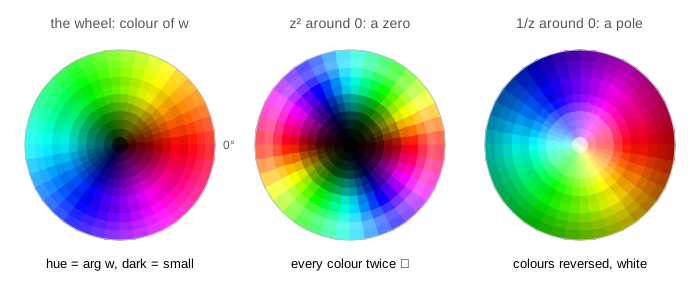
A zero is a black point with all colours around it; go once round it and the colours go round as many times as the order of the zero (twice for z² at 0). A pole is a white point with the colours in the other order. (z − i)/(z + i) has one of each, at i and −i (Demo: domain colouring, a double zero, then a zero and a pole). The ring edges, where |f| is constant, cross the lines of constant colour at right angles: conformality again.
Why conformal maps are useful
Because they keep angles, conformal maps carry solutions of Laplace's equation (steady heat, electric potential, ideal fluid flow) from a simple region to a complicated one. The Joukowski map z + 1/z turns flow around a circle into flow around an aerofoil. The Mercator projection of the globe is conformal too: it keeps angles (good for navigation) and pays for it with sizes. The Riemann mapping theorem says any simply connected region of the plane (other than the whole plane) can be mapped conformally onto the unit disk, as (z − i)/(z + i) does for the half-plane. For maps that keep straight lines, see linear transformations; for z² applied again and again, see Julia sets.
What the page leaves out
Proofs (the Cauchy–Riemann equations behind "f′ is one complex number"), branch cuts for √z and log z, maps with essential singularities, the Joukowski aerofoil itself, Schwarz–Christoffel maps onto polygons, and the "morph" path: the page moves each point in a straight line from z to f(z), which is only a way to watch it, not part of the maths.